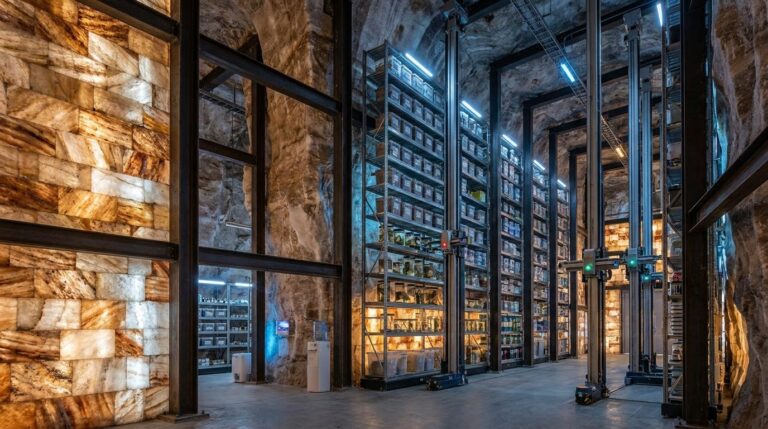


This is the introduction to a new line of work on Kylos Arc: close audits of specific, named civilizational-infrastructure proposals, paired with long-form audio panels that stress-test them from both a technical and a financial angle. The subject of the first audit is Douglas C. Youvan’s Salt Cities for Civilizational Survival and its companion paper, The Autonomous Discovery Engine (ADE), a 197-page, two-paper proposal to build continuously occupied, nuclear-powered underground cities inside salt formations, operated in peacetime as a research platform for twelve robotic-laboratory programs.
To be direct about the posture: this is not an endorsement. It is adversarial by design. We’re curious about the idea, doubtful about the execution. This is written on the assumption that the exercise should be useful to Youvan himself if he ever reads it, and useful to us regardless. A proposal this specific, this fully worked-out, and this publicly archived is rare. Most of what circulates under “civilizational operating system” branding, including the seven frameworks surveyed on this site’s Civilizational Operating System page, never gets past slide-deck abstraction. Youvan’s papers commit to 197 pages of actual chapters, actual geology, actual (if thin) financing language. That makes them worth taking apart properly, using the same tools this site already built for exactly this purpose.
The Proposal, in Brief
Two June 2026 papers form the core of the project:
- Salt Cities for Civilizational Survival (June 17, 2026, 102 pp., 70 refs) proposes continuously occupied, nuclear-powered underground communities built into stable salt formations, marketed as investable infrastructure against nuclear war and systemic catastrophe rather than dormant elite bunkers.
- The Autonomous Discovery Engine (June 24, 2026, 95 pp., 65 refs) proposes twelve robotic-laboratory programs spanning genetic-code geometry, artificial genetic codes, aging research, materials discovery, quantum-to-classical emergence, and (in Section 13) treats the salt cities themselves as the experimental platform for validating closed-loop survival engineering before any catastrophe occurs.
Two companion papers round out the corpus: Beyond the Black Swan supplies the systemic-risk argument for why survival infrastructure is needed at all (extreme optimization breeds fragility; civilizational shocks are phase transitions), and The Speculative Engine supplies the epistemology, the claim that science itself is “high-fidelity narrative construction,” which does some quiet, important work excusing the speculative register of the other three papers.
Author Profile
| Field | Detail |
|---|---|
| Name | Douglas Charles Youvan |
| Credentials | Ph.D. Biophysics, UC Berkeley (1981); former Associate Professor of Chemistry, MIT; founder/CEO, Kairos Scientific Inc. |
| Citations | 8,370+ (Google Scholar) almost entirely from decades of legitimate photosynthesis and molecular-genetics work, not from the papers under discussion here |
| Recent output | Approximately 6,000+ AI-assisted preprints since 2024–2025, spanning mathematics, physics, theology, political science, and civilizational-survival engineering |
| Co-authorship | Papers explicitly credit, by name, AI collaborators: OpenAI GPT-5.5 Thinking and Google Gemini-Pro / Gemini-3.1-Thinking |
| Peer review | None found. All four papers are preprints on youvan.ai and ResearchGate; no evidence of journal publication for this specific corpus |
| License | CC4.0 on all recent preprints |
The credentials are real. The output pace since 2024 is not what a working scientist with a normal publication cadence produces. It’s closer to what an AI collaboration produces when pointed at a prolific person’s back-catalog of ideas. That doesn’t invalidate any specific claim, but it does mean each paper needs to be judged on what’s actually in it, not on the author’s 1981-vintage Berkeley Ph.D.
The Audit
This site already built a critical framework for exactly this genre of proposa: the Civilizational Operating System page runs nine independently-generated “ideal civilizational OS” essays through Ostrom’s commons research, Stafford Beer’s Project Cybersyn, James C. Scott’s Seeing Like a State, and Taleb’s antifragility distinction, and comes out the other side with one master principle: no component of a civilizational system should be designed at civilizational scale before it’s been proven narrow, boring, and local. Rather than invent a new rubric, we ran Salt Cities and the ADE through the same four tests.
=>The Scott Test: Does it Skip the Narrow Pilot?
Youvan’s own deployment staging (Chapter 12) runs: geological feasibility study → small demonstration facility → progressive closed-loop food/life-support experiments → productive underground campus → 1,000-person prototype → 5,000-to-20,000-person cities → national and international networks. That is, on its face, a staged rollout — but the jump from “progressive closed-loop experiments” straight to a thousand permanent residents, with no described intermediate step for testing governance, conflict resolution, or exit rights at a scale smaller than an actual town, is precisely the move Scott’s critique flags: administrative legibility designed top-down, validated bottom-up only in the engineering subsystems (air, water, power), never in the human-institutional ones. Ostrom’s durable commons took decades of local rule-patching before they scaled. Youvan’s paper allocates it a chapter heading.
=>The Cybersyn Test: Does Legitimacy Have a Maintenance Plan?
Chapter 9 does engage with governance mechanics more seriously than most proposals in this genre. It specifies that funds collected for “long-term maintenance, reactor replacement, emergency inventories, and infrastructure renewal should not be available for routine dividends,” and that “a governing charter must also prevent commercial tenants from acquiring control over admission, food allocation, or emergency authority merely because they contribute substantial revenue.” That’s a real design instinct, and a correct one. But it’s a static charter, not a legitimacy-maintenance system. Cybersyn had cleaner constitutional intent than most of what came after it, and it was gone within days of a coup because nothing in its design treated legitimacy as a resource that depletes and has to be actively replenished. Salt Cities has no equivalent of a legitimacy telemetry system. It has no described mechanism for detecting, before a crisis, that the population’s trust in the admission or rationing authority is eroding.
=>The Reversibility Test: Does Authority Scale with Stakes?
Underground nuclear reactors and permanent salt-cavern excavation are about as irreversible as civil infrastructure gets. Youvan’s Chapter 11 (“Security, Governance, Ethics, and Failure Modes”) is listed in the outline but, even in the full 102-page text, never develops the specific question of who holds authority over decisions that can’t be undone: reactor siting, population admission caps, when to seal a district during a water-containment failure. The paper’s own geology chapter is honest about the stakes (“water is the greatest natural enemy”; salt creep requires “oversized galleries, replaceable internal shells”) without ever pairing that honesty with an authorization framework proportional to it.
=>The Money Test: Do the Financial Claims Survive Contact with the Full Text?
This is the finding we’d flag most directly to Youvan if he’s reading. Chapter 10, “Finance, Ownership, and Investment Structure,” is the chapter that has to carry the paper’s central economic claim, that salt cities convert “civilizational survival from a sunk public expense into a diversified infrastructure investment.” Having now read the complete chapter rather than a summary of it: there are no dollar figures. No reactor MWe ratings. No projected revenue per resident, per data-center rack, or per acre of controlled-environment agriculture. No capital-stack sizing. The chapter is a genuinely sound discussion of risk-sharing structure, splitting the project into legally distinct entities, matching investor type to risk profile, separating ordinary operation from emergency reserves. But it is a financing philosophy, not a financial projection. Anyone treating this paper as containing an investable business case, including an AI panel asked to “debate whether the financial projections hold up,” will find there’s nothing numerical to stress-test. That’s worth knowing before building anything on top of it.
The ADE, Measured Against What Actually Gets Funded
The Autonomous Discovery Engine’s strongest section is its framing, not any individual program: “a traditional instrument answers the question it is asked; a closed-loop laboratory improves the question itself.” That’s a genuinely good description of what autonomous/self-driving labs are trying to become, and it’s consistent with real, funded work this site has separately tracked: Stanford’s LabOS, the self-driving-labs field generally, and the materials-discovery agentic-intelligence literature.
Where the gap opens up is Section 8, “Quantum-to-Classical Emergence Experiments”. There is one paragraph of aspiration about qubits and measurement, with no experimental design, no hardware platform named, no budget. Compare that to what a real national quantum-infrastructure program looks like in practice: the DOE’s Quantum Genesis initiative committed to a phased RFI → competitive demonstration → National Quantum Supercomputing User Facility timeline targeting a fault-tolerant machine by 2028, and ORNL and EPB Chattanooga’s CERQS partnership — a named $180M/10-year collaboration. The project has already deployed a working commercial quantum network and demonstrated cross-vendor QKD key relay on real grid infrastructure. Those programs have governance, named institutional partners, funding, and failure modes written into their own planning documents. The ADE’s §8 has a sentence. The ambition is similar; the institutional weight behind it is not remotely comparable, and that gap is the single clearest signal of where this proposal sits on the spectrum from “research agenda” to “research agenda that someone is actually resourcing.”
What’s Actually Worth Taking Seriously
Adversarial doesn’t mean dismissive. Three things in this corpus are genuinely well-reasoned:
- The geology is sound. The distinction between dry-mined room-and-pillar salt (habitable) and solution-mined caverns (not habitable, but useful for storage), the self-sealing property of intact salt, and the honest treatment of salt creep as a design constraint rather than an afterthought, all of this tracks real geological literature and is argued carefully.
- The core integration idea is genuinely interesting. Using the salt cities as a live testbed for the ADE’s closed-loop survival-engineering experiments rather than building emergency infrastructure speculatively and hoping it works when needed, inverts the usual doomsday-bunker logic in a way worth engaging with on its own terms, independent of whether this specific author is the one who should build it.
- The explicit rejection of elite-bunker framing is a real and correct normative stance, even if the governance mechanics to actually prevent capture by “commercial tenants” acquiring admission authority are underdeveloped.
Why This Belongs on Kylos Arc
Youvan’s proposal is useful here precisely because it’s a complete, named, real specimen of the exact failure pattern this site’s own governance framework already diagnosed in the abstract: a fully-worked-out civilizational blueprint, built top-down, that never pauses to prove any layer small before specifying it for thousands of people. It’s rare to find a case this concrete and this citable. Most “civilizational operating system” material stays at the level of slide decks and GitHub READMEs. Youvan actually wrote the 197 pages, which makes it possible to point at a specific chapter and say exactly where the reasoning holds and where it doesn’t, rather than arguing with a vibe.
What’s Next
This post is the frame. Four long-form audio panels are in production on this same material:
- A technical panel — three voices stress-testing the robotics, quantum-computing, and materials-science viability of the ADE’s experimental programs against the engineering specifics (and gaps) in the full text.
- A business panel — three voices examining the real-estate and financial case against actual commercial precedents (SubTropolis, Gulf Coast salt-cavern hydrogen storage), with the Chapter 10 finding above as a starting constraint rather than something to paper over.
- And two more
Salt City Podcast Episodes
Sources
- Youvan, D.C. Salt Cities for Civilizational Survival: Nuclear-Powered Underground Communities as Investable Infrastructure Against Nuclear War and Global Catastrophe. youvan.ai, June 17, 2026.
- Youvan, D.C. The Autonomous Discovery Engine: Robotic Laboratories, AI-Driven Experiments, Genetic Code Geometry, Quantum Emergence, and Civilizational Survival. youvan.ai, June 24, 2026.
- Youvan, D.C. Beyond the Black Swan: Systemic Fragility, Algorithmic Crises, and the Non-Linear Dynamics of Civilizational Shock. youvan.ai, June 24, 2026.
- Youvan, D.C. The Speculative Engine: Science as High-Fidelity Fiction and the Narrative Architecture of Predictive Discovery. youvan.ai, April 26, 2026.
- Kylos Arc — Civilizational Operating System (the critical framework applied above)
- Kylos Arc — 7 Civilizational Operating System Frameworks Compared
- DOE Office of Science. Energy Department Announces Initiative to Create and Deploy World’s First Scientifically Relevant, Fault-Tolerant Quantum Computers (“Quantum Genesis”), 2026-06-23.
- ORNL. EPB, ORNL Announce Plans for Research Collaborative Focused on Energy Resilience, Quantum Technology (CERQS), 2024-01-26.