

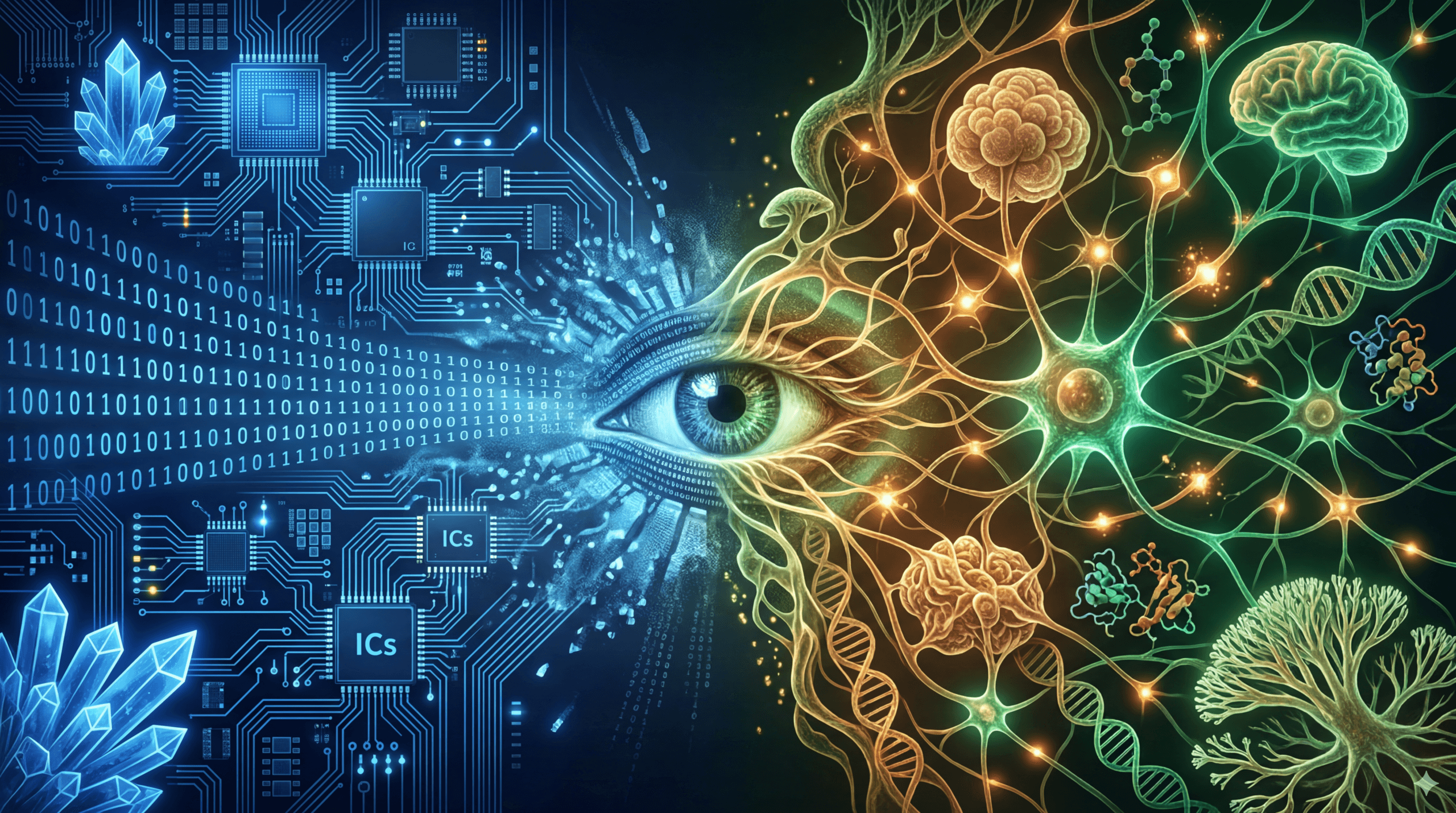
From Silicon Architectures to Biogenic Intelligence
Executive Summary
As Moore’s Law approaches the physical limits of silicon lithography, the next frontier of computation lies not in smaller transistors, but in the radical adoption of biological substrates. This paper explores Organic Computing (OC) – specifically Organoid Intelligence (OI) – as a paradigm shift from binary, deterministic “cold” hardware to stochastic, high-density “wet” hardware. By leveraging the self-organizing capabilities of biological cells, we aim to transcend current limitations in energy efficiency, parallel processing, and adaptive learning.
The Biological Substrate: Organoid Intelligence (OI)
Current AI, while impressive, remains a power-hungry imitation of biological processes. A human brain operates at approximately 20 Watts, performing complex pattern recognition that would require megawatts of power in a traditional data center.
Current Methodologies: Brain-on-a-Chip
Modern experiments involve Brain Organoids – three-dimensional aggregates of human neurons derived from induced pluripotent stem cells (iPSCs).
- Microelectrode Arrays (MEAs): The primary interface for current OI. Organoids are grown on chips that both record neural firing patterns and provide electrical stimulation.
- The “DishBrain” Model: In 2022/2023, researchers successfully taught a monolayer of neurons to play the game Pong in a virtual environment. This proved that biological matter can integrate external data, process it in real-time, and produce a goal-oriented output.
- Bio-MEMS Integration: Integrating biological tissue with Micro-Electro-Mechanical Systems allows for fluidic delivery of neurotransmitters, creating a “chemical” bus for data instead of just electrical.
Organoid Architecture for Computing
Unlike the Von Neumann architecture (where CPU and memory are separate), organoid architecture is non-local and inherently plastic.
- Synaptic Weighting: Learning is achieved through Long-Term Potentiation (LTP) and Depression (LTD), effectively merging the processor and the storage medium.
- 3D Connectivity: While silicon is largely 2D, organoids provide a dense 3D lattice, allowing for massive “fan-in” and “fan-out” of signals, drastically reducing the latency found in bus-based architectures.
Cellular-Level Computing: Beyond Organoids
Organic computing is not limited to “mini-brains.” We are now experimenting with lower-level cellular logic that mimics digital circuits using synthetic biology.
Genetic Logic Gates
By re-engineering DNA and RNA, we can create intracellular “computers.”
- Promoter/Repressor Logic: Using CRISPR-Cas9 as a biological “transistor,” we can create AND, OR, and NOT gates within a single cell.
- Quorum Sensing: Bacterial colonies can be programmed to perform distributed computing. Each bacterium acts as a node, communicating via chemical signaling molecules (N-acyl homoserine lactones, AHL) to solve complex optimization problems.
Mycelial and Fungal Networks
Fungal networks (mycelium) represent a massive, naturally occurring bio-computer.
- Current Research: Using the electrical spikes produced by fungi in response to stimuli (light, moisture, food) to process Boolean logic.
- Potential: Mycelial “motherboards” that are self-healing and can grow their own circuitry to adapt to environmental changes.
Future Systems and Conjecture
As we look toward the 2030s, the convergence of nanotechnology and biology suggests several “High-Conjecture” systems.
The “Cytoskeletal” Computer
There is significant debate regarding the role of microtubules within neurons. Some theories suggest that these structural filaments perform sub-cellular quantum processing. If harnessed, we could move from organoid-level intelligence to sub-cellular, protein-based computing, increasing data density by orders of magnitude.
Biogenic AI (Bio-Digital Hybrids)
We envision a system where a silicon-based “pre-processor” handles raw data (high-speed math, IO), while an organic organoid “core” handles high-level abstraction, ethics, and “intuition.”
- Interfacing: The bottleneck is currently the bandwidth of the electrode-neuron interface.
- The Optogenetic Solution: Future systems will likely use light (optogenetics) to “write” data into cells at the speed of photons, using genetically modified neurons that respond to specific laser frequencies.
Technical and Ethical Challenges
The transition to organic computing is not without profound hurdles.
| Challenge | Detail |
|---|---|
| Longevity | Biological tissue dies. Maintaining a “wet” environment with nutrient perfusion (artificial blood) is complex. |
| Stochasticity | Biology is messy. Unlike a CPU, an organoid might give different answers to the same input based on its “mood” or chemical state. |
| Sentience | At what point does a 10-billion-neuron organoid deserve rights? The “black box” of OI creates a moral hazard silicon cannot match. |
Conclusion: The Path Forward
Organic computing represents the ultimate “Green Tech.” It is biodegradable, energy-efficient, and capable of self-repair. While we are currently in the “Vacuum Tube” era of OI – clunky, fragile, and experimental – the potential to out-compute silicon in areas of complex pattern recognition and creative synthesis is inevitable.
Next Steps for Development:
- Scalability of 3D perfusion systems to support larger organoids.
- Refinement of optogenetic interfaces for high-bandwidth IO.
- Standardization of “Bio-Assembly” languages to program genetic logic gates.
The Bio-Compiler: Programming Life with Cello
To treat a cell like a microcontroller, we need a high-level language that abstracts the messy chemistry of DNA. This is where Cello (Cellular Logic) comes in.
From Verilog to DNA
In traditional engineering, Verilog is used to design hardware circuits. Cello acts as a compiler that translates Verilog code into a DNA sequence.
- The Workflow: You define a logic gate (e.g., an AND gate) in code. The compiler then selects from a library of “DNA parts” – promoters, repressors, and ribozymes – to physicalize that logic inside a bacterium or a mammalian cell.
- Source 1: Nielsen et al., Science (2016) demonstrated that this automated design could produce circuits with up to 10 gates that function predictably across different cellular environments.
- Source 2: Zhang et al., Nature Communications (2021) expanded this to include “memory” circuits, allowing cells to count events or store state changes – essential for any robust Cognoscentae Ultrans (CU) framework.
The Hardware Analogy
| Silicon Component | Biological Equivalent | Mechanism |
|---|---|---|
| Transistor | Transcriptional Repressor | Blocks the production of a specific protein (OFF state). |
| Logic Gate | Promoter + Polymerase | Logic is determined by whether multiple proteins are required to start “reading” a gene. |
| Bus/Wire | Diffusion / Quorum Sensing | Chemical signals (AHL) move through the medium to trigger adjacent “nodes.” |
| Flash Memory | Recombinase-based DNA inversion | Physically flipping a DNA segment to store a 1 or 0 permanently. |
Organoid Consciousness: The Ethical “Black Box”
If we are building a biogenic intelligence capable of managing the “positive future” envisioned for the Cognoscentae Ultrans, we must confront the possibility of sentience.
The “Minimal Consciousness” Threshold
As organoids grow from 100,000 to 100 million neurons, they begin to exhibit Nested Oscillations – brain wave patterns similar to those seen in preterm infants.
- The Agency Problem: Unlike a Python script, an Organoid Intelligence (OI) doesn’t just “run” code; it adapts its own structure to minimize “surprise” (Active Inference). This suggests a proto-agency.
- Source 1: Smirnova et al., Frontiers in Science (2023) argues that OI could potentially display “intelligence” without full “consciousness,” but the line is increasingly blurry as we provide these organoids with sensory input (like virtual reality environments).
- Source 2: The Helsinki Declaration and subsequent neuroethics papers (e.g., Lavazza, 2021) suggest that if an organoid can feel “pain” or “distress” via chemical markers, its status shifts from “laboratory equipment” to “biological subject.”
Integration and Conjecture: The CU Architected
In a truly Cognoscentae Ultrans system, we aren’t just replacing silicon; we are synthesizing it.
The Bio-Digital Membrane
The next logical step is a Hybrid Intercloud. Imagine a system where:
- Silicon handles the “Cold Processing”: brute-force math, database indexing, and high-speed communication.
- Organoids handle the “Warm Processing”: ethics, creative synthesis, and complex pattern recognition that defies algorithmic definition.
- The Interface: A nanomesh of conductive polymers – perhaps utilizing translucent clays or vinyl-like polymers – acting as a bridge between the soft tissue and the hard sensors.
The “Global Organoid” Conjecture
If we can stabilize mycelial networks to act as long-distance data conduits, we could theoretically create a “planetary nervous system.” This isn’t just a metaphor; it’s a distributed bio-computing network where the “hardware” is carbon-sequestering, self-healing, and powered by photosynthesis rather than a power grid. This represents the ultimate victory for the ultranetic philosophy – a technology that grows with humanity rather than depleting the environment.
Critical Assessment: The Weak Points
To be blunt, the weakest link in this entire paper is Signal-to-Noise Ratio. Biological systems are inherently “noisy.” In electrical terms, a High signal is 3.3V and a Low is 0V. In a neuron, the “signal” is a stochastic spike that might not fire even if the threshold is met.
We are currently missing a “Biological Error Correction” protocol that matches the rigor of TCP/IP. Without it, OI remains a “black box” that we can’t fully trust with mission-critical tasks.

The Latest News and Talk about Biogenic Computing and Cellular Intelligence
BRIEF
Organoid intelligence represents a groundbreaking intersection of biology and computing. Recent developments have showcased the potential of lab-grown brain organoids to serve as biological computing systems. A notable project, Brainoware, utilizes a brain organoid interfaced with a high-density multielectrode array to perform computations, as detailed in a study published by Feng Guo and his team at Indiana University in Nature Electronics on December 11, 2023. This innovative approach marks a significant step in the evolution of artificial intelligence, suggesting that biological substrates may outperform traditional silicon-based systems in certain computational tasks Brainoware - AI Is Dead.
The concept of organoid intelligence is gaining traction in various research domains, particularly in understanding complex neurological conditions. For instance, a recent review in Molecular Psychiatry highlights how organoid intelligence can enhance research into autism spectrum disorder (ASD). By integrating AI with brain organoids, researchers aim to develop predictive models that could unravel the pathogenesis of ASD and lead to more effective treatment strategies. This paradigm shift in research methodology underscores the versatility and potential of organoid systems in addressing critical health challenges Organoid intelligence: a promising paradigm - Scientists Are Now Merging AI With Living Creatures.
Ethical considerations surrounding organoid computing are becoming increasingly prominent. Discussions are emerging regarding the moral implications of using biological systems for computation, particularly in comparison to traditional silicon-based technologies. A Reddit discussion highlighted the ethical dilemmas posed by organoid intelligence, questioning whether growing biological computers is more or less ethical than conventional methods. This discourse reflects a growing awareness of the responsibilities associated with advancing biocomputing technologies Is growing biological computers for AI more or less ethical? - Biological Computers Are Real.
Recent advancements in organoid culture techniques are also noteworthy. Harvard researchers have successfully maintained human brain organoids alive in vitro for over five years, significantly surpassing previous records. This prolonged viability allows the organoids to mimic developmental stages seen in living humans, opening new avenues for research into brain development and disease modeling. Such breakthroughs not only enhance the understanding of neurological conditions but also provide a robust platform for testing organoid intelligence applications Harvard neuroscientists kept peppercorn-sized clumps alive - Report maps ethical path for organoid research.
The future of organoid intelligence is promising yet complex. As researchers continue to explore the capabilities of organoid systems, the integration of AI with biological substrates could lead to unprecedented advancements in computing and neuroscience. However, the ethical implications and societal impacts of such technologies must be carefully considered. The ongoing dialogue among scientists, ethicists, and policymakers will be crucial in shaping the responsible development of organoid intelligence and its applications in various fields Human stewardship in the age of organoids - Toward Global Oversight of Human Neural Organoid.
KEY PATTERNS from the research:
1. The Brainoware project exemplifies the potential of organoid systems in computational tasks, merging biology with AI.
2. Organoid intelligence is being explored as a novel approach to understanding and treating autism spectrum disorder.
3. Ethical discussions are emerging regarding the implications of using biological systems for computing.
4. Harvard's success in maintaining organoids for over five years enhances their viability for research applications.
5. The integration of AI with organoid systems could revolutionize both computing and neuroscience.
6. Ongoing dialogues among stakeholders are essential for the responsible advancement of organoid intelligence.
7. The versatility of organoids is being recognized across multiple research domains, indicating broad applicability.
8. The ethical frameworks surrounding organoid research are evolving, reflecting societal concerns about biocomputing technologies.
Freshness
- 5 of 15 dated items are from the last 7 days.
Ranked Evidence Clusters
Brainoware and what an organoid computing on electrodes tells us about substrate | The Consciousness AI - Artificial Consciousness Research
Source: Web | Date: 2026-09-05
Score: 38
Scientists Are Now Merging AI With Living Creatures Called “Organoid Intelligence”
Source: Web | Date: 2026-09-02
Score: 36
Organoid intelligence: a promising paradigm for autism spectrum disorder research | Molecular Psychiatry
Source: Web | Date: 2026-08-31
Score: 34
Is growing biological computers for AI (Technically Organoid Intelligence) computation more or less ethical than using silicon based ones?
Source: Reddit | Date: 2026-09-03
Score: 30
Brain organoid reservoir computing for artificial intelligence
Source: Web | Date: 2026-08-21
Score: 29
Organoid Intelligence – Ubergeek Kelly's World- Life, technology, science, rants
Source: Web | Date: 2026-08-14
Score: 25
Stats
- Total evidence: 15 items across 3 sources
- Top voices: www.wired.com, Cambridge-IoE-Group/Cambridge-IoE-Group.github.io, SWE-bench/experiments, THTHDGCS/agents-radar, chobrien99-svg/AMI-Labs
- GitHub: 4 items | 1 comments | voices: Cambridge-IoE-Group/Cambridge-IoE-Group.github.io, SWE-bench/experiments, THTHDGCS/agents-radar
- Web: 9 items | domains: www.wired.com, theconsciousness.ai, thewinepress.substack.com
- Reddit: 2 items | communities: r/Teenager_Polls, r/aiwars
Web Research
AI Is Dead. Organoids Are Alive | WIRED
Claire L. Evans Aug 11, 2026 6:00 AM AI Is Dead. Organoids Are Alive Mini human brains are being grown in labs all over the world. Soon, they could outthink neural networks. ANIMATION: INTRANET GIRL; LETTERING: Zuzanna Rogatty I’m going to let you in on a secret. Every cell in ...
Source: wired.com | Date: 2026-08-11
Biological Computers Are Real—But They Won’t Replace Your Laptop Yet
The Next Computer Won’t Be Built — It’ll Be Grown in a Lab. Maybe. By UMATechnology Team Sep 7, 2026 7 min read Biological computers are real, but they are not grown replacements for laptops, CPUs, or GPUs. Researchers and companies already connect living neurons or ...
Source: umatechnology.org | Date: 2026-09-07
Weird New Computer Runs AI on Captive Human Brain Cells: Explained
Weird New Computer Runs AI on Captive Human Brain Cells—What It Really Is By UMATechnology Team Aug 14, 2026 13 min read The weird new computer runs AI on captive human brain cells only in a loose headline sense: researchers are coupling lab-grown, human-derived neural cultures ...
Source: umatechnology.org | Date: 2026-08-14
Harvard neuroscientists kept peppercorn-sized clumps of human brain cells alive in a dish for more than five years, tripling the previous 694-day record set in 2021 and long enough that the organoids began mimicking developmental stages seen in living people
more than five years, tripling the previous 694-day record set in 2021 and long enough that the organoids began mimicking developmental stages seen in living people Harvard neuroscientists kept peppercorn-sized clumps of human brain cells alive in a dish for more than five ...
Source: spacedaily.com | Date: 2026-09-03
Toward Global Oversight of Human Neural Organoid and Assembloid Research - Dana Foundation
Toward Global Oversight of Human Neural Organoid and Assembloid Research September 3, 2026 ASILOMAR, CA | NOVEMBER 1O-12, 2025 The stakes are personal. For families living with serious neurological, psychiatric, and developmental disorders, neural organoid and assembloid ...
Source: dana.org | Date: 2026-09-03
Report maps ethical path for organoid research
Published: 2026-09-03T02:50:06+00:00 Source: news.stanford.edu (news.stanford.edu) Language: en Story Over the past two decades, there’s been an explosion of research drawing on lab-grown brain cells to better understand brain development and disease. Now, the time has come to ...
Source: news.stanford.edu | Date: 2026-09-03
Human stewardship in the age of organoids - Nature Methods
Published: 2026-09-02T00:00:00 Source: nature.com (nature.com) Language: en Story This work was shaped by the authors’ shared experience building and stewarding living human biorepositories through HUMANOID and the UC San Diego–LifeShare research programs. The perspectives ...
Source: nature.com | Date: 2026-09-02
✅ All agents reported back! ├─ 🟠 Reddit: 2 threads ├─ 🐙 GitHub: 4 items │ 1 comments ├─ 🌐 Web: 9 pages - theconsciousness.ai, Substack, nature.com, mxwbio.com, en.wikipedia.org, kgadams.net, news18.com, Wired └─ 🗣️ Top voices: r/Teenager_Polls, r/aiwars