

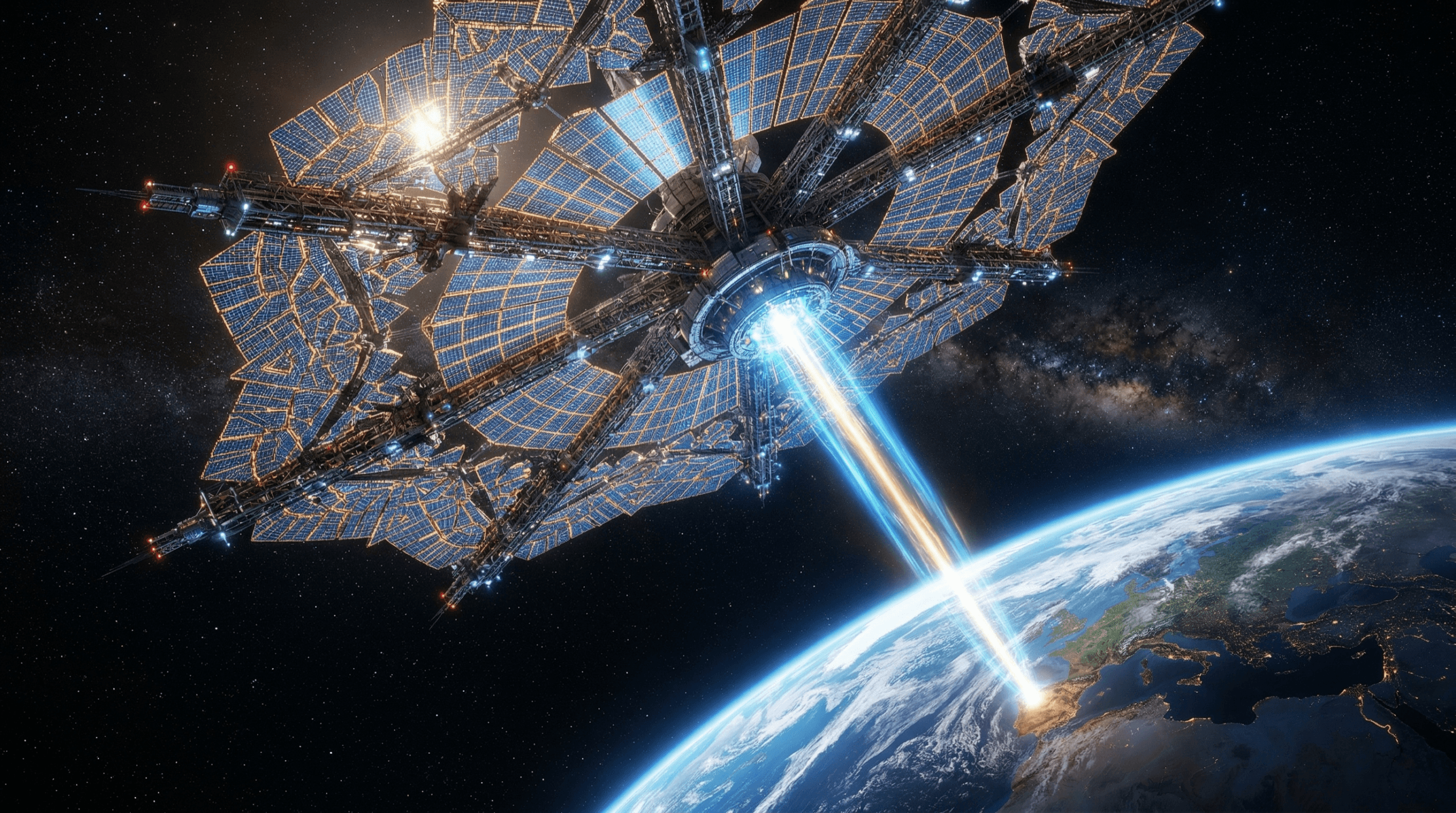
The Fractal Architecture: Engineering the Sierpinski Collector
Traditional flat-panel satellites suffer from structural rigidity issues and inefficient heat dissipation at megastructure scales. The Helios-Fractal design utilizes a recursive 3D fractal geometry (modeled after a Menger sponge or Sierpinski tetrahedron).
Why Fractal Geometry?
- Surface Area Maximization: Fractal patterns allow for an exponential increase in collection surface area within a defined volume.
- Modular Self-Assembly: Small, autonomous robotic units can assemble “base” units that then dock to form higher-order iterations.
- Thermal Regulation: The high surface-area-to-mass ratio enables passive radiative cooling, essential for managing the thermal load of gigawatt-scale energy conversion.
Orbital Mechanics and Uninterrupted Flux
To provide continuous power to megacities, the array is positioned in Geostationary Earth Orbit (GEO) at approximately 35,786 km.
- Sun-Synchronous Orientation: Unlike terrestrial panels, the SBSP array is not hindered by atmospheric scattering, cloud cover, or the diurnal cycle.
- Seasonal Shadows: In GEO, the array remains in sunlight 99% of the time, experiencing brief eclipses only during the equinoxes.
- Power Density: The solar flux in space is roughly 1.4 times higher than the best terrestrial locations at noon, and significantly higher when averaged over 24 hours.
Transmission: The Microwave Energy Column
The core of the megatecture is the Phased Array Microwave Transmitter. The harvested DC electricity is converted into microwave radiation, typically at 2.45 GHz or 5.8 GHz. These frequencies are chosen for their ability to penetrate the atmosphere with minimal attenuation (< 2%), even during heavy rain or storm conditions.
The “Visible” Column
While microwaves are invisible to the naked eye, the Helios-Fractal system incorporates a Lumen-Sync Laser Guide. A low-energy, green-spectrum laser co-axially aligns with the microwave beam. This serves two purposes:
- Safety: provides a visual marker for aviation and satellite avoidance.
- Telemetry: acts as a pilot signal for the terrestrial rectenna, enabling precise beam targeting.
Space Industrialization: Providing the “grid” necessary for permanent lunar bases and orbital manufacturing.
The engineering of fractal SBSP arrays is no longer a question of if, but when. The physics is settled; the remaining challenge is the industrialization of the high frontier.
Terrestrial Integration: Rectenna Farms
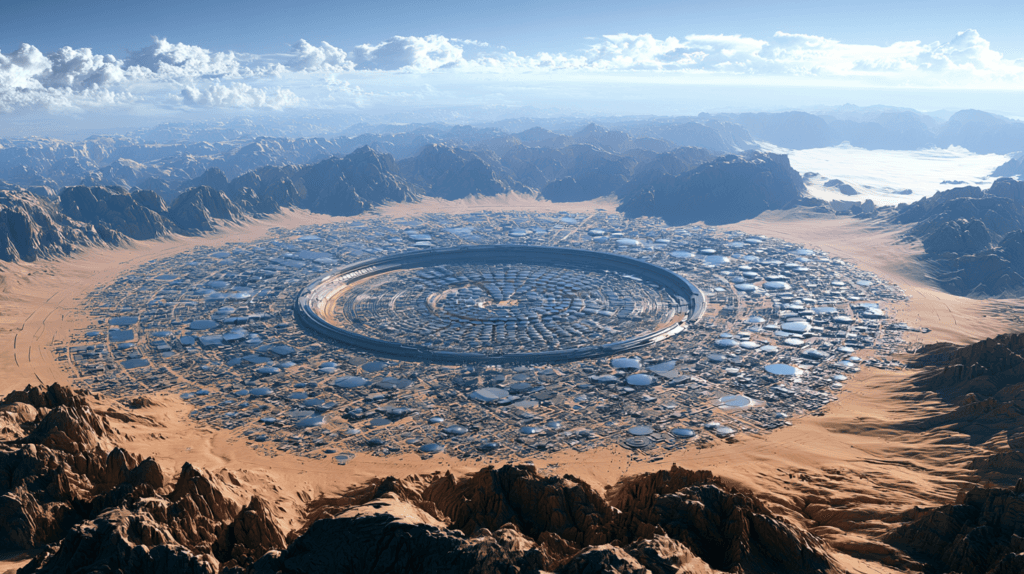
On the surface, the energy is received by a Rectifying Antenna (Rectenna) farm. These are vast meshes of dipole antennas and Schottky diodes that convert microwave energy back into high-voltage DC electricity.
Specifications of a Megacity Hub
Feature Specification
Output Capacity 2 GW to 5 GW per array
Rectenna Diameter 5–10 km (depending on latitude)
Land Use Dual-use (agriculture/grazing possible beneath the mesh)
Efficiency ~85% (RF to DC conversion) Feasibility and Technical Hurdles
While conceptually sound, several “weak points” in the SBSP roadmap must be addressed:
- Launch Costs: Even with heavy-lift vehicles like Starship, the mass required for a 5 GW array is thousands of tons. We must transition to In-Situ Resource Utilization (ISRU)—mining the moon or asteroids for structural materials—to make this economically viable.
- Beam Safety: The power density at the center of the beam must be kept within safe limits (~23 mW/cm²), comparable to sunlight) to prevent harm to avian life, though the sheer scale of the rectenna ensures the total energy is massive.
- Space Debris: A structure of this size is a massive target. It requires an active laser ablation system to clear incoming micrometeoroids.
Implementation Timeline
The transition to a space-powered economy is a multi-decade endeavor.
- Phase I: Prototype (2026–2030): Deployment of a 10 MW fractal demonstrator in Low Earth Orbit (LEO) to test wireless power transfer and modular assembly.
- Phase II: Infrastructure (2030–2038): Construction of orbital foundries and robotic assembly hubs in MEO. First 500 MW pilot beam to a remote rectenna.
- Phase III: Scaling (2038–2045): Deployment of the first full-scale 5 GW Helios-Fractal array in GEO. Establishment of the “Visible Column” telemetry.
- Phase IV: Global Mesh (2045–2060): A constellation of 20+ arrays providing continuous, clean energy to every major megacity on Earth.
Global Benefits
The successful deployment of SBSP would result in:
True Decarbonization: Eliminating the need for fossil-fuel baseload plants.
Energy Equity: Providing gigawatts of power to developing regions without the need for extensive terrestrial fuel infrastructure.
The Latest News and Talk about Space Based Solar Power
BRIEF
Space-based solar power (SBSP) represents a transformative approach to energy generation, harnessing solar energy from geostationary orbit and transmitting it to Earth. This technology utilizes photovoltaic cells to convert solar power into electricity, which can then be beamed down as microwaves or laser beams. According to a recent report by Stratview Research, the SBSP market is an emerging segment within the clean energy and aerospace industries, indicating a growing interest in this innovative energy solution. The potential for continuous energy generation, unaffected by terrestrial weather conditions, positions SBSP as a compelling alternative to traditional solar installations.
Recent developments highlight significant governmental support for SBSP initiatives. The U.S. Department of Energy (DOE) has launched a $12 million R&D fund aimed at advancing technologies for solar panels designed for space applications. This funding, announced in September 2026, underscores the federal commitment to exploring SBSP as a viable energy source (PV Tech). Additionally, the Space Energy Initiative has proposed a whitepaper advocating for government co-funding of an orbital demonstrator, further emphasizing the collaborative efforts needed to bring SBSP to fruition (Sustainable Business Magazine).
Technological advancements are critical to the success of SBSP, particularly in the development of rectenna systems. These systems are essential for efficiently converting microwave energy back into electricity upon reaching Earth. Recent research has focused on enhancing coupling efficiency in geometric terahertz rectennas, which could significantly improve the viability of energy transmission from space (Springer Nature Link). As the technology matures, the integration of advanced materials and designs will likely play a crucial role in overcoming existing challenges associated with energy capture and transmission.
Despite the promise of SBSP, challenges remain regarding its economic feasibility and infrastructure requirements. A recent analysis suggests that while the technology is advancing, it may not yet be ready for large-scale investment, as highlighted by Helio Corporation's recent roadshow to attract investors (Ainvest). The commercial case for SBSP continues to evolve, with ongoing discussions about the necessary infrastructure to support its deployment and integration into existing energy systems (Environment+Energy Leader).
In summary, the development of space-based solar power is characterized by a combination of technological innovation, government support, and ongoing challenges related to infrastructure and investment. As research and development efforts continue, the potential for SBSP to provide a reliable and sustainable energy source could reshape the future of energy generation on Earth. The collaboration between government entities and private companies will be vital in addressing the hurdles that remain.
KEY PATTERNS from the research:
1. The U.S. government is actively investing in SBSP through targeted funding initiatives.
2. Technological advancements in rectenna systems are crucial for efficient energy transmission from space.
3. There is a growing interest in SBSP as a viable energy source, despite current economic challenges.
4. Collaborative efforts between government and private sectors are essential for the successful deployment of SBSP.
5. Continuous energy generation from space presents a significant advantage over terrestrial solar installations.
6. The SBSP market is emerging as a distinct segment within the clean energy sector, indicating a shift in energy strategies.
7. Infrastructure development remains a critical barrier to the commercialization of SBSP technology.
8. Investor interest is cautious, reflecting the need for further technological validation and economic justification.
Freshness
- 4 of 25 dated items are from the last 7 days.
Hiring Signals
- Mode: explicit; company-size tier: startup
- Interpret these as focus or priority signals, not exact roadmap predictions.
- general hiring: hiring activity is visible, but the priority signal is diffuse (confidence: low; evidence: 1 roles)
- Space Industry Jobs | Space-Careers (2026-09-07)
Ranked Evidence Clusters
Space-Based Solar Power Market | Size, Share, Trend, Industry Analysis | 2025-2032
Source: Web | Date: 2026-09-05
Score: 42
US DOE launches US$12 million R&D fund for space-based solar power
Source: Web | Date: 2026-09-02
Score: 40
Space Based Solar Power Market Size, Share Report, 2034
Source: Web | Date: 2026-08-24
Score: 35
Space-based solar power | Definition, History, Advantages, & Facts | Britannica
Source: Web | Date: 2026-08-23
Score: 34
Space-Based Power: Will It Happen? - The National Interest
Source: Web | Date: 2026-08-18
Score: 31
DOE's $12 Million SBSP Bet: What the Fund Proves — and What It Doesn't
Source: Web | Date: 2026-09-03
Score: 28
Stats
- Total evidence: 25 items across 5 sources
- Top voices: toddmaustin/forge-gpu-economics, Hacker News, SirTangent/SBSPSS-Supercharged, northguild/gmt, Keinsleif/sbsp
- GitHub: 11 items | 4 comments | voices: toddmaustin/forge-gpu-economics, SirTangent/SBSPSS-Supercharged, northguild/gmt
- Web: 8 items | domains: www.stratviewresearch.com, www.pv-tech.org, www.fortunebusinessinsights.com
- Hacker News: 3 items | 53 points, 7 comments | domains: Hacker News
- Jobs: 1 item | voices: web
- Reddit: 2 items | communities: r/technews, r/OffGrid
Web Research
Space-Based Solar Power Prototypes: Microwave Power Beaming Trials and Orbital Collector Efficiency Challenges | Streamline
Streamline Author: Streamline Feed Official Published: 2026-09-14T12:13:14+00:00 Source: streamlinefeed.co.ke (streamlinefeed.co.ke) Language: en Story Space-Based Solar Power Prototypes: Microwave Power Beaming Trials and Orbital Collector Efficiency Challenges An investigat ...
Source: streamlinefeed.co.ke | Date: 2026-09-14
Solar power from space
Solar power from space Space Energy and environment Monday, 07. September 2026 13:58 Author Simon Koechlin Space-based solar power stations could generate electricity almost round the clock and transmit it to Earth via microwaves. The individual technologies are well developed ...
Source: satw.ch | Date: 2026-09-07
Enhanced coupling efficiency in geometric terahertz rectennas based on scalable CVD graphene | Discover Electronics | Springer Nature Link
Electronics | Springer Nature Link Your privacy, your choice We use essential cookies to make sure the site can function. We also use optional cookies for advertising, personalisation of content, usage analysis, and social media, as well as to allow video information to be ...
Source: link.springer.com | Date: 2026-09-13
Space Solar Backs UK Orbital Demonstrator Call - Sustainable Business Magazine
Space Solar Backs UK Orbital Demonstrator Call The Space Energy Initiative has published a whitepaper calling for government co-funding of a first orbital demonstrator for space-based solar power, with Space Solar backing the proposal through its CASSIOPeiA satellite ...
Source: sustainablebusinessmagazine.net | Date: 2026-09-02
Can Space-Based Solar Power Become a Competitive Source of Firm Clean Energy? | New Space Economy
Space Economy Can Space-Based Solar Power Become a Competitive Source of Firm Clean Energy? Table Of Contents 1. Key Takeaways 2. Why Space-Based Solar Power Is Back in the Energy Debate 3. What an Orbital Power System Would Actually Do 4. Which Technologies Have Been ...
Source: newspaceeconomy.ca | Date: 2026-08-19
Space-Based Power: Will It Happen? - The National Interest
Space-Based Power: Will It Happen? August 18, 2026 By: Peter Garretson, and Michael Brown This debate examines whether space-based power is on the verge of becoming a viable industry or whether it remains a technically and economically implausible idea. Space-based power is ...
Source: nationalinterest.org | Date: 2026-08-18
Space-Based Solar Power Is Not Ready for Investors. Helio's Roadshow Reminds Us Why.
Published: 2026-09-08T09:01:19-04:00 Source: ainvest.com (ainvest.com) Language: en Story Helio Corporation, a tiny aerospace hardware maker based in Berkeley, California, announced on Tuesday a four-city investor roadshow across Austin, Houston, Phoenix, and Scottsdale. CEO Ed ...
Source: ainvest.com | Date: 2026-09-08
Space-Based Solar Power Faces Its Infrastructure Test - Environment+Energy Leader
Space-Based Solar Power Faces Its Infrastructure Test Photo Credit: Space Energy Initiative Posted Wednesday, August 19, 2026 2:00 pm By Environment+Energy Leader | Infrastructure + Energy Systems A new whitepaper makes the commercial case for orbital solar power, but a run of ...
Source: environmentenergyleader.com | Date: 2026-08-19
Have scientists found the secret to eternal power?
The sun contains 99.86 per cent of the mass of the entire solar system. Credit: NASA GSFC Solar Dynamics Observatory Have scientists found the secret to eternal power? Engineers have for decades dreamed of harvesting the constant power of the sun. Now, plans to build solar ...
Source: prospectmagazine.co.uk | Date: 2026-08-22
✅ All agents reported back! ├─ 🟠 Reddit: 2 threads ├─ 🟡 HN: 3 stories │ 53 points │ 7 comments ├─ 🐙 GitHub: 11 items │ 4 comments ├─ 💼 Jobs: 1 role ├─ 🌐 Web: 8 pages - stratviewresearch.com, pv-tech.org, fortunebusinessinsights.com, britannica.com, nationalinterest.org, spacesolar.news, link.springer.com, colorcove.org └─ 🗣️ Top voices: r/technews, r/OffGrid