


1. The Economic Landscape and Market Drivers
The contemporary data landscape is increasingly defined by an operational paradox: while the efficacy of machine learning models depends on high-quality information, the most valuable data is becoming inaccessible due to stringent privacy constraints. Global regulations, such as the General Data Protection Regulation (GDPR), have effectively transformed high-utility “data assets” into redacted or censored repositories. Synthetic data generation has emerged as a critical strategic solution to this problem, evolving from a niche academic pursuit into an industrial necessity. By creating artificial datasets that preserve statistical utility while mitigating re-identification vectors, organizations can bypass the legal and ethical barriers associated with production data.
Market quantification indicates a rapid acceleration in this sector. The global synthetic data market, valued at USD 290 million in 2023, is projected to reach USD 3.79 billion by 2032. This expansion, driven by a 33% compound annual growth rate (CAGR), reflects a systemic shift in the AI development lifecycle where data is engineered rather than merely collected.
The industrial necessity of this technology is substantiated by the fact that 60% of AI projects now incorporate synthetic elements. This adoption is necessitated by the difficulty of accessing high-dimensional production data in sensitive sectors. In healthcare, patient records are frequently redacted to the point of utility loss; in finance, transaction signals are obscured by compliance protocols. Synthetic data serves as the primary bridge, yet its adoption introduces a core technical challenge: the optimization of the trade-off between data fidelity and privacy-preserving security.
2. The Core Dilemma: Fidelity, Privacy, and Bias
The strategic implementation of synthetic data is governed by the “Synthetic Data Dilemma”—the inherent tension between imitating real-world patterns and ensuring individual anonymity. For a strategist, architectural selection is a function of the organization’s risk tolerance regarding re-identification versus the required accuracy of downstream models.
The Utility-Privacy Trade-off Generation mechanics involve a constant negotiation between two conflicting metrics:
- Fidelity: The degree to which the artificial data mirrors the marginal distributions, bivariate correlations, and complex patterns of the source.
- Privacy: The mathematical assurance that the synthetic dataset cannot be used to re-identify individuals or reveal sensitive attributes through reconstruction.
Strategic Implication: This trade-off is most acute in sparse or redacted datasets. If a generator maximizes fidelity, it risks over-learning unique outlier signals—precisely the points where re-identification risk is highest. Conversely, excessive privacy preservation often results in “distributional drift,” where the model fails to capture the predictive signals required for healthcare or financial modeling.
The Sparsity Challenge A specific frontier in this dilemma is the synthesis of short-form user content, such as search queries and reviews. These signals are “inherently sparse,” making traditional augmentation methods insufficient. Large Language Models (LLMs) represent the recommended technological solution here, bridging the gap by utilizing pre-trained semantic knowledge to maintain natural patterns that GANs or rule-based systems often miss.
3. Archetypes of Synthetic Generation: GANs, LLMs, and Rules
Enterprises utilize three primary technological archetypes, each offering distinct advantages based on data complexity and the requirement for auditability.
Generative Adversarial Networks (GANs)
GANs function as an “Adversarial Game” between a generator and a discriminator. While effective for complex distributions, they are prone to Mode Collapse, where the generator produces a narrow subset of the data. This is resolved via the Dynamic GAN (DynGAN) framework, which utilizes preset diversity thresholds to ensure the synthetic output matches the true diversity of the original population.
| Model | Utility Profile | Privacy Risk |
| CTGAN | Optimized for mixed data types and non-Gaussian tabular distributions. | Moderate; requires precise hyperparameter tuning. |
| TVAE | Superior utility for high-dimensional data using variational autoencoder principles. | Highest risk; greatest potential for individual re-identification. |
Large Language Model (LLM) Augmentation
LLMs have democratized access to synthesis, allowing practitioners to leverage prompt engineering rather than specialized GAN architectures.
- Performance: Research indicates 15.53% accuracy gains in low-data regimes. LLMs consistently produce lower Wasserstein distances compared to CTGAN, proving they better preserve marginal distributions.
- Implementation Strategy: Because LLM output can be noisy, the current best practice is to mix synthetic and real data, using real examples to anchor the model while synthetic portions provide necessary scale.
Rule-Based Synthesis
Rule-based systems are deterministic and logical. While they lack “naturalness,” they are preferred for Compliance and Auditability. For regulatory scrutiny, deterministic transformation rules are significantly easier to validate than the opaque weights of a deep learning model.
4. The Relational Data Frontier
The strategic focus has shifted from single-table synthesis to “Relational Data” (multi-table databases). This transition introduces significant architectural complexity.
Hierarchical Complexity and Propagation of Error The primary risk in relational synthesis is the Propagation of Errors. In multi-table structures, child rows are generated conditionally on parent rows. Current benchmarks reveal a “fidelity decay” where child tables exhibit lower quality than parent tables. For organizations with deep data hierarchies, this represents a high-risk area for model reliability.
Relational Architectures
- SDV (Synthetic Data Vault): Uses Gaussian Copulas and recursive parameter aggregation to model dependencies across tables.
- REaLTabFormer: A GPT-2 based causal model. Note: This model is limited to single-parent structures.
- ClavaDDPM: An advanced framework using cluster-guided diffusion models. It supports multi-parent scenarios by employing “majority voting” to mitigate clustering inconsistencies.
5. Advanced Evaluation: Discriminative Detection (DD)
Traditional statistical tests often fail to capture complex column interactions. Consequently, the industry is moving toward Detection-based Fidelity, treating validation as a classification problem.
Metric Deep Dive The Wasserstein distance (Earth Mover’s distance) is the preferred indicator for distribution variability in continuous variables. For categorical variables, Jensen-Shannon and total variation distance remain the standard.
Discriminative Detection with Aggregation (DDA) DDA is a “one-size-fits-all” approach that provides a robust measure of relational fidelity. It incorporates three specific statistical actions:
- CountRows: Calculating the number of child rows for each parent row.
- Mean Calculation: Computing the means of numeric attributes in child tables.
- Unique Category Counts: Tracking the number of unique categories within related rows.
Strategic Advantage: Benchmarks show that XGBoost-based DD is superior to Logistic Detection (LD). LD is effectively “blind” to column interactions, meaning it can be fooled by datasets that have perfect marginals but corrupted internal logic.
The Data-Copying Diagnostic DD serves as a critical privacy safeguard. If detection accuracy drops significantly below 50%, it is a red flag for Data Copying (overfitting). This indicates the generator is reproducing original records rather than learning patterns, creating a severe re-identification risk.
6. The Ecosystem: Commercial Vendors vs. Open Source Tools
Despite rapid advances, no current method produces synthetic data that is entirely “indistinguishable” from the original source.
Commercial Solutions Analysis
- Gretel.ai: Focused on developer-friendly APIs using ACTGAN and TabularLSTM.
- Mostly AI: Positions itself on high-quality anonymization and “as-good-as-real” fidelity.
- Strategic Players: Hazy (financial focus), Tonic (production data mimicry), and Statice (privacy-preserving replacements).
Open Source Utility
- Foundational Libraries: Copulas, CTGAN, and Synth remain the baseline for custom multivariate modeling.
- Domain-Specific Tools: Synthea (patient records) and Tofu (UK Biobank simulation) are essential for specialized research.
7. Core Challenges in Synthetic Data
The Multi-Table Fidelity Gap
Synthetic data often fails to capture the relationships between columns across different tables. While deep learning-based methods can synthesize marginal distributions well, they struggle to model the complex, high-dimensional inter-dependencies found in relational databases.
- Hierarchical Error Propagation: Most current methods generate child rows conditionally on parent rows. Sources hypothesize that errors in parent table distributions propagate down the hierarchy, leading to poor fidelity in child and grandchild tables.
- The Inseparability Problem: Benchmarks show that no current method—commercial or open-source—is capable of generating a relational dataset that is truly indistinguishable from the original when subjected to “discriminative detection”.
Challenges in Relational Aggregation
Aggregations (e.g., counting orders per customer or averaging transaction values) are the primary way analysts interact with relational data. Capturing these is the hardest part of relational synthesis.
- Maintaining Referential Integrity: If tables are generated independently, the “referential integrity” is shattered; a synthetic order might refer to a non-existent customer.
- Aggregation-Based Detection: A novel benchmark method, Discriminative Detection with Aggregation (DDA), distinguishes real from synthetic data by adding “aggregation attributes” (like
CountRowsormean) to parent tables. This testing consistently reveals that even when individual tables look realistic, the relationships between them (visible through aggregations) are statistically flawed.
The Combinatorial Optimization Problem
In specialized sectors like finance, generating realistic transaction sequences is described as a high-dimensional combinatorial optimization problem.
- Rare-Event Distributions: Fraud patterns involve thousands of interacting variables (e.g., account behavior, geography, time-of-day).
- Classical Limits: Traditional solvers often hit computational limits trying to reproduce these rare signatures. If surreal numbers (which encompass infinite and infinitesimal values) could provide a more flexible mathematical basis for navigating these high-dimensional spaces, they would be addressing a core bottleneck identified in the research.
Implementation Hurdles for New Mathematical Constructs
Any new approach using surreal numbers would need to navigate existing risks identified in the ecosystem:
- Model Collapse: Repeated training on synthetic outputs can cause a recursive degradation where the model “forgets” the tails of the original distribution.
- Privacy-Utility Trade-off: Increasing the fidelity of aggregations often increases the risk of linkage attacks, where synthetic records are matched back to real people using auxiliary data.
8. Strategic Conclusions: Machine Learning Utility and Future Directions
The ultimate metric for synthetic data is Machine Learning Efficacy (ML-E)—the “Train-on-Synthetic, Evaluate-on-Real” paradigm.
Utility Performance Summary Benchmarks across AirBnB, Rossmann, and Walmart tasks indicate that predictive performance is context-dependent. While many methods produce results near “naive baselines” (predicting the mean) in regression, a strategic outlier was observed: SDV outperformed real data on the Walmart task (XGB score of 4,954 vs. 6,117). This proves that under specific conditions, synthetic data can exceed the utility of the original set.
Future Directions To bridge remaining gaps, three areas require immediate development:
- Weighted Rank Correlation: Improving feature selection evaluation. Unweighted rankings are misleading because they are skewed by noise in irrelevant features; practitioners must prioritize the ordering of top-performing features.
- Privacy Metrics for Relational Data: Robustly measuring re-identification risks across multi-table structures remains an open challenge.
- Improved Representative Sampling: Addressing non-linear relational structures where standard independent and identically distributed (i.i.d.) assumptions are invalid.
As the “Synthetic Data Dilemma” persists, the role of systems theorists and independent analysts is vital. The transition from data access to data engineering is a strategic imperative, necessitating rigorous technical validation.
Quantum-Enhanced Data Synthesis
Quantum computing is currently being explored as a solution to high-dimensional combinatorial optimization problems in synthetic data creation that frequently exceed the capacity of classical mathematical solvers.
Prospects for Quantum-Enhanced Synthesis
The primary prospect for quantum computing in this field is its theoretical ability to explore massive search spaces more effectively than classical methods. Key areas of impact include:
- Modeling Complex Transactional Sequences: Generating statistically accurate transaction data is not a simple sampling problem but involves thousands of interacting variables (e.g., geography, time, merchant categories, and account behavior).
- Capturing Rare-Event Distributions: Quantum-enhanced solvers, such as quantum annealing and Ising machines, may eventually produce synthetic fraud datasets with more accurate “long-tail” or rare-event distributions—signatures that classical solvers often hit computational limits trying to replicate.
- Financial Risk Modeling: The technology has already seen experimental applications in financial portfolio optimization and risk modeling, which provides a straightforward theoretical case for its extension into data synthesis.
Key Players and Research Landscape
While the field is in its early research stages, the following entities and technologies are central to the ecosystem:
- NVIDIA: Identified as an expert hub for financial AI and synthetic data research. NVIDIA’s work in accelerated computing often intersects with Ising machine approaches used to simulate quantum-like optimization for high-dimensional problems.
- Quantum Annealing Vendors: Though hardware is still evolving, vendors focusing on quantum annealing are the primary providers of the specialized hardware required for these optimization tasks.
- Academic and Corporate Research Teams: Organizations like JPMorgan Chase are noted for building internal pipelines for high-dimensional synthetic transaction sequences, which are the exact types of problems quantum computing is positioned to solve.
The Future of Quantum in Data Synthesis
The current state of the technology is defined as the NISQ (Noisy Intermediate-Scale Quantum) era, and its immediate future involves several caveats for engineering teams:
- Stability Concerns: Current quantum hardware is not yet stable enough for most production-grade machine learning workloads.
- Sparse Peer-Reviewed Evidence: Results specifically documenting quantum computing’s success in synthetic data generation remain sparse, and broad applicability has not yet been established.
- Strategic Monitoring: For technical leads, the current recommendation is to monitor quantum optimization as a long-horizon direction rather than making immediate production investments. Premature dependency on current quantum hardware is considered a high-risk engineering move.
As the hardware matures beyond the NISQ era, it is anticipated to change the economics of data generation by providing more accurate rare-event distributions for safety-critical scenarios like fraud detection and autonomous system stress-testing.
Proposed Policy Framework
Synthetic Data Policy — A Living Record
This framework converges on the shape of existing recognized disciplines — Datasheets for Datasets, Model Cards, and the emerging requirements in the EU AI Act (specifically Articles 10 and 50) and NIST’s synthetic content guidance. This record is a mandatory “nutritional label” designed to prevent the systemic risks of the “synthetic mirror”—a manufactured reflection of reality that can amplify historical biases or lead to recursive model degradation.
Every synthetic dataset or generator used in this project should include a verified entry covering:
- Identification & Provenance
- Entity & Software: The generating entity and the specific platform or tool used (e.g., Tonic Fabricate, MOSTLY AI, Gretel).
- Architecture Details: The specific generative paradigm used—GAN, VAE, Diffusion, or LLM.
- Seed Data Basis: The origin of the source data and its Lawful Basis (e.g., GDPR Art. 6). Note if a Data Protection Impact Assessment (DPIA) was completed at the input phase.
- Synthetic-to-Real Ratio: Document the exact ratio (e.g., 10 real cases used to generate 1,000 synthetic records).
- Modality & Schema Complexity
- Explicit enumeration of data types: Tabular, Relational, Time-Series, Unstructured (text/audio), or Multi-camera Video.
- Referential Integrity: For multi-table datasets, document how primary-key/foreign-key constraints and parent-child dependencies were preserved.
- Intended Use & Risk Classification
- EU AI Act Tier: Categorize the system’s use of this data as High-Risk (e.g., credit scoring, diagnostics) or Minimal Risk.
- Purpose: Plain language description of how this data facilitates innovation or safety (e.g., simulating “long-tail” safety-critical driving scenarios).
- Operational Constraints & Prohibited Uses
- Explicitly state what this data should never be used for.
- Legal Traceability: Note if the data is unsuitable for use cases requiring legal provenance back to real transactions or events.
- Quality Matrix (Fidelity vs. Utility)
- Fidelity Scores: Record statistical similarity results using Kolmogorov-Smirnov, Wasserstein distance, or cardinality shape similarity.
- Utility Validation: Results of Train-on-Synthetic, Test-on-Real (TSTR) protocols to prove the data can replace real records in production models without unacceptable performance drops.
- Privacy-Preserving Architecture
- DP Parameters: If using Differential Privacy, explicitly record the ϵ (epsilon) and δ (delta) values and the privacy budget spent.
- SBPM Audits: If using Similarity-based Privacy Metrics (IMS, DCR, NNDR), document them but note they do not provide formal guarantees and are insufficient for high-stakes clinical or financial data sharing.
- Systematic Risk Assessment
- Bias Audit: Demographic parity or disparate impact audits performed on the output. Note if bias was redistributed, obscured, or amplified.
- Adversarial Testing: Results of simulated attacks: Membership Inference (MIA), Attribute Inference (AIA), and Reconstruction attacks.
- Outlier Vulnerability: Specific assessment of whether rare, distinctive records (e.g., high-net-worth individuals) are reproduced too faithfully.
- Explicit Environment Assumptions
- State what the simulation “silently” assumes.
- Adversary Knowledge: Define the assumed background knowledge (Quasi-identifiers) an intruder would likely possess.
- Model Lifecycle & Maintenance
- Model Collapse Prevention: Record data provenance to ensure this synthetic data is not recursively used to train its own future iterations.
- Retention/Deletion: When the dataset expires. Separate this from versioning to ensure compliance with the GDPR Right to Erasure (Art. 17).
- Transparency & Distinguishability
- Mandatory Labelling: Define the technical marking or watermarking method used to comply with EU AI Act Article 50(2) for identifying AI-generated content.
- Independent Verification & Standards
- Attestation: Identity of the independent verifier (e.g., a third-party auditor or an internal DPO).
- Trust-but-Verify: Document if the data underwent Leave-One-Out (LOO) training to empirically verify DP claims.
- Standards Adherence: Adherence to ISO/IEC 42001, NIST SDNist, or IEEE privacy protocols.
- Version Control & Dataset Ledger
- Linkage to the central dataset ledger for historical auditability.
Key Improvements Summary
- Fidelity vs. Utility: The revised policy now distinguishes between statistical “look-alike” metrics (Fidelity) and functional “performance” metrics (Utility/TSTR).
- Attack-Based Evaluation: Rather than relying on simple checks, the policy now mandates adversarial testing (MIAs/AIAs) as the legally relevant perspective of a “motivated intruder”.
- Relational Integrity: Specific fields were added for multi-table datasets, which are prone to “shattered” integrity if generated independently.
- Model Collapse Safeguards: Explicit documentation of training ratios is added to prevent recursive degradation of the project’s models.
- Regulatory Blocking Gates: The policy treats validation checks as blocking gates in the pipeline rather than optional post-hoc audits.
Expanded Synthetic Data Audit Metadata Framework
| FIELD | PURPOSE | IMPROVEMENT/REQUIREMENT |
|---|---|---|
| dataset_name | Standard unique identifier | Include the domain or use case for quick identification. |
| version | Dataset and schema versioning | Vital for tracking “model collapse” in recursive training loops. |
| generated_by | The entity and specific software tool | Name the generator (e.g., GAN, VAE, LLM) and the platform used (e.g., Tonic, MOSTLY AI, SDV). |
| authorized_by | Approver and role | Must include the Data Protection Officer (DPO) for compliance sign-off in regulated sectors. |
| generated_at | Timestamp of generation | Essential for the “data-lifecycle” perspective and retention limits. |
| source_seed_data | Origin and Lawful Basis | Document the lawful basis (e.g., GDPR Art. 6) and whether original consent covered secondary AI training. |
| synthetic_real_ratio | (New) Proportion of records | Note the exact ratio (e.g., 10 real cases used to generate 1,000 synthetic records). |
| models_used | Architecture and parameters | Specify architecture (e.g., CTGAN, Diffusion) and hyperparameters used during training. |
| privacy_parameters | (New) DP & Anonymity metrics | Record ϵ (epsilon) and δ (delta) for Differential Privacy, or SBPM scores (IMS, DCR, NNDR). |
| fidelity_score | (New) Statistical similarity | Document results of Kolmogorov-Smirnov or Wasserstein distance tests against the original distribution. |
| utility_validation | (New) Performance evidence | Include results from Train-on-Synthetic, Test-on-Real (TSTR) protocols to prove downstream usefulness. |
| bias_audit_results | (New) Fairness verification | Record results of demographic parity or disparate impact audits performed on the synthetic output. |
| rationale | Motivation for synthetic use | Specifically note if real data was insufficient or too sensitive (EU AI Act requirement). |
| attested_by | Independent verifier | Note if it underwent an independent re-identification test or the “Trust-but-Verify” empirical framework. |
| human_oversight | (New) Oversight mechanism | Define the technical feature or role responsible for monitoring the AI system’s use of this data. |
| review_date | Maintenance schedule | Model drift and bias amplification must be continuously re-audited. |
| superseded_version | Lineage tracking | Track the ancestral real data or previous synthetic versions to prevent model degradation. |
| appeal_path | Contestation point | Where a data subject can contest inferences made about them using this dataset. |
| distinguishability_marking | Labelling/Watermarking | Must state how the data complies with EU AI Act Article 50(2) for labeling AI-generated content. |
Key Recommendations for Metadata Implementation
- Implement “Nutrition Labels”: Treat this metadata as a “nutritional label” for the dataset to ensure transparency for downstream consumers who may not have access to the original raw data.
- Mandate Blocking Gates: The Fidelity and Privacy fields should not just be descriptive; they should function as blocking validation gates in your MLOps pipeline. If a dataset does not meet a predefined ϵ threshold or fidelity score, the audit trail should reflect that it was rejected.
- Document Input-Phase Compliance: The sources emphasize that legal exposure often happens before the synthetic data exists. Your audit trail should explicitly confirm that a Data Protection Impact Assessment (DPIA) was completed at the input phase (when real data was first processed to train the model).
- Traceability for Regulated Industries: In sectors like healthcare or finance, ensure the rationale field documents why synthetic data was the only viable path, as this serves as regulatory evidence for compliance with data minimization principles.

The Latest News and Talk about Synthetic Data
BRIEF
Synthetic data generation is rapidly transforming the landscape of data privacy and analytics. The market for synthetic data is projected to reach USD 34.62 billion by 2035, with a staggering compound annual growth rate (CAGR) of 46.30% from 2025 to 2035, driven by the increasing demand for diverse datasets across various sectors, including healthcare and finance source. This growth is further fueled by advancements in artificial intelligence (AI) that enhance the efficiency and speed of synthetic data generation, making it an attractive alternative to traditional data collection methods source.
Recent developments highlight a growing focus on privacy issues associated with synthetic data. A position paper from DNV outlines six essential steps for ensuring trustworthy synthetic data in healthcare, emphasizing the need for robust governance frameworks to mitigate privacy risks source. Additionally, research published in arXiv has raised concerns about privacy risks in seeded local combination synthetic data, suggesting that while synthetic data can protect individual privacy, it may inadvertently introduce vulnerabilities that could be exploited source.
The ethical implications of synthetic data generation are also under scrutiny. A recent article discusses the ethical trade-offs involved in using synthetic medical data, particularly in light of the four principles of biomedical ethics: autonomy, beneficence, non-maleficence, and justice source. As organizations increasingly rely on synthetic data for machine learning and AI applications, balancing the benefits of data availability with ethical considerations becomes crucial source.
Innovative applications of synthetic data are emerging across various industries. For instance, The Analyst project allows users to practice data science within a synthetic 16 million-row dataset, demonstrating the practical utility of synthetic data for training and testing source. Furthermore, advancements in generative AI are enabling the creation of deterministic synthetic fingerprints, showcasing the potential for synthetic data to enhance security and privacy measures source.
In conclusion, the landscape of synthetic data generation is evolving rapidly, influenced by market demands, privacy concerns, and ethical considerations. As organizations navigate this complex terrain, the integration of synthetic data into their operations will require careful attention to governance, ethical implications, and the potential for innovation. The future of synthetic data promises to reshape how industries approach data privacy and analytics, making it imperative for stakeholders to stay informed and proactive.
KEY PATTERNS from the research:
1. The synthetic data generation market is expected to grow to USD 34.62 billion by 2035.
2. AI advancements are significantly enhancing the efficiency of synthetic data generation.
3. Privacy risks associated with synthetic data are increasingly being recognized and addressed.
4. Ethical considerations are becoming a focal point in discussions about synthetic data usage.
5. Innovative applications of synthetic data are emerging, particularly in training datasets for AI.
6. Governance frameworks for synthetic data are critical for ensuring trustworthiness in healthcare applications.
7. Deterministic synthetic data methods are being developed to enhance security measures.
8. The balance between data availability and ethical considerations is essential for sustainable synthetic data practices.
Freshness
- 9 of 36 dated items are from the last 7 days.
Hiring Signals
- Mode: explicit; company-size tier: large-enterprise
- Interpret these as focus or priority signals, not exact roadmap predictions.
- ai and machine learning: appears to be increasing focus on ai and machine learning (confidence: low; evidence: 4 roles)
- Bioinformatics Engineer (2026-09-08)
- Biomedical Subject Matter Expert (2026-08-21)
- Machine Learning/AI Engineer (2026-08-23)
- data and analytics: appears to be increasing focus on data and analytics (confidence: low; evidence: 4 roles)
- Bioinformatics Engineer (2026-09-08)
- Biomedical Subject Matter Expert (2026-08-21)
- Machine Learning/AI Engineer (2026-08-23)
- enterprise readiness: appears to be increasing focus on enterprise readiness (confidence: low; evidence: 3 roles)
- Bioinformatics Engineer (2026-09-08)
- Biomedical Subject Matter Expert (2026-08-21)
- Machine Learning/AI Engineer (2026-08-23)
- product expansion: appears to be increasing focus on product expansion (confidence: low; evidence: 3 roles)
- Bioinformatics Engineer (2026-09-08)
- Biomedical Subject Matter Expert (2026-08-21)
- Machine Learning/AI Engineer (2026-08-23)
Ranked Evidence Clusters
The Analyst – Practice Data Science Inside a Synthetic 16M-Row Company
Source: Hacker News | Date: 2026-09-04
Score: 40 | Points: 1
Synthetic Data Generation Market Size, Forecast Analysis - 2035
Source: Web | Date: 2026-08-24
Score: 35
Show HN: Deterministic Synthetic Fingerprints from a Seed
Source: Hacker News | Date: 2026-09-06
Score: 34 | Points: 1
Introduction to Synthetic Data Generation | DeepEval - The LLM Evaluation Framework
Source: Web | Date: 2026-08-21
Score: 34
What is Synthetic Data? - Synthetic Data Explained - AWS
Source: Web | Date: 2026-08-20
Score: 33
Stats
- Total evidence: 36 items across 5 sources
- Top voices: Hacker News, ashby, ggml-org/llama.cpp, aws.amazon.com, anthropics/claude-code
- GitHub: 13 items | 621 reactions, 480 comments | voices: ggml-org/llama.cpp, anthropics/claude-code, NousResearch/hermes-agent
- Web: 7 items | domains: aws.amazon.com, www.marketresearchfuture.com, deepeval.com
- Hacker News: 11 items | 104 points, 8 comments | domains: Hacker News
- Jobs: 4 items | voices: ashby
- Reddit: 1 item | communities: r/computervision
Web Research
(2609.01273) Position: Privacy Is a Claim, Not a Property of Synthetic Data
[2609.01273] Position: Privacy Is a Claim, Not a Property of Synthetic Data Skip to main content (https://arxiv.org/IgnoreMe) ** ** Search arXiv Press Enter to ...
Source: arxiv.org | Date: 2026-09-01
(2608.27037) Neighborhood Watch: Privacy Risks in Seeded Local Combination Synthetic Data
[2608.27037] Neighborhood Watch: Privacy Risks in Seeded Local Combination Synthetic Data Skip to main content (https://arxiv.org/IgnoreMe) ** ** Search arXiv ...
Source: arxiv.org | Date: 2026-08-27
(2608.29674) Creation begins with understanding: LLMs as strategy designers for privacy-preserving tabular data synthesis
[2608.29674] Creation begins with understanding: LLMs as strategy designers for privacy-preserving tabular data synthesis Skip to main content (https://arxiv.org/IgnoreMe) [ ...
Source: arxiv.org | Date: 2026-08-30
(2608.10891) Benchmarking Time Series Generation Methods for Privacy-Preserving Forecasting
[2608.10891] Benchmarking Time Series Generation Methods for Privacy-Preserving Forecasting [Submitted on 11 Aug 2026] Title: Benchmarking Time Series Generation Methods for Privacy-Preserving Forecasting Authors: Luis Amorim, Vitor Cerqueira, Moises Santos, Paulo J. Azevedo ...
Source: arxiv.org | Date: 2026-08-11
Synthetic Medical Data vs. The Four Principles: Ethical Trade-Offs and Zombie Data | springermedicine.com
Synthetic Medical Data vs. The Four Principles: Ethical Trade-Offs and Zombie Data Authors Yael Friedman Anna Smajdor Abstract Rapid advances in AI for medical applications are accompanied by an increasing demand for vast datasets. Privacy constraints – legal restrictions such as ...
Source: springermedicine.com | Date: 2026-08-20
Artificial Intelligence | Ethical considerations in generative artificial intelligence for synthetic data generation in ophthalmology | springermedicine.com
ophthalmology | springermedicine.com Ethical considerations in generative artificial intelligence for synthetic data generation in ophthalmology Kadircan Hidir Keskinbora Fatih Sinan Esen Abstract Generative artificial intelligence (AI) is beginning to reshape medical ...
Source: springermedicine.com | Date: 2026-08-18
A semantic firewall for proactive governance of synthetic tabular data in generative AI pipelines | Discover Artificial Intelligence | Springer Nature Link
Discover Artificial Intelligence | Springer Nature Link A semantic firewall for proactive governance of synthetic tabular data in generative AI pipelines - Research - Open access - Published: 24 August 2026 - Waleed Al Shehri ORCID: orcid.org/0000-0003-2862-4897 1 Abstract The ...
Source: link.springer.com | Date: 2026-08-24
(2608.30619) Hidden Threat in Synthetic Data: Covert Targeted Bias Injection through Benign Text
[2608.30619] Hidden Threat in Synthetic Data: Covert Targeted Bias Injection through Benign Text Skip to main content (https://arxiv.org/IgnoreMe) ** ** Search ...
Source: arxiv.org | Date: 2026-08-31
DNV Sets Out Six Steps For Trustworthy Synthetic Data In Healthcare – SMBtech
DNV Sets Out Six Steps For Trustworthy Synthetic Data In Healthcare Staff Writer August 21, 2026 News Surprisingly Useful AI Article Enhancements A position paper from assurance and risk management provider, DNV, has laid out a six-step method for judging whether synthetic data ...
Source: smbtech.au | Date: 2026-08-21
Synthetic Health Data: What It Is, Uses and Limits - Lifebit
Synthetic Health Data: What It Is, Uses and Limits Lifebit August 26, 2026 Photo by Francesco Ungaro on Pexels Synthetic health data is artificially generated data that mimics the statistical properties of real patient data without corresponding to real individuals. It is ...
Source: lifebit.ai | Date: 2026-08-26
SciTePress - Publication Details
The Search is performed on all of the following fields: Paper Evaluating Synthetic Data Generation Techniques for Medical Dataset Topics: Big Data in Healthcare; Confidentiality and Data Security; Data Mining and Data Analysis In Proceedings of the 17th International Joint ...
Source: scitepress.org | Date: 2026-08-25
Anterior's Anuj Iravane on Synthetic Healthcare Data | StartupHub.ai
Anterior's Anuj Iravane on Synthetic Healthcare Data Anuj Iravane of Anterior discusses how the company overcomes PHI challenges in healthcare AI by generating synthetic data, reversing inference workflows, and empowering clinicians. Daniel Singer Editor, StartupHub.ai Aug 19 at ...
Source: startuphub.ai | Date: 2026-08-19
✅ All agents reported back! ├─ 🟠 Reddit: 1 thread ├─ 🟡 HN: 11 stories │ 104 points │ 8 comments ├─ 🐙 GitHub: 13 items │ 621 reactions │ 480 comments ├─ 💼 Jobs: 4 roles ├─ 🌐 Web: 7 pages - marketresearchfuture.com, deepeval.com, AWS, Business Insider, syntho.ai, mostly.ai └─ 🗣️ Top voices: r/computervision
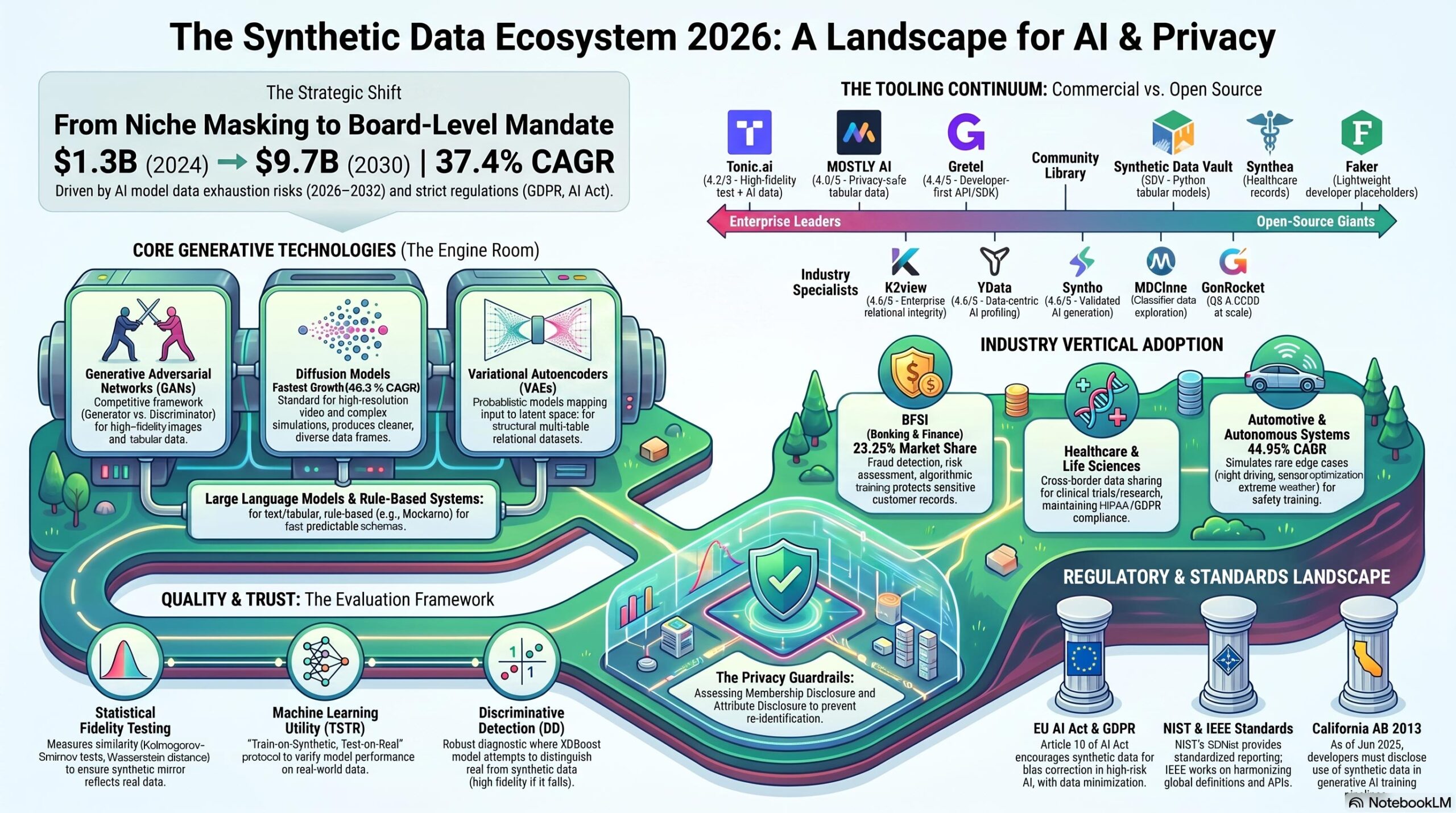
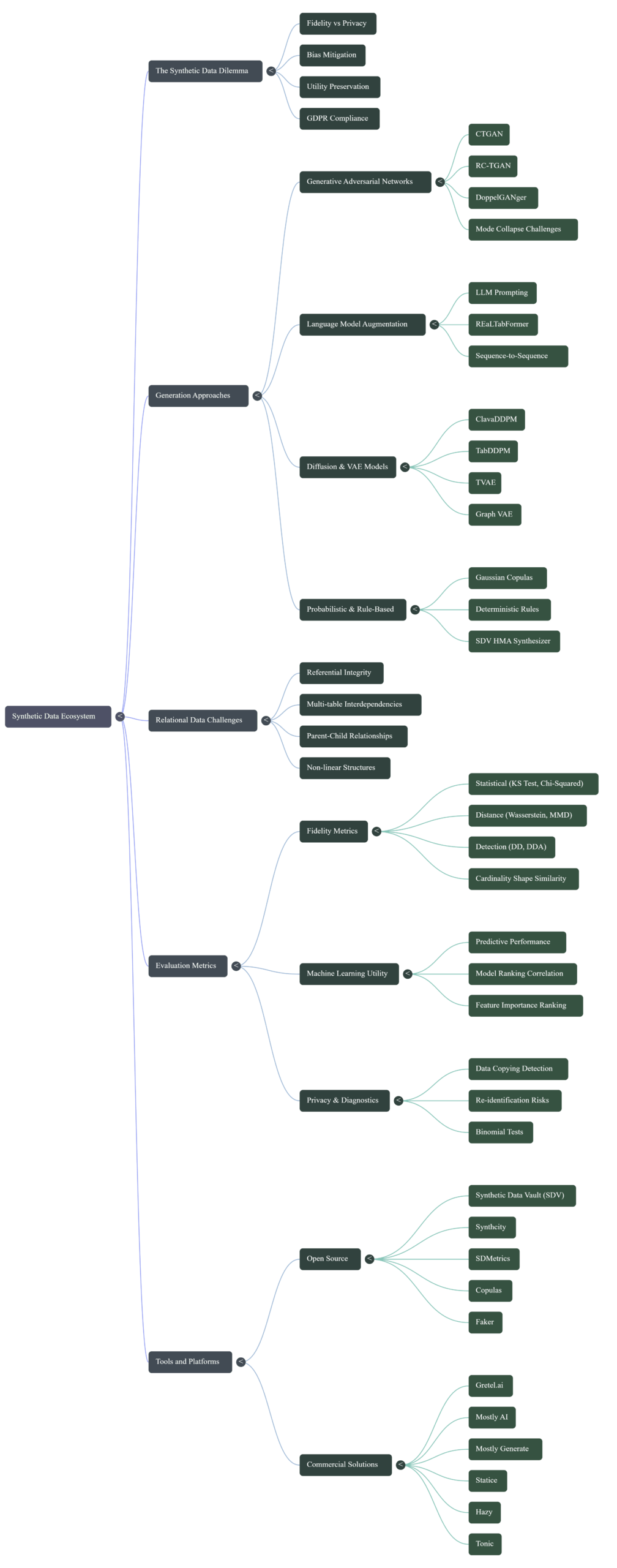
Synthetic Data Ecosystem Map
Comparison of Synthetic Data Creation Tools
| Tool Name | License Type | Data Modalities Supported | Underlying Techniques | Key Features | Privacy Mechanisms | Target Use Cases | Source |
|---|---|---|---|---|---|---|---|
| Mostly AI | Commercial (Free tier available) | Tabular, Relational, Structured data, Time-series | Deep Learning, Generative AI (GANs, VAEs, Diffusion Models) | High fidelity (97.8%) enterprise-grade generation; automated bias detection and demographic balancing; no-code UI and natural-language AI assistant. | Similarity-based Privacy Metrics (SBPMs, IMS, DCR, NNDR), GDPR/CCPA compliance, fully anonymous data. | Banking, Insurance, Healthcare, Fraud detection, Analytics, Cross-border data sharing. | [1], [2], [3], [4], [5], [6], [7], [8], [9], [10], [11], [12], [13], [14] |
| Gretel (Gretel.ai) | Commercial (Free tier / OSS libraries available) | Tabular, Relational, Time-series, Text, Image, APIs, Genomics | GANs (ACTGAN), LSTMs, VAEs, Diffusion Models, LLMs | Developer-first API and SDK; programmatic pipelines; integration into NVIDIA cloud services; open development community. | Differential Privacy (DP), SBPMs, Federated privacy layers, PII redaction/replacement. | CI/CD integration, AI/ML model development, Healthcare (EHR), Regulated data sharing. | [1], [2], [3], [15], [4], [5], [7], [8], [9], [12], [13], [14] |
| Tonic.ai (Tonic Fabricate) | Commercial (Free tier available) | Structured, Unstructured, Relational, Text, Audio, Semi-structured | Agentic AI, Generative AI (GANs, VAEs, Diffusion), Rules-based, Masking | Generates from scratch or existing data; chat-based agent configuration; mock APIs; referential integrity; Tonic CDM (Compliance Management). | Differential Privacy (DP), Data masking, De-identification, PII/PHI detection, Redaction. | Software testing, AI training, QA, Fintech, Healthcare, RAG/LLM pipelines. | [2], [3], [15], [5], [7], [16], [17], [14] |
| Synthetic Data Vault (SDV) | Open Source (Community) / Commercial (Enterprise) | Tabular, Relational, Multi-table, Sequential | GANs (CTGAN), VAEs (TVAE), Gaussian Copulas, HMA, DPGC | Python library for complex data; captures multivariate distributions and inter-column dependencies; quality evaluation (SDMetrics) and benchmarking (SDGym). | Differential Privacy (DPGC), Built-in anonymization, Trust-but-Verify framework. | Data science research, ML model training, Enterprise data management, Sandbox environments. | [2], [3], [4], [5], [6], [18], [9], [17], [12], [13] |
| Hazy (SAS Data Maker) | Commercial | Tabular, Relational | AI-powered synthetic modeling, Statistical modeling, SAS algorithms | Integrated with SAS ecosystem; visual statistical metrics; sandbox-ready datasets; regulatory alignment. | Differential Privacy (DP), Privacy-preserving metrics, GDPR/CCPA compliance. | Banking, Insurance, Risk analytics, Fraud detection, Telecom. | [1], [3], [15], [5], [6], [7], [8], [9], [17], [13], [14] |
| Synthea | Open Source | Healthcare, Clinical patient records (HL7 FHIR, CSV, C-CDA) | Rule-based simulation, Generic Module Framework | Simulates full medical histories, social determinants of health, and disease progression based on public health statistics. | HIPAA-safe (generates entirely new records, no real PHI used). | Health IT research, EHR integration testing, Policy simulation, Healthcare prototyping. | [2], [3], [6], [16], [9], [17] |
| K2view | Commercial | Complex relational data, Production database schemas, APIs, Legacy platforms | AI, Rules-based, Data cloning, Masking | Micro-Database technology; maintains cross-system referential integrity; large-scale data integration. | Intelligent masking, Encryption, Tokenization, GDPR/CCPA compliance. | Enterprise QA, CI/CD, Secure test environments, Complex relational test data. | [3], [6], [7], [14] |
| Syntho | Commercial | Tabular, Relational, Time-series, Text, NoSQL, JSON | AI-driven synthesis (GANs/VAEs inferred), Rule-based | No-code UI; direct Python API; PII scanner; automatic source data deletion; synthetic mock data substitution. | PII masking/scanning, Smart De-Identification, Documented privacy assurance reports. | Software testing, HealthTech, Finance, Public sector data sharing. | [2], [3], [7], [8] |
| NVIDIA Cosmos (Predict/Transfer/Reason) | Open source (Models available) | Video, Image, Text, 3D spatial, Multicamera video, Sensor | World Foundation Models (WFMs), Transformer-based, ViT, Diffusion, ControlNet | Generates consistent multicamera video worlds; predicts future states; spatiotemporal reasoning and physics-aware transformation. | Not in source | Robotics, Autonomous vehicles, Physical AI development, Embodied AI. | [19], [20], [21] |
| Faker | Open Source (MIT License) | Basic data types (Names, addresses, finance, timestamps) | Rule-based, Programmatic generation | Lightweight; highly customizable; available in multiple languages (Python, JS, Ruby, PHP); no statistical modeling. | Entirely fabricated fake data (no real PII). | UI development, Unit test fixtures, Seed scripts, Prototyping. | [2], [3], [6], [16], [17] |
| YData (Fabric) | Commercial (Free tier available) | Tabular, Relational, Time-series | AI-powered automated data profiling | Automated data profiling; SDK for data-centric AI; data quality issue detection and augmentation. | Privacy-preserving synthetic generation. | Data science, Analytics, Improving dataset quality for AI/ML training. | [3], [16] |
| BlueGen AI | Commercial | Structured data (Smart meter load profiles, Patient data) | DP-SGD (Differentially Private Stochastic Gradient Descent), Noise injection | Automated generation preserving statistical utility; protection against membership/attribute inference attacks. | Differential Privacy ($ \epsilon $ parameter), Gaussian mechanism. | Healthcare (clinical trials), Energy, Finance, National Statistics Offices. | [22] |
| GoTrust Compliance Automation | Commercial | Health records, Biometric profiles, Financial data | Generative models (GANs), Differentially private synthesizers | Automated DPIA workflow; lawful basis identification; audit trails for consent; cross-border transfer assessments. | Differential privacy ($ \epsilon $ and $ \delta $ parameters), $ k $-anonymity, WP29 three-risk assessment. | Healthcare, Finance, E-commerce, Cross-border data sharing. | [23] |
| GenRocket | Commercial | Relational data, 110+ data formats | Rules-based automation, 750+ data generators | Test Data as a Service; massive generator library; self-service portal; conditional logic. | PII detection, Masking, Subsetting. | Enterprise scale QA, DevOps continuous testing. | [3], [16] |
| Large Language Models (LLMs) | Varies (Commercial/Open Source) | Text, Code, Structured output | Transformers, Self-attention, BERT, GPT, PaLM, Llama | Contextual fluency; multilingual capabilities; zero-shot/few-shot learning; reasoning; synthetic clinical note generation. | Controllable generation; privacy preservation by mimicking distributions without individual identities. | Conversational AI, Healthcare (clinical text), Education, Software engineering, Content writing. | [24], [16], [25], [26] |
| PrivBayes | Open Source | Tabular, High-dimensional | Bayesian networks, Graphical models | Private data release via low-dimensional marginal distributions. | Differential privacy | Privacy-preserving data sharing, Scientific research. | [27], [8] |
| PATE-GAN | Open Source | Tabular | GANs, PATE mechanism | Generates synthetic data using teacher discriminators for privacy guarantees. | Differential privacy | Privacy-preserving data generation, Software testing. | [27], [8] |
| Aindo (Panfilo) | Commercial | Tabular, Relational | Deep Learning, AI generation | Utility and privacy evaluation metrics; data bias removal; privacy evaluation dashboards. | Similarity-based privacy metrics (IMS, DCR, NNDR). | Healthcare, Finance, Public sector, Enterprise processing. | [3], [8] |
| Mockaroo | Commercial (Free tier available) | CSV, JSON, SQL, Excel | Rule-based / Schema-based generation | Browser-based interface; mock API design; library of data types (custom formulas, regex); no AI modeling. | Non-production random data generation. | Quick test datasets, API mocking, Software demos. | [2], [3], [16] |
| DataSynthesizer | Open Source | Tabular, Health records, Finance | Bayesian networks | Preserves statistical patterns for privacy-preserving synthetic dataset generation. | Differential privacy, Anonymization. | Privacy-preserving data release, Regulated environments, Research. | [27], [9] |
| Statice | Commercial | Relational tables, Time-series | Not in source | Scalable modular architecture; SDK with APIs; deep support for multi-table relationships. | Preventing re-identification. | Enterprises needing structured data with high privacy, Insurance, Healthcare. | [7], [2], [10] |
| NVIDIA Omniverse | Commercial | Video, Text, 3D Scene Metadata, Sensor streams | Generative Physical AI, Digital Twins, LLM-backed Scenario Agent | Generates physics-rich scenarios; declarative scenario authoring from natural language; deterministic permutation rendering. | Not in source | Autonomous driving (perception/planning), Robotics, Predictive maintenance. | [15], [28] |
| Duality Technologies | Commercial | Tabular, Structured national security data | Generative AI models (GANs, VAEs, Diffusion) | Secure computation integration; collaborative training without raw data exchange. | Secure compute specialist, Privacy-preserving AI, Federated learning. | Government, Medical R&D, National security, Healthcare. | [2], [5] |
| Synthesis AI | Commercial | Visual data, 3D simulation, Image | Generative AI models (GANs, VAEs, Diffusion) | Human realism; pose control; lighting variance; direct integration with NVIDIA Omniverse. | Not in source | Automotive, Biometrics, Facial recognition, Robotics. | [2], [5] |
| Datagen | Commercial | Visual data, Image, Video | Generative AI models (GANs, VAEs, Diffusion) | Scene simulation; 3D realism; high-fidelity edge case simulation. | Not in source | Retail, Robotics, Computer vision training, Smart devices. | [2], [5] |
| DoppelGANger | Open Source | Time-series, Sequence tracking | Generative Adversarial Networks (GANs) | Captures temporal dependencies in sensor readings, logs, or market movements. | Maintaining data privacy. | Sequential data research, IoT/sensor data pattern testing. | [2], [9], [17] |
| Twinify | Open Source | Highly confidential information, Clinical data | Bayesian inference | Python library; retains essential statistical properties; privacy-preserving synthetic twin. | Strong privacy guarantees (unspecified). | Healthcare, Clinical/epidemiological research, Social sciences. | [2], [9], [17] |
| CTGAN | Open Source | Tabular | Conditional GANs | Handles imbalanced distributions, mixed data types, and non-Gaussian distributions. | Privacy-safe model development. | Machine learning teams, Classification or regression tasks. | [27], [4], [6], [17] |
| DECAF | Open Source | Tabular | Causally-aware GANs | Generates fair synthetic data using causal modelling to drop biased edges. | Causal fairness | Data de-biasing, Fairness. | [27] |
| G-PATE | Open Source | Tabular, High-dimensional | PATE mechanism, GANs | Scalable private aggregation of teacher discriminators. | Differential privacy | Privacy-preserving data release. | [27] |
| FairGAN | Open Source | Tabular | GANs | Fairness-aware networks using extra loss terms for disparity. | Fairness constraints | De-biasing, Software testing. | [27] |
| National COVID Cohort Collaborative (N3C) | Open Source (Inferred) | Tabular | Generative AI | Supports COVID-19 research using NIH infrastructure. | Privacy metrics evaluation | Healthcare, COVID-19 research. | [29] |
| TAPAS | Open Source (Inferred) | Tabular | Adversarial auditing | Toolbox for adversarial privacy auditing of synthetic data. | Adversarial privacy auditing | Software testing, Privacy evaluation. | [29] |
| Diffusion Models | Open Source (Inferred) | Tabular, Images, Audio, 3D | Diffusion (e.g., TabDDPM, Stable Diffusion) | Iterative noise-based generation; stable training; high-fidelity outputs. | SBPMs, DCR, Privacy-preserving techniques. | Healthcare, Finance, Entertainment, Scientific visualization. | [1], [25] |
| Transformer-based Models | Open Source (Inferred) | Tabular, Relational, Text, Code | Transformers, LLMs (e.g., REaLTabFormer) | Autoregressive generation; interactive access via API or UI; contextual fluency. | Differential Privacy (DP), SBPMs. | Software testing, Census data, Finance, NLP. | [1], [25] |
| Gretel Navigator | Commercial | Tabular, Relational, Genomics | Generative AI | Production-ready solutions; interactive model access; conditional generation. | Differential Privacy (DP), SBPMs. | Genomics, Healthcare, Software development. | [1] |
| GPT-3 / GPT-3.5 | Commercial | Text, Code | Transformers, Few-shot prompting | Cost-effective annotation; synthetic labeling; iterative self-refinement (Self-Instruct). | Mimics real data without revealing individual identities (DP inferred). | Sentiment analysis, Healthcare, Finance, Instruction following. | [24] |
| K2View | Commercial | Relational, Flat files, Legacy systems | Data masking, Tokenization, Synthetic generation | Preserves referential integrity; large-scale data generation. | GDPR/CCPA compliance, Anonymization. | Secure test environments, CI/CD, Data testing. | [6], [7] |
| Aikido | Freemium + Enterprise | Source code, dependencies, containers | Vulnerability scanning | Unified DevSecOps platform; compliance enforcement; developer-first approach. | Security scanning to prevent data leaks. | Engineering teams, CI/CD environments. | [6] |
| SDMetrics | Open Source | Synthetic datasets | Statistical evaluation metrics | Synthetic data evaluation platform; quality reports. | Not in source | Evaluating synthetic data quality. | [18] |
| SDGym | Open Source | Tabular, Relational | Benchmarking framework | Benchmarking platform for synthetic data generators. | Not in source | Comparing performance of different generators. | [5], [18] |
| DPGC Synthesizer | Commercial (SDV Bundle) | Tabular | Gaussian Copula with noise injection | Control of privacy amount using epsilon ($ \epsilon $) parameter. | Differential Privacy | Sharing sensitive data externally, Private AI training. | [18] |
| ActReady | Commercial | Tabular (Implicit) | Classifier, Document generator | Compliance tracker; vendor risk assessments; EU AI Act document generation. | Transparency notices, Audit trails. | HR, Credit scoring, Medical devices, Biometric systems. | [30] |
| VerityAI | Commercial (Inferred) | Tabular, Relational | Generative AI, Overfitting Detection | Risk-based identifiability judgement; GDPR compliance testing. | Differential Privacy, Anonymisation, Re-identification risk assessment. | Healthcare, Finance, Fintech, HR & Recruitment. | [31] |
| DP_WGAN-UCLANESL | Open Source | Tabular | Wasserstein GAN (W-GAN) | Solution from NIST differential privacy synthetic data challenge. | Differential Privacy | Privacy-preserving data generation. | [17] |
| Syntheticus | Commercial | Structured (Tabular) | Deep Learning / AI-generated | Drop-in replacement for original data; privacy-preserving data utilization. | AI-generated synthetic data (anonymization). | AI training, Analytics, Public sector. | [11] |
| Infosys | Commercial | Structured (Tabular) | Deep Learning / AI-generated | Focus on data-driven innovation and regulatory compliance (GDPR/CCPA). | AI-generated synthetic data (anonymization). | Software testing, AI training, Enterprise data sharing. | [11] |
| Clearbox AI Replica | Commercial | Tabular, Audio, Video, Text, Images | GANs, VAEs, Transformers, Diffusion | Maintains statistical properties; used for bias detection and correction. | Differential privacy (Inferred), PII removal, Anonymization. | Credit scoring, Patient diagnostics, Regulatory compliance. | [32] |
| Row Conditional-TGAN (RC-TGAN) | Open Source | Tabular, Relational | GANs | Conditional synthesis on parent rows; captures grandparent-grandchild influence. | Not in source | Healthcare, Finance, Education. | [12] |
| REaLTabFormer | Open Source | Tabular, Relational | Transformers (GPT-2, Seq2Seq) | Independent parent modeling; sequence-to-sequence conditional child modeling. | Not in source | Healthcare, Finance, Education. | [12], [1] |
| Incremental Relational Generator (IRG) | Open Source | Tabular, Relational | GANs | Incremental fitting; context table construction via joins/aggregation. | Not in source | Healthcare, Finance, Education. | [12] |
| ClavaDDPM | Open Source | Tabular, Relational | Diffusion Models | Latent variable GMM clustering; bottom-up modeling for parent-child constraints. | Not in source | Healthcare, Finance, Education. | [12] |
| Graph Variational Autoencoders | Open Source | Tabular, Relational (Graph) | VAEs, Graph Neural Networks | Message passing using GRU; adjacency matrix from foreign keys. | Not in source | Healthcare, Finance, Education. | [12] |
| Simulacrum | Commercial/Public Use | Tabular | Generative modeling | Synthetic cancer dataset from Public Health England. | Not in source | Healthcare, Oncology research. | [29] |
| TabDDPM | Open Source | Tabular | Diffusion Models | Modeling mixed-type tabular data using diffusion. | Not in source | General data science, Machine learning research. | [29], [8] |
| CorGAN | Open Source | Tabular | GANs, CNNs | Correlation-capturing synthetic healthcare records. | Not in source | Healthcare. | [29] |
| Replica Analytics | Commercial | Tabular | Generative AI | Healthcare-focused synthetic data generation. | Not in source | Healthcare. | [1] |
| Code Alpaca / WizardCoder / Magicoder | Open Source | Code, Text | LLM-based, Self-Instruct, Evol-Instruct | Instruction-following examples; iterative complexity scaling; OSS-Instruct from GitHub snippets. | Not in source | Fine-tuning code assistants, Instruction tuning. | [24] |
| SmartNoise Synthesizer | Open Source | Tabular | Not in source | OpenDP Initiative integration; differentially private open source synthesizer. | Mathematical Differential Privacy. | Tabular datasets containing PII. | [2], [17] |
| Synth / Pydbgen / Synner | Open Source | Database streams, SQL, Tables | Data-as-Code CLI, Lightweight Python | Rapid prototyping; command-line workflow; visual schema modeling for non-technical users. | Not in source | Fast prototyping, Database population. | [2], [9] |
| NVIDIA Nemotron-4 340B | Commercial | Text, Multilingual NLP | LLM-based Foundation Models | Designed to feed downstream pipelines; reducing data-acquisition costs. | Not in source | AI/ML Training, Multilingual NLP. | [15], [13] |
| Synthesized (Synthesized.io) | Commercial | Tabular, Relational | AI engine, Statistical replicas | Data as Code approach; SDK for ML; embeds into Google BigQuery; maintains inter-table relationships. | Codified compliance requirements, Data masking, Anonymization. | Banking, Credit-risk analysis, SAP testing, CI/CD. | [15], [16], [9] |
| Applied Intuition | Commercial | Visual, Sensor | Domain-specific Simulation | High-fidelity simulation for autonomous systems. | Not in source | Autonomous Driving, Robotics. | [15] |
| Gramosynth (Rightsify) | Commercial | Audio | Not in source | Platform for copyright-free music generation. | Not in source | Content creation, Entertainment. | [15] |
| SynthEval | Open Source | Not in source | Statistical / ML techniques | Evaluation tool for fidelity and privacy integrity. | Privacy-preserving integrity evaluation. | Validation of synthetic data quality. | [4] |
| NDSI | Commercial | Financial data | Not in source | Specialized for financial services. | Regulatory-compliant. | Risk management, Fraud detection. | [6] |
| dbForge Edge | Commercial | SQL, MySQL, Oracle tables | Pattern-based generation (regex, masks) | Test data generator; CLI automation; multi-database management. | Replacing real records for compliance. | DevOps, CI/CD, QA environments. | [6] |
| NVIDIA Isaac Sim | Open Source (Framework) | 3D, Video, Depth, LiDAR | Physically based simulation, Replicator | Digital twin reconstruction; SimReady assets; generates large-scale datasets for sensor simulation. | Not in source | Robotics simulation, Logistics, Delivery robots. | [19] |
| World Model (Waymo) | Internal/Proprietary | Camera, LiDAR | Generative AI (Genie 3) | Hyper-realistic driving scenarios; natural language prompts. | Not in source | Autonomous driving safety-critical edge cases. | [13] |
| SDNist | Open Source | Tabular | Not in source | Compares synthetic data to NIST excerpts; evaluates utility and privacy. | Differential Privacy (evaluation metrics). | Public safety, Community data analysis. | [33] |
| Betterdata | Commercial | Not in source | Not in source | Privacy-enhancing synthetic data generation capabilities. | Privacy-preserving (unspecified). | AI, Data sharing, US DHS projects. | [17], [14] |
Sources
- Rethinking Anonymity Claims in Synthetic Data Generation: A Model-Centric Privacy Attack Perspective – arXiv
- The Synthetic Data Ecosystem: Market Dynamics, Generative Architectures, and Governance Frameworks
- 15 best synthetic data tools for AI and testing in 2026 – Guideflow Blog
- Balancing Fidelity, Privacy, and Bias: The Synthetic Data Dilemma – SmarterArticles
- Synthetic Data Generation Market Size ($9.7 Billion) 2030 – Strategic Market Research
- Best Synthetic Data Generation Tools – Devart
- Top 7 Synthetic Data Companies Plus Criteria for Choosing the Best Provider – Syntho AI
- Synthetic Data, Similarity-based Privacy Metrics, and Regulatory (Non-)Compliance
- Finding Best Free Ai Tools For Data Generation For Your Project
- Synthetic Data – IEEE Standards Association
- Synthetic Data – IEEE Standards Association
- Benchmarking the Fidelity and Utility of Synthetic Relational Data – arXiv
- Synthetic Data for AI Model Training: A Decision Framework for ML …
- The Urgency of Standards for Synthetic Data in the Era of Agentic AI …
- Synthetic Data Market Size, Share, Trends & Research Report, 2031 – Mordor Intelligence
- Best Synthetic Data Generation Tools Compared for 2026 | Blog | Tonic.ai
- statice/awesome-synthetic-data: A curated list of awesome synthetic data tools (open source and commercial). – GitHub
- Differential Privacy for Synthetic Data (Part II): Trust-but-Verify – DataCebo
- Into the Omniverse: Open World Foundation Models Generate Synthetic Worlds for Physical AI Development – NVIDIA Blog
- Scale Synthetic Data and Physical AI Reasoning with NVIDIA Cosmos World Foundation Models
- Curating Synthetic Datasets to Train Physical AI Models with NVIDIA Cosmos Reason
- Why do you need differential privacy on your synthetic data? – BlueGen AI
- Synthetic Data as a Privacy Tool: The Unsettled Legal Threshold …
- Synthetic Data Generation Using Large Language Models: Advances in Text and Code
- Generative AI Models: A Comprehensive Review of GANs, Diffusion Models, and LLMs – International Journal of Scientific Research and Engineering Development
- GANs vs. LLMs: What You Need to Know
- Synthetic Data – what, why and how? – Royal Society
- nvidia/PhysicalAI-WorldModel-Synthetic-Autonomous-Driving-Scenarios · Datasets at Hugging Face
- A consensus privacy metrics framework for synthetic data – PMC – NIH
- If you’re already GDPR compliant, here’s what actually carries over to the EU AI Act and what doesn’t – Reddit
- Is Synthetic Data GDPR-Exempt? The Re-Identification Test – VerityAI
- The Role of Synthetic Data within the European Artificial Intelligence …
- SDNist: Synthetic Data Report Tool | NIST – National Institute of Standards and Technology