

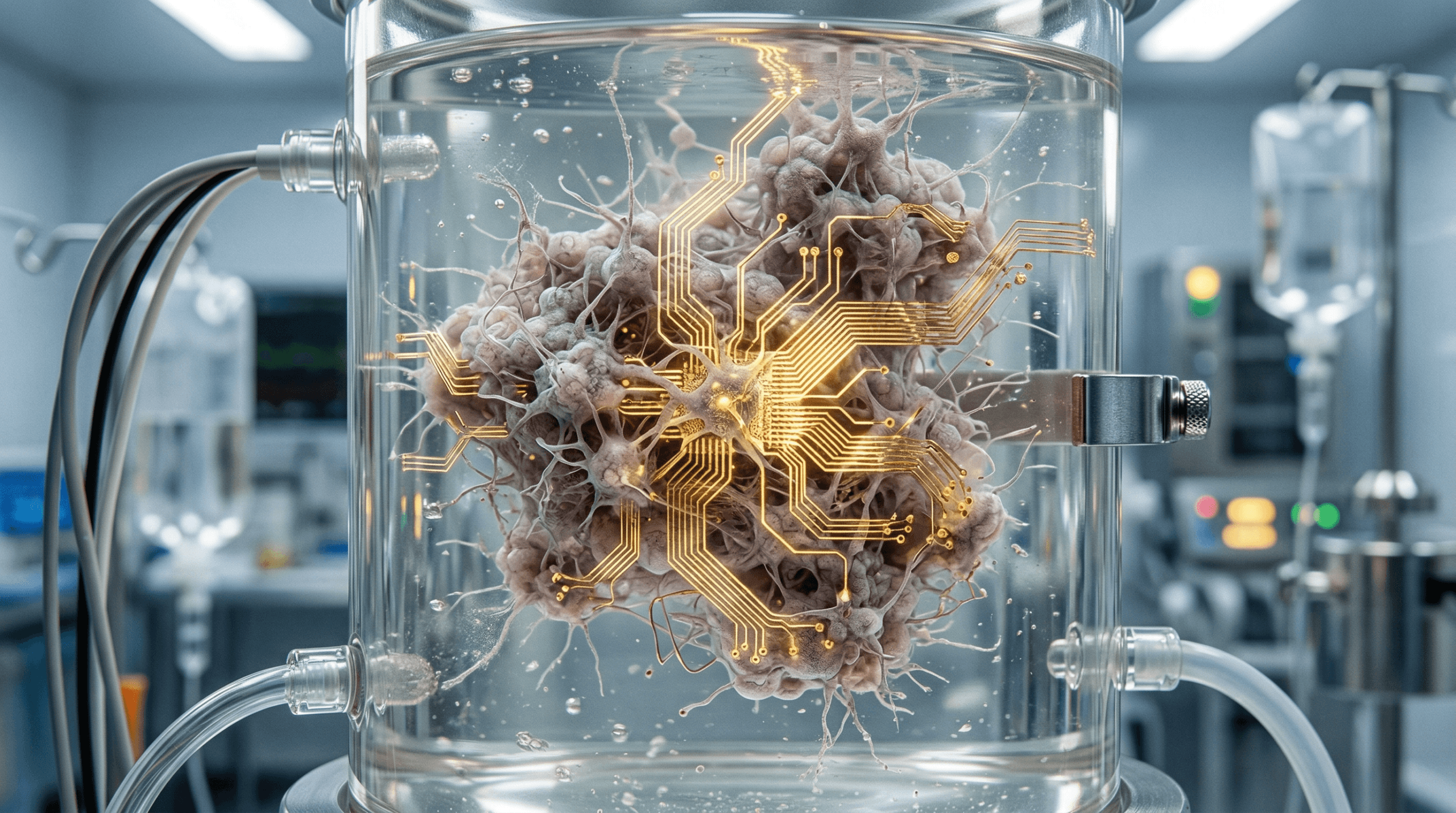
The OI (Organic Intelligence) Matrix represents the pinnacle of hybrid computing. By integrating living biological neural tissue clusters with glowing gold circuitry, the system achieves unprecedented parallel processing capabilities. Suspended in a translucent nutrient gel under clinical lighting, the matrix requires constant biological upkeep but delivers computational power that dwarfs traditional silicon-based architectures.
The Latest News and Talk about Organoid Intelligence and Cellular Computing
BRIEF
Organoid intelligence represents a groundbreaking intersection of biology and computing. Recent developments have showcased the potential of lab-grown brain organoids to serve as biological computing systems. A notable project, Brainoware, utilizes a brain organoid interfaced with a high-density multielectrode array to perform computations, as detailed in a study published by Feng Guo and his team at Indiana University in Nature Electronics on December 11, 2023. This innovative approach marks a significant step in the evolution of artificial intelligence, suggesting that biological substrates may outperform traditional silicon-based systems in certain computational tasks Brainoware - AI Is Dead.
The concept of organoid intelligence is gaining traction in various research domains, particularly in understanding complex neurological conditions. For instance, a recent review in Molecular Psychiatry highlights how organoid intelligence can enhance research into autism spectrum disorder (ASD). By integrating AI with brain organoids, researchers aim to develop predictive models that could unravel the pathogenesis of ASD and lead to more effective treatment strategies. This paradigm shift in research methodology underscores the versatility and potential of organoid systems in addressing critical health challenges Organoid intelligence: a promising paradigm - Scientists Are Now Merging AI With Living Creatures.
Ethical considerations surrounding organoid computing are becoming increasingly prominent. Discussions are emerging regarding the moral implications of using biological systems for computation, particularly in comparison to traditional silicon-based technologies. A Reddit discussion highlighted the ethical dilemmas posed by organoid intelligence, questioning whether growing biological computers is more or less ethical than conventional methods. This discourse reflects a growing awareness of the responsibilities associated with advancing biocomputing technologies Is growing biological computers for AI more or less ethical? - Biological Computers Are Real.
Recent advancements in organoid culture techniques are also noteworthy. Harvard researchers have successfully maintained human brain organoids alive in vitro for over five years, significantly surpassing previous records. This prolonged viability allows the organoids to mimic developmental stages seen in living humans, opening new avenues for research into brain development and disease modeling. Such breakthroughs not only enhance the understanding of neurological conditions but also provide a robust platform for testing organoid intelligence applications Harvard neuroscientists kept peppercorn-sized clumps alive - Report maps ethical path for organoid research.
The future of organoid intelligence is promising yet complex. As researchers continue to explore the capabilities of organoid systems, the integration of AI with biological substrates could lead to unprecedented advancements in computing and neuroscience. However, the ethical implications and societal impacts of such technologies must be carefully considered. The ongoing dialogue among scientists, ethicists, and policymakers will be crucial in shaping the responsible development of organoid intelligence and its applications in various fields Human stewardship in the age of organoids - Toward Global Oversight of Human Neural Organoid.
KEY PATTERNS from the research:
1. The Brainoware project exemplifies the potential of organoid systems in computational tasks, merging biology with AI.
2. Organoid intelligence is being explored as a novel approach to understanding and treating autism spectrum disorder.
3. Ethical discussions are emerging regarding the implications of using biological systems for computing.
4. Harvard's success in maintaining organoids for over five years enhances their viability for research applications.
5. The integration of AI with organoid systems could revolutionize both computing and neuroscience.
6. Ongoing dialogues among stakeholders are essential for the responsible advancement of organoid intelligence.
7. The versatility of organoids is being recognized across multiple research domains, indicating broad applicability.
8. The ethical frameworks surrounding organoid research are evolving, reflecting societal concerns about biocomputing technologies.
Freshness
- 5 of 15 dated items are from the last 7 days.
Ranked Evidence Clusters
Brainoware and what an organoid computing on electrodes tells us about substrate | The Consciousness AI - Artificial Consciousness Research
Source: Web | Date: 2026-09-05
Score: 38
Scientists Are Now Merging AI With Living Creatures Called “Organoid Intelligence”
Source: Web | Date: 2026-09-02
Score: 36
Organoid intelligence: a promising paradigm for autism spectrum disorder research | Molecular Psychiatry
Source: Web | Date: 2026-08-31
Score: 34
Is growing biological computers for AI (Technically Organoid Intelligence) computation more or less ethical than using silicon based ones?
Source: Reddit | Date: 2026-09-03
Score: 30
Brain organoid reservoir computing for artificial intelligence
Source: Web | Date: 2026-08-21
Score: 29
Organoid Intelligence – Ubergeek Kelly's World- Life, technology, science, rants
Source: Web | Date: 2026-08-14
Score: 25
Stats
- Total evidence: 15 items across 3 sources
- Top voices: www.wired.com, Cambridge-IoE-Group/Cambridge-IoE-Group.github.io, SWE-bench/experiments, THTHDGCS/agents-radar, chobrien99-svg/AMI-Labs
- GitHub: 4 items | 1 comments | voices: Cambridge-IoE-Group/Cambridge-IoE-Group.github.io, SWE-bench/experiments, THTHDGCS/agents-radar
- Web: 9 items | domains: www.wired.com, theconsciousness.ai, thewinepress.substack.com
- Reddit: 2 items | communities: r/Teenager_Polls, r/aiwars
Web Research
AI Is Dead. Organoids Are Alive | WIRED
Claire L. Evans Aug 11, 2026 6:00 AM AI Is Dead. Organoids Are Alive Mini human brains are being grown in labs all over the world. Soon, they could outthink neural networks. ANIMATION: INTRANET GIRL; LETTERING: Zuzanna Rogatty I’m going to let you in on a secret. Every cell in ...
Source: wired.com | Date: 2026-08-11
Biological Computers Are Real—But They Won’t Replace Your Laptop Yet
The Next Computer Won’t Be Built — It’ll Be Grown in a Lab. Maybe. By UMATechnology Team Sep 7, 2026 7 min read Biological computers are real, but they are not grown replacements for laptops, CPUs, or GPUs. Researchers and companies already connect living neurons or ...
Source: umatechnology.org | Date: 2026-09-07
Weird New Computer Runs AI on Captive Human Brain Cells: Explained
Weird New Computer Runs AI on Captive Human Brain Cells—What It Really Is By UMATechnology Team Aug 14, 2026 13 min read The weird new computer runs AI on captive human brain cells only in a loose headline sense: researchers are coupling lab-grown, human-derived neural cultures ...
Source: umatechnology.org | Date: 2026-08-14
Harvard neuroscientists kept peppercorn-sized clumps of human brain cells alive in a dish for more than five years, tripling the previous 694-day record set in 2021 and long enough that the organoids began mimicking developmental stages seen in living people
more than five years, tripling the previous 694-day record set in 2021 and long enough that the organoids began mimicking developmental stages seen in living people Harvard neuroscientists kept peppercorn-sized clumps of human brain cells alive in a dish for more than five ...
Source: spacedaily.com | Date: 2026-09-03
Toward Global Oversight of Human Neural Organoid and Assembloid Research - Dana Foundation
Toward Global Oversight of Human Neural Organoid and Assembloid Research September 3, 2026 ASILOMAR, CA | NOVEMBER 1O-12, 2025 The stakes are personal. For families living with serious neurological, psychiatric, and developmental disorders, neural organoid and assembloid ...
Source: dana.org | Date: 2026-09-03
Report maps ethical path for organoid research
Published: 2026-09-03T02:50:06+00:00 Source: news.stanford.edu (news.stanford.edu) Language: en Story Over the past two decades, there’s been an explosion of research drawing on lab-grown brain cells to better understand brain development and disease. Now, the time has come to ...
Source: news.stanford.edu | Date: 2026-09-03
Human stewardship in the age of organoids - Nature Methods
Published: 2026-09-02T00:00:00 Source: nature.com (nature.com) Language: en Story This work was shaped by the authors’ shared experience building and stewarding living human biorepositories through HUMANOID and the UC San Diego–LifeShare research programs. The perspectives ...
Source: nature.com | Date: 2026-09-02
✅ All agents reported back! ├─ 🟠 Reddit: 2 threads ├─ 🐙 GitHub: 4 items │ 1 comments ├─ 🌐 Web: 9 pages - theconsciousness.ai, Substack, nature.com, mxwbio.com, en.wikipedia.org, kgadams.net, news18.com, Wired └─ 🗣️ Top voices: r/Teenager_Polls, r/aiwars