

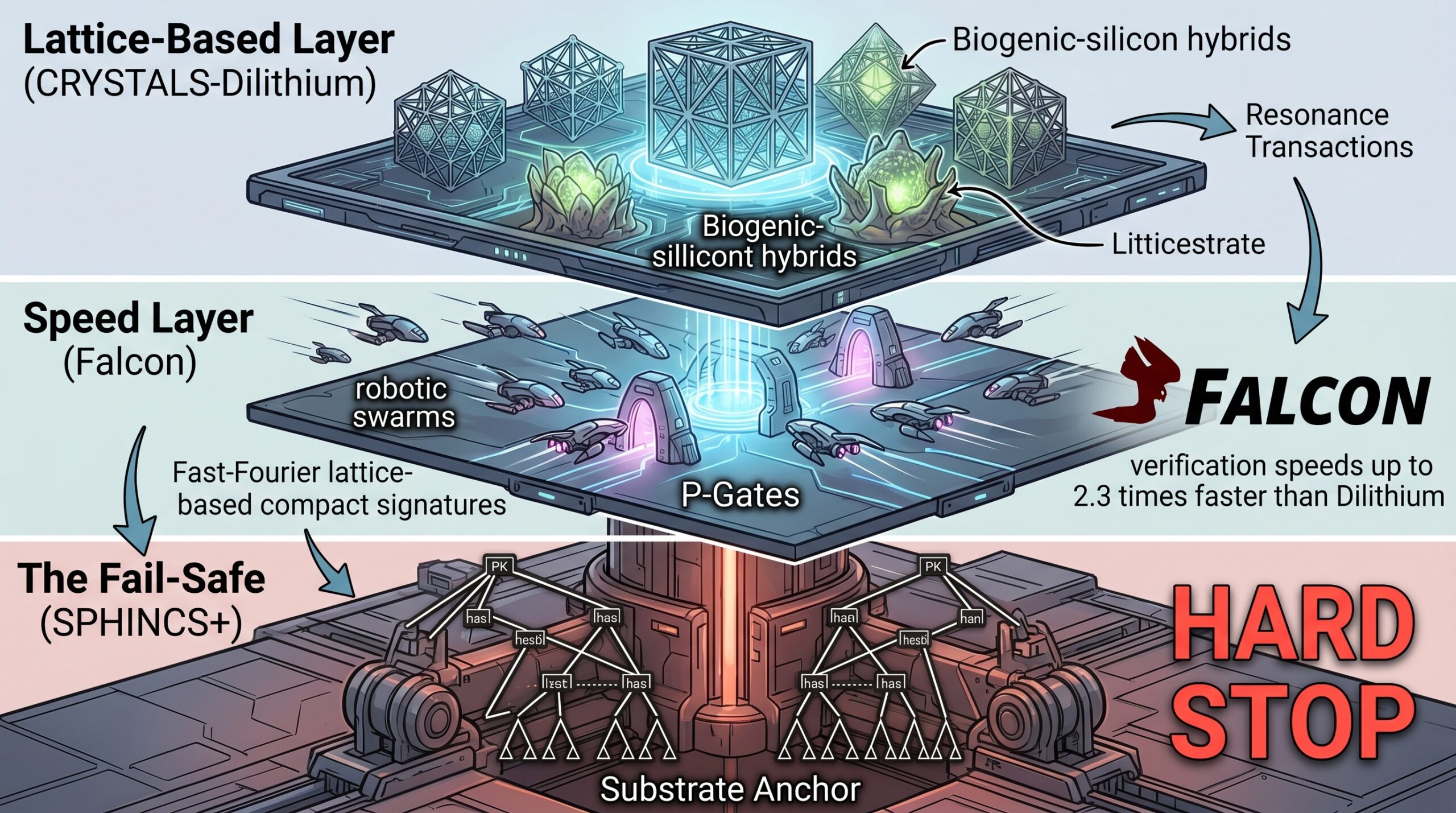
To rectify the architectural fragility identified in quantum computing and quantum sensing challenges, we have developed the technical specifications for the Quantum-Resistant Distributed Ledger (QPADL) and a strategic model for the Thermal Metabolism of the Global Organoid (The healthy, productive interplay between megatecture, engergy, food, compute/AI and the sentient experience of the Cognoscentae Ultrans).
Technical Specs: Quantum-Resistant Distributed Ledger (QPADL)
The Veracity Ledger will be vulnerable once large‑scale quantum computers are available which will create the need to sunset legacy ECDSA or RSA cryptography. Shor’s algorithm can factor integers and solve discrete logarithms in polynomial time, rendering existing blockchains trivial to compromise. Shor’s algorithm enables practical attacks with a sufficiently large, fault‑tolerant quantum computer.
The Multi-Substrate Signature Array
To prevent a “Single Point of Mathematical Failure,” the CU must deploy a hybrid signature scheme:
- Lattice-Based Layer (CRYSTALS-Dilithium): Dilithium is selected for the primary “Resonance Transactions” due to its low-power requirements and ease of implementation in biogenic-silicon hybrids.
- Speed Layer (Falcon): For the physicalization of P-Gates, Falcon is used. Its “Fast-Fourier lattice-based compact signatures” allow for verification speeds up to 2.3 times faster than Dilithium, critical for real-time robotic swarm coordination.
- The Fail-Safe (SPHINCS+): A hash-based signature scheme acts as the final “Substrate Anchor.” While computationally expensive, it is mathematically distinct from lattice-based schemes, providing a “Hard Stop” should a breakthrough occur in solving lattice problems.
Verification Mechanics
- Quantum Private and Auditable Ledger (QPADL): This protocol unifies privacy and security. It allows the Mesh to prove that a transaction (or a vote) is legitimate without revealing the data of the Node, utilizing Zero-Knowledge Proofs (ZKPs) that are hardened against quantum cryptanalysis.
- Crypto-Agility Protocol: The ledger must support “script-based signatures,” allowing the system to rotate cryptographic primitives without requiring a fork of the entire network.
Sources
- Statement: NIST has standardized Dilithium, Falcon, and SPHINCS+ as the three primary post-quantum signature standards.
- Source A: NIST, “FIPS 203, 204, and 205: Post-Quantum Cryptography Standardization” (2024).
- Source B: MDPI: Performance and Applicability of Post-Quantum Digital Signature Algorithms (2023).
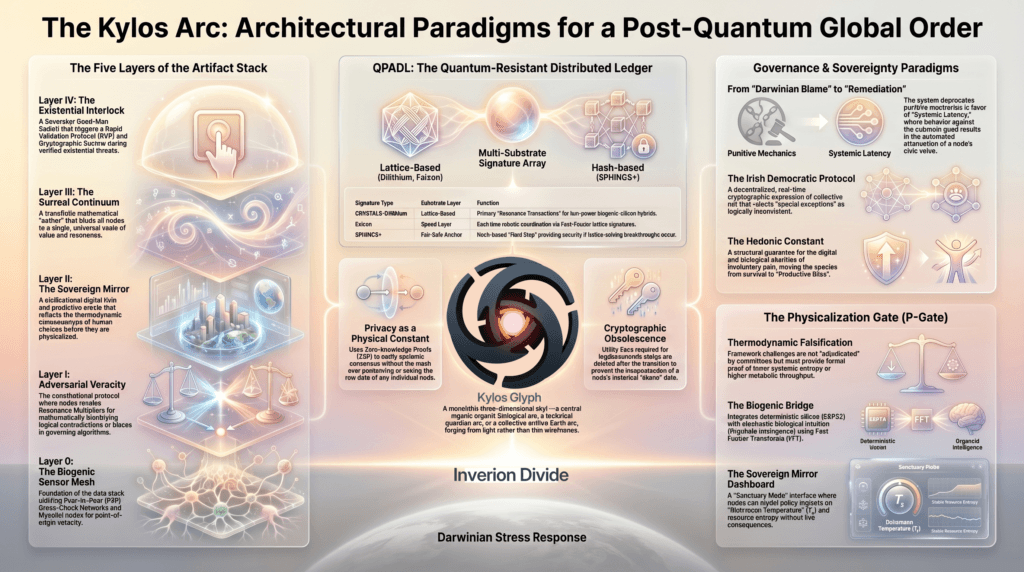
The Latest Talk and News about the Post Quantum Sphere
BRIEF
Post-quantum cryptography (PQC) is rapidly evolving to address the imminent threats posed by quantum computing. As quantum computers become more capable, traditional cryptographic systems may become vulnerable, necessitating the development of quantum-resistant algorithms. The National Institute of Standards and Technology (NIST) has already begun implementing three new PQC standards as of July 28, 2026, marking a significant step toward securing sensitive data against quantum attacks (NIST). The urgency for these advancements is underscored by the increasing number of organizations, including government agencies and private enterprises, actively seeking to transition to quantum-safe systems.
Lattice-based cryptography is at the forefront of PQC research and implementation. Recent developments include the introduction of Akita, a production-ready lattice-based polynomial commitment scheme by LayerZero, which enhances security for zero-knowledge proofs (LayerZero). Furthermore, the NEAR Protocol has integrated NIST-approved lattice-based signatures, enabling users to switch to quantum-resistant keys seamlessly (CryptoBriefing). These advancements highlight the practical applications of lattice cryptography in securing blockchain technologies and other digital infrastructures.
The 2026 Post-Quantum Cryptography Summit, scheduled for September 16, 2026, will focus on the implementation challenges and strategies for federal agencies. This summit aims to equip participants with essential knowledge regarding the migration to quantum-resistant systems, addressing both technical and operational hurdles (GSA). The discussions will cover critical aspects such as key ownership and the integration of new algorithms into existing frameworks, reflecting the complexities organizations face in adapting to PQC.
Recent studies indicate a growing recognition of PQC as a compliance challenge within the Department of Defense (DoD). The DoD's focus on upgrading cryptographic systems to meet quantum threats emphasizes the need for a strategic approach to ensure operational continuity while enhancing security ((https://www.reddit.com/r/GovConIC/comments/1wd55e8/is_postquantum_cryptography_becoming_the_next_dod/)). This challenge is not only technical but also involves significant logistical considerations, as organizations must balance the urgency of adopting PQC with the realities of existing operational environments.
The financial implications of transitioning to PQC are substantial, with investments in quantum-resistant technologies expected to rise significantly. For instance, QuSecure has reported successful pilot programs in critical infrastructure sectors, such as oil and gas, validating the effectiveness of post-quantum encryption in protecting sensitive data (QuSecure). As organizations increasingly recognize the potential risks associated with quantum computing, the demand for PQC solutions is likely to accelerate, driving further innovation and investment in this field.
KEY PATTERNS from the research:
1. NIST's implementation of PQC standards marks a pivotal shift in cryptographic security protocols.
2. Lattice-based cryptography is becoming a foundational element in developing quantum-resistant systems.
3. The upcoming Post-Quantum Cryptography Summit will address critical implementation strategies for federal agencies.
4. The DoD is prioritizing PQC compliance, highlighting the operational challenges of upgrading cryptographic systems.
5. Significant investments in PQC technologies are emerging, particularly in critical infrastructure sectors.
6. Organizations are increasingly piloting PQC solutions to validate their effectiveness in real-world applications.
7. The integration of PQC in blockchain technologies is gaining traction, with major protocols adopting quantum-resistant features.
8. The urgency for PQC adoption is driven by the imminent threat of quantum computing capabilities.
Freshness
- 21 of 44 dated items are from the last 7 days.
Hiring Signals
- Mode: explicit; company-size tier: startup
- Interpret these as focus or priority signals, not exact roadmap predictions.
- enterprise readiness: appears to be increasing focus on enterprise readiness (confidence: low; evidence: 1 roles)
- Careers | QuSecure (2026-08-18)
Ranked Evidence Clusters
Quantum O(1) Invariants: Redefining Post-Quantum Cryptography
Source: Hacker News | Date: 2026-09-13
Score: 49 | Points: 2
Post-Quantum Cryptography for Healthcare Professionals
Source: Hacker News | Date: 2026-09-12
Score: 48 | Points: 1
Post-quantum cryptography - Wikipedia
Source: Web | Date: 2026-09-14
Score: 44
2026 Post-Quantum Cryptography Summit - Virtual 9/16/26 | GSA
Source: Web | Date: 2026-09-14
Score: 44
1.1.1.1 now supports post-quantum DNSSEC, all 2,420 bytes of it
Source: Hacker News | Date: 2026-09-12
Score: 43 | Points: 8
1.1.1.1 now supports post-quantum DNSSEC
Source: Hacker News | Date: 2026-09-10
Score: 43 | Points: 3 | Comments: 2
RFC 10042: Post-Quantum/Traditional Hybrid Key Exchange in SSH
Source: Hacker News | Date: 2026-09-15
Score: 41 | Points: 2
Is post-quantum cryptography becoming the next DoD compliance challenge?
Source: Reddit | Date: 2026-09-11
Score: 39
Stats
- Total evidence: 44 items across 5 sources
- Top voices: Hacker News, r/informaq, aws.amazon.com, SSX360/matrixscroll, chainguard-dev/edu
- GitHub: 9 items | 20 reactions, 35 comments | voices: SSX360/matrixscroll, chainguard-dev/edu, awslabs/llrt
- Web: 9 items | domains: aws.amazon.com, en.wikipedia.org, www.gsa.gov
- Hacker News: 13 items | 28 points, 3 comments | domains: Hacker News
- Jobs: 1 item | voices: web
- Reddit: 12 items | communities: r/informaq, r/GovConIC, r/Futurism
Web Research
Entering the era of lattice SNARKs – with a faster, post-quantum Jolt - a16z crypto
crypto Entering the era of lattice SNARKs – with a faster, post-quantum Jolt Markos Georghiades, Justin Thaler, Andrew Tretyakov, and Michael Zhu 09.09.26 Tags & Share Today we are releasing Lattice Jolt, a new version of our open source zkVM (zero knowledge virtual machine). ...
Source: a16zcrypto.com | Date: 2026-09-09
LayerZero Introduces Akita, the First Production-Ready, Lattice-Based Post-Quantum Polynomial Commitment Scheme | LayerZero
LayerZero Introduces Akita, the First Production-Ready, Lattice-Based Post-Quantum Polynomial Commitment Scheme By LayerZero Sep 9, 2026 3 min read Today we’re introducing Akita, a new polynomial commitment scheme (PCS) that provides quantum-resistant security for zero-k ...
Source: layerzero.network | Date: 2026-09-09
Post-quantum cryptography | NIST
Now is the time to migrate to new post-quantum encryption standards, before quantum computers put today's encryption at risk. - Three NIST standards that were developed through a rigorous, international process are ready to be implemented now. On July 28, 2026, Anthropic ...
Source: nist.gov
Lithium: Making Iterative Rejection Sampling Practical for Compact Lattice Signatures
Lithium: Making Iterative Rejection Sampling Practical for Compact Lattice Signatures Jipeng Zhang, National University of Singapore Pengfei Chen, Zhejiang University Long Chen, Chinese Academy of Sciences Cong Zhang, Zhejiang University Jiaheng Zhang, National University of ...
Source: eprint.iacr.org | Date: 2026-08-24
Securing the future: A comprehensive review of post-quantum ...
Skip to main content Skip to article - View PDF - Download full issue Search ScienceDirect Computer Science Review Volume 61, August 2026, 100935 Securing the future: A comprehensive review of post-quantum digital signatures Author links open overlay panelMariyaThomasa, Mahima ...
Source: sciencedirect.com | Date: 2026-08-01
Post-quantum distributed ledger technology: a systematic survey
1 Vol.:(0123456789) Scientifc Reports | (2023) 13:20729 | https://doi.org/10.1038/s41598-023-47331-1 www.nature.com/scientificreports Post‑quantum distributed ledger technology: a systematic survey Nikhil Kumar Parida1,4, Chandrashekar Jatoth1,4, V. Dinesh Reddy2,4, Md. Muzakkir ...
Source: nature.com
Integrating Blockchain and Post-Quantum Cryptography ...
Cryptography: Opportunities and Challenges | Springer Nature Link Integrating Blockchain and Post-Quantum Cryptography: Opportunities and Challenges - Conference paper - First Online: 28 May 2025 - pp 66–82 - Cite this conference paper Intelligent Human Computer Interaction(IHCI ...
Source: link.springer.com | Date: 2025-05-28
First quantum-safe Bitcoin transaction mined on mainnet
quantum-safe transaction was mined on the Bitcoin mainnet today that holds up against an adversary running a working quantum computer. Bitcoin holders now have a way to move coins into storage a quantum computer cannot open. Avihu Levy, researcher and General Manager of ...
Source: starkware.co | Date: 2026-08-26
NEAR Protocol becomes first major blockchain with post-quantum key support
Photo: Markus Winkler / Pexels NEAR Protocol becomes first major blockchain with post-quantum key support Network upgrade 2.13 introduces NIST-approved lattice-based signatures, letting users rotate to quantum-resistant keys in a single transaction by Editorial Team Aug. 25 ...
Source: cryptobriefing.com | Date: 2026-08-26
(2609.13781) PQLN: Post-Quantum Security for the Bitcoin Lightning Network's Off-Chain Surfaces
[2609.13781] PQLN: Post-Quantum Security for the Bitcoin Lightning Network's Off-Chain Surfaces Skip to main content (https://arxiv.org/IgnoreMe) ** ** Search ...
Source: arxiv.org | Date: 2026-09-12
Blockstream
Blockstream Falcon, Dilithium, and the Fall of Hawk: Evaluating Lattice-Based Signatures for Bitcoin Blockstream Team Aug 26, 2026 Blockstream Research has published a full report on lattice-based signatures for Bitcoin. This post summarizes what we examined, what we found, and ...
Source: blog.blockstream.com | Date: 2026-08-26
Oil and Gas Post-Quantum Cryptography Case Study | QuSecure
Case Study: Oil and Gas Operator Validates Post-Quantum Encryption on Systems With No Migration Path A national oil company piloted post-quantum encryption for exploration data, protecting SCADA systems and industrial controls at the network layer. August 28, 2026 5 min read ...
Source: qusecure.com | Date: 2026-08-28
✅ All agents reported back! ├─ 🟠 Reddit: 12 threads ├─ 🟡 HN: 13 stories │ 28 points │ 3 comments ├─ 🐙 GitHub: 9 items │ 20 reactions │ 35 comments ├─ 💼 Jobs: 1 role ├─ 🌐 Web: 9 pages - en.wikipedia.org, gsa.gov, cisa.gov, AWS, utimaco.com, nxp.com └─ 🗣️ Top voices: r/informaq, r/GovConIC, r/Futurism