

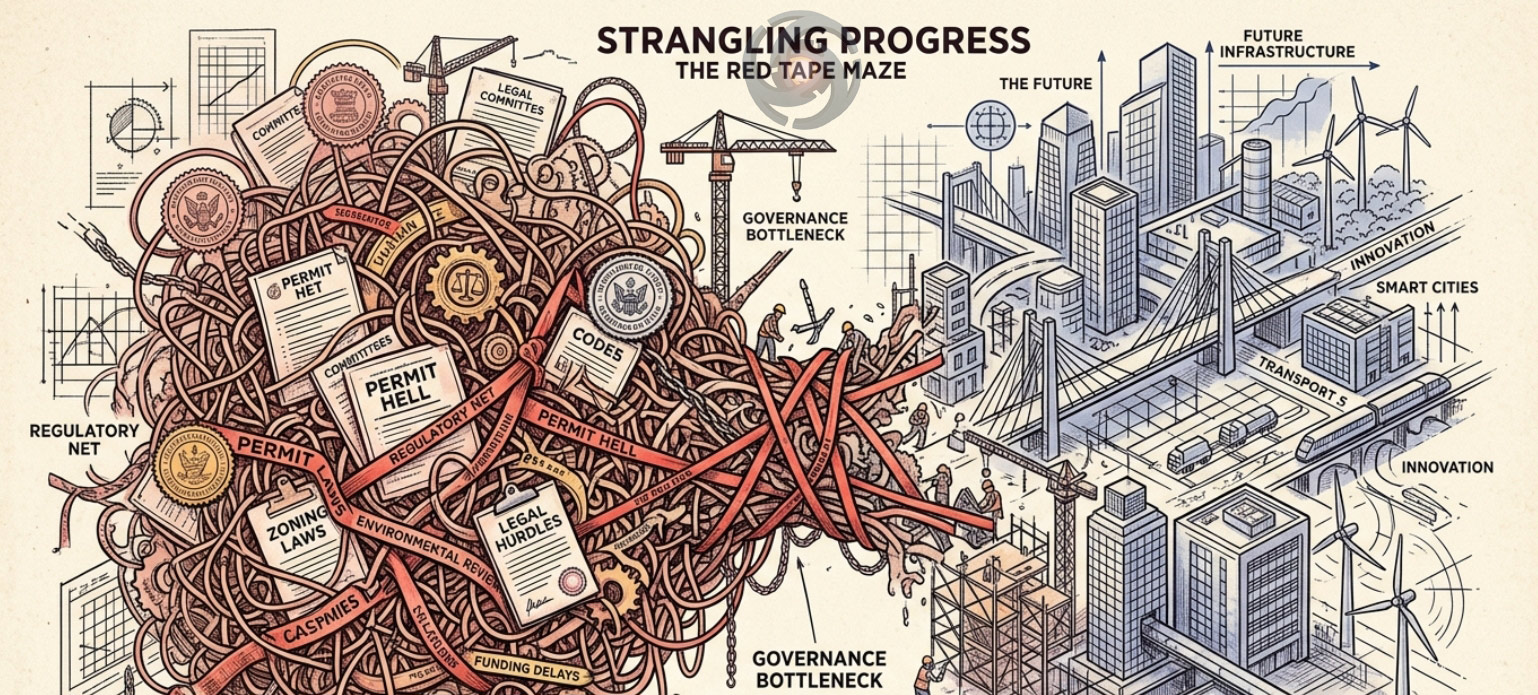
The primary bottleneck in deploying next-generation infrastructure proposed by the Kylos Arc and the CU is not technological viability, but the profound misalignment between novel technologies and linear, legacy regulatory frameworks. The assumption that technological readiness directly translates to implementation readiness ignores the reality of bureaucratic latency. Across multiple sectors, regulatory policy hurdles manifest as the primary governor of transition speed, dictating whether innovations scale or die in “pilot purgatory”.
1. The Misapplication of Legacy Frameworks to Novel Technologies
Regulatory agencies consistently attempt to govern fundamentally new architectures using rules designed for legacy systems. In the advanced nuclear sector, the U.S. Nuclear Regulatory Commission (NRC) defines “utilization facilities” in a way that applies the same strict, costly, and time-intensive requirements to microreactors—some generating less power than a lightbulb—as it does to massive commercial power plants. This has provoked legal action from developers arguing that the regulatory burden is unlawful and suffocates deployment.
Similarly, geothermal energy deployment on public lands managed by the Bureau of Land Management (BLM) has historically suffered from 7 to 10-year permitting timelines. These delays are driven by staffing shortages, redundant environmental reviews under the National Environmental Policy Act (NEPA), and varied restrictions across different state agencies overseeing water rights and health.
2. Jurisdictional Fragmentation and Inconsistency
Implementation scale is destroyed by fractured, heterogeneous global regulations. In the synthetic biology and biofuel sectors, the commercialization of genetically modified microorganisms faces severe international inconsistencies, pitting strict European Union regulations against more lax frameworks in the United States and India.
This fragmentation creates massive barriers to entry for smaller companies. In the precision fermentation market, the U.S. FDA’s Generally Recognized as Safe (GRAS) pathway allows for relatively rapid market entry, whereas the European Union’s Novel Food Regulation requires 18 to 36 months for a single ingredient approval. Such delays heavily drain capital and create regional monopolies where only heavily funded incumbents can afford the regulatory wait times. Furthermore, in the cement and concrete industry, inconsistent material standards globally mean that lower-carbon blended materials or waste-derived fuels can be safely co-processed in kilns in some countries, but are effectively banned or routed to landfills in others.
3. Siloed Governance and Perverse Economic Incentives
Implementation challenges are frequently self-inflicted through siloed government policies that fail to account for complex systems. The Water-Energy-Food-Environment (WEFE) nexus is routinely undermined by isolated sector-specific policies that create counterproductive economic incentives. For example, in an effort to boost national food security, the Iranian government implemented energy subsidies for irrigation alongside high tariffs on grain imports. While this boosted food production, it completely bypassed environmental regulatory checks, resulting in the proliferation of over 800,000 unlicensed wells and the catastrophic over-extraction of groundwater. Subsidies designed to fix a problem in one vertical often disrupt green water flows and cause ecological collapse in another because governance lacks a unified, cross-sectoral architecture.
4. The “Soft Law” Implementation Gap
When addressing global ecological shifts, there is a critical failure in translating international commitments into binding domestic law. Multilateral Environmental Agreements (MEAs), such as the Convention on Biological Diversity (CBD), rely heavily on “soft law” and lack legally binding enforcement mechanisms. The failure of the previous Aichi biodiversity targets was directly linked to the fact that national targets lacked legally binding force and effective domestic legal measures. To implement the newer Kunming-Montreal Global Biodiversity Framework effectively, nations must move beyond abstract policy documents and establish hard environmental codes with strict compliance, monitoring, and review mechanisms, otherwise accountability dissolves.
5. Trade Policy and the Carbon Leakage Threat
Unilateral regulatory attempts to force decarbonization introduce complex trade and implementation hurdles. The EU’s Carbon Border Adjustment Mechanism (CBAM) imposes financial obligations on high-carbon imports like steel and cement, creating competitive advantages for clean producers. However, implementing such border adjustments introduces massive technical complexities regarding how to accurately measure emissions from complex international supply chains. This poses severe risks of World Trade Organization (WTO) compliance conflicts, disproportionate economic impacts on developing nations, and retaliatory trade policies.
To successfully engineer an industrial and ecological transition, the modification of the regulatory substrate is just as critical as the modification of the physical infrastructure. If the legal and bureaucratic pathways are not actively reformed to handle rapid, iterative deployment, technological breakthroughs will remain stranded assets.