

Feasibility, Economic Architectures, and Multi-Decadal Global Implementation
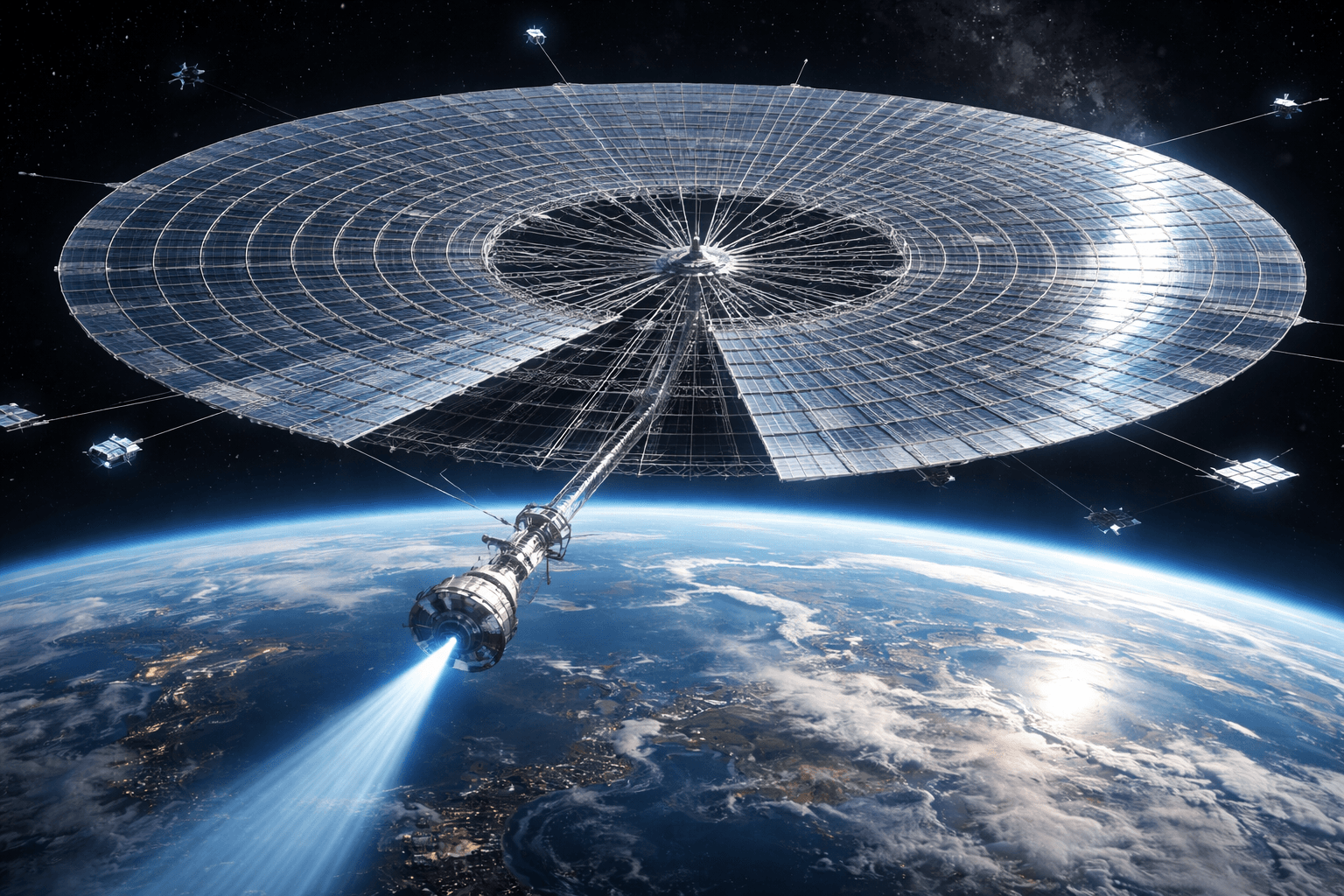
The global energy landscape is currently undergoing a structural rewiring as nations and private entities navigate the complexities of trade shocks, geopolitical uncertainty, and the urgent necessity of decarbonization.[1] Within this paradigm shift, space-based solar power (SBSP) has transitioned from a science-fiction trope into a strategic infrastructure priority for the world’s major space agencies and energy players.[1, 2] The fundamental premise of SBSP involves the in-orbit collection of solar radiation, its conversion into a wireless energy beam, and its transmission to terrestrial receiving stations for delivery to the electrical grid.[3, 4] This technology offers a unique solution to the intermittency inherent in terrestrial renewable energy, providing a clean, firm, and baseload alternative that operates regardless of atmospheric conditions, weather variability, or the diurnal cycle.[1, 5, 6]
Market Trajectory and Global Economic Landscape
The economic valuation of the SBSP market reflects a sector entering a scaling phase, characterized by increased government underwriting and the emergence of commercially viable service concepts.[5, 7, 8] As of 2024, the global market for space-based solar power was valued at approximately US$667.2 million and is projected to reach US$1 billion by 2030, exhibiting a compound annual growth rate (CAGR) of 7.7%.[1] More aggressive market forecasts suggest that the broader industry could reach US$3.1 billion by 2024 and expand to US$6.6 billion by 2034, driven by advancements in space infrastructure and the international race to achieve net-zero emissions.[5]
The United States currently holds the largest regional market share, valued at approximately US$175.4 million in 2024, followed closely by China, which is forecasted to reach US$167.9 million by 2030.[1] This regional dominance is supported by strong federal and private investments in satellite solar panel development and wireless energy transmission technologies.[8, 9] The European market, particularly led by Germany and the United Kingdom, is also seeing significant growth as nations evaluate SBSP as a pillar of their renewable energy strategies.[1, 5, 10]
Sectoral Segmentation and Technological Adoption
Market analysis identifies several key segments that are driving current development. The microwave transmitting solar satellite segment is expected to reach US$605.4 million by 2030, maintaining its position as the dominant transmission type due to its technical maturity and efficiency.[1, 9] Concurrently, the laser transmitting solar satellite segment is poised for a faster growth rate of 10.3% CAGR, appealing to niche applications that require higher power density and smaller ground station footprints.[1, 2]
| Market Indicator | 2024/2025 Valuation | 2030-2035 Projection | CAGR (%) |
|---|---|---|---|
| Global Market Size (Conservative) | $667.2 Million [1] | $1.0 Billion (2030) [1] | 7.7% [1] |
| Global Market Size (Aggressive) | $3.1 Billion [5] | $10.7 Billion (2035) [9] | 11.95% [9] |
| U.S. Market Share | $1.09 Billion (2025) [9] | $3.59 Billion (2035) [9] | 12.63% [9] |
| Asia-Pacific Market Share | $732 Million (2025) [9] | N/A | N/A |
| Microwave Transmission Share | 68.57% [9] | N/A | 11.56% [9] |
| Government & Defense Share | 54.83% [9] | N/A | N/A |
The dominant end-user for these technologies remains the government and defense sector, accounting for over 54% of the market share.[9] Military requirements for reliable energy in remote areas, forward operating bases, and disaster recovery scenarios provide a high-value application that justifies early-stage adoption despite currently high research and development costs.[2, 11] Commercial and private companies represent the fastest-growing end-user segment, with an expected CAGR of 12.28% through 2035 as utility-scale applications become more viable.[9]
Technical Feasibility and Reference Architectures
The technical feasibility of SBSP has moved beyond theoretical research due to successful laboratory and field experiments in wireless power transfer and orbital component durability.[1, 12, 13] Current engineering efforts focus on scaling these systems from watt-level demonstrators to gigawatt-scale utility plants.[12, 14] NASA, ESA, and JAXA have developed various reference designs (RD) to evaluate the logistical, structural, and economic parameters of these systems.[3, 15]
NASA Reference Designs: RD1 and RD2
In its 2024 assessment, NASA analyzed two primary architectures to provide a baseline for lifecycle cost and emission estimates.[3, 4] These designs are normalized to deliver 2 gigawatts (GW) of power to the terrestrial grid, making them comparable to the largest terrestrial solar farms currently in operation.[3]
- Representative Design One (RD1): The Innovative Heliostat Swarm utilizes a collection of autonomously redirecting reflectors that focus sunlight onto a central concentrator. This design achieves high utilization, generating power for approximately 99% of the year by maintaining its orientation toward the Sun throughout the orbit.[3, 15]
- Representative Design Two (RD2): The Mature Planar Array is a flat-panel architecture where solar cells face the Sun and microwave emitters face the Earth. Due to its limited repositioning capability, RD2 generates power for roughly 60% of the year.[3]
The mass and area requirements for these systems are substantial. RD1 requires a solar panel area of 11.5 km2 and a total mass of 5.9 million kilograms, while RD2 necessitates 19 km2 and a mass of 10 million kilograms.[3] For comparison, the solar array area of RD1 is more than 3,000 times larger than that of the International Space Station.[3]
The CASSIOPeiA Architecture
The UK-led CASSIOPeiA (Constant Aperture Solid-State Integrated Orbital Phased Array) represents a paradigm shift in SBSP design by eliminating moving parts and rotating joints.[15, 16, 17] This solid-state architecture uses a helical array that electronically steers the energy beam through 360 degrees while the satellite remains Sun-facing.[18, 19, 20]
| Parameter | CASSIOPeiA (2 GW) | NASA RD1 (2 GW) | NASA RD2 (2 GW) |
|---|---|---|---|
| Mass (Tonnes) | 2,000 [16] | 5,900 [3] | 10,000 [3] |
| Orbit | GEO [16] | GEO [3] | GEO [3] |
| Specific Power (kW/kg) | 0.8 – 1.0 [18, 21] | 0.34 [3] | 0.20 [3] |
| Solar Concentration | ×2 to ×500 [16] | Heliostat Swarm [15] | Planar [15] |
| Efficiency (Solar-to-Grid) | 16-22% [16, 22] | N/A | N/A |
The CASSIOPeiA design achieves a market-leading specific power of up to 1.0 kW per tonne, which is critical for reducing launch costs.[18, 21] Its modular nature allows for the manufacturing of millions of identical “tiles,” leveraging economies of scale that are not possible with traditional, custom-built monolithic satellites.[18, 20, 23]
Orbital Geometry and Mission Profiles
The selection of an operational orbit involves balancing the requirements for beam focus, power density, and continuous coverage. Geostationary Earth Orbit (GEO) remains the primary target for utility-scale systems because it allows a satellite to remain fixed over a single terrestrial rectenna.[1, 15, 24, 25] However, the 36,000 km distance causes the energy beam to spread significantly, necessitating receiving antennas that are several kilometers in diameter.[25, 26]
Highly Elliptical Orbits (HEO) and Molniya Dynamics
For high-latitude regions like the UK or Canada, GEO satellites appear low on the horizon, reducing transmission efficiency. Highly Elliptical Orbits (HEO), specifically Molniya orbits, offer a compelling alternative.[15, 27] These orbits feature long dwell times (approximately 11.5 hours per 12-hour orbit) over a specific hemisphere.[27] Companies like Virtus Solis propose constellations of two or more arrays in Molniya orbits to provide constant power to either the northern or southern hemisphere, utilizing ground storage to bridge the brief transitions between satellites.[15, 27]
Low Earth Orbit (LEO) and Laser Transmission
Laser-based systems typically operate in LEO (approx. 400 km) to maintain high power density and keep ground receiver sizes manageable – often less than 10 meters in diameter.[28, 29, 30] While LEO satellites have much shorter dwell times over a single location, a dense constellation can provide continuous global coverage.[29, 31] This approach is favored by startups like Aetherflux and Overview Energy for tactical military and disaster response applications.[28, 30]
Economic Analysis and Levelized Cost of Electricity
The financial viability of SBSP is fundamentally tethered to the cost of space transportation. Historically, launch costs of US$10,000 per kilogram rendered SBSP an economic impossibility.[14,26,30] However, the advent of fully reusable heavy-lift launch vehicles, such as the SpaceX Starship, is projected to drive costs toward US$10 per kilogram.[14, 32]
LCOE Projections and Competitive Benchmarking
Levelized Cost of Electricity (LCOE) estimates for SBSP have shifted from being an order of magnitude higher than terrestrial renewables to being potentially competitive with current grid prices by 2040.[5, 22]
| Implementation Phase | Estimated LCOE (£/MWh) | Estimated LCOE ($/MWh) | System Delivery (GWh/year) |
|---|---|---|---|
| FOAK (2030) | £335 – £595 [22] | $450 – $800 | 585 [22] |
| Early Scaling (2035) | £154 – £249 [22] | $200 – $330 | 790 [22] |
| Mature NOAK (2040) | £87 – £129 [22] | $110 – $170 | 980 [22] |
| Virtus Solis (Target) | N/A | $25 – $30 [15, 27] | Grid Competitive |
Virtus Solis claims that its Lucidus hyper-modular architecture can achieve an LCOE of US$25/MWh, outperforming firmed ground-based solar, which currently averages US$150/MWh when storage is included.[15, 27, 32] For utility-scale 2 GW systems, NASA’s more conservative modeling suggests costs between 61 cents and US$1.59 per kilowatt-hour for first-of-a-kind systems, highlighting a significant “learning curve” requirement to achieve grid parity.[14]
Sensitivity to Launch and Finance Parameters
Economic sensitivity analysis indicates that launch costs account for over 50% of the variance in LCOE for mature systems.[22] Furthermore, because SBSP represents a capital-intensive infrastructure project with a long operational life (typically 20-30 years, but potentially up to 80 years with maintenance), the hurdle rate and cost of financing are critical.[15, 27, 32] Small-scale “Minimum Viable Product” (MVP) implementations in the 2030s are considered essential for de-risking the pathway to larger systems, potentially reducing the hurdle rate for subsequent 2 GW projects by 16% to 27%.[22]
Technical and Operational Challenges
Transitioning SBSP from conceptual designs to operational infrastructure requires overcoming several unprecedented engineering hurdles, primarily in structural assembly, thermal management, and long-range energy delivery.
In-Orbit Assembly and Robotics
The sheer scale of SBSP arrays – stretching kilometers in length – precludes launching them as completed structures. Instead, modular “satlets” or components must be launched and assembled in orbit.[3, 33, 34] This requires advanced space robotics capable of autonomous rendezvous, docking, and structural truss construction.[35, 36] The “E-Walker” (End-Over-End Walking Manipulator) is a key technology under development to facilitate the assembly and maintenance of these large apertures without requiring risky and expensive extravehicular activities by human astronauts.[33, 36]
Thermal Dissipation in Vacuum
A critical paradox of SBSP is that the system is designed to absorb massive amounts of solar radiation, yet it must also reject the waste heat generated during the DC-to-RF conversion process.[26, 37] In a vacuum, heat can only be dissipated through radiation.[38] Traditional spacecraft thermal control systems, such as radiative vanes, may interfere with the solar panels or power transmitters.[26] For a 1 GW system, conversion losses can result in hundreds of megawatts of waste heat, necessitating innovative radiator geometries and variable emissivity materials (VEM) to manage extreme temperature swings.[38, 39, 40]
Atmospheric Interaction and Beam Scattering
Wireless power transmission must pass through the Earth’s atmosphere with minimal attenuation. For microwave systems, the 2.45 GHz and 5.8 GHz bands are preferred because they occupy the “radio window,” where atmospheric absorption is minimal.[37, 41, 42] However, frequencies above 6 GHz are subject to increased attenuation during heavy rain or overcast conditions.[41, 42] Conversely, laser-based systems using near-infrared light have very high power density but suffer from significant scattering by clouds and precipitation, limiting their reliability for baseload terrestrial power.[25, 29]
The maximum beam intensity is typically limited to 230-245 W/m2 at the center of the rectenna – approximately one-quarter of the intensity of midday sunlight (1,000 W/m2).[15, 37, 42] This intensity ensures that humans or wildlife accidentally entering the beam would not be subjected to immediate thermal harm, as the heating effect is estimated to be as low as 0.006°C.[42]
Regulatory and Spectrum Considerations
The broadcast frequency of the microwave downlink requires strict coordination with the International Telecommunication Union (ITU) to prevent interference with existing communications, aviation, and science services.[26, 43]
Spectrum Allocation and ITU WRC Updates
Space-based wireless power transmission (WPT) currently has no formal status in the Radio Regulations, meaning it must operate on a non-interference basis.[41, 44] The ITU-R is actively studying WPT under Question 210/1, with the goal of identifying dedicated frequency bands that balance antenna efficiency with spectrum protection.[41, 44]
| Band / Application | Considerations | Relevant ITU/Standards |
|---|---|---|
| 2.45 GHz (ISM) | High technical maturity; shared with Wi-Fi/Bluetooth.[41] | RR No. 5.150.[44] |
| 5.8 GHz (ISM) | Smaller antenna sizes; interference with toll systems.[41] | RR No. 5.138.[44] |
| 10 GHz | High efficiency; increased rain attenuation.[41, 42] | N/A |
| 19-21 kHz / 79-90 kHz | Non-beam WPT for electric vehicles (EV).[45] | Rec. ITU-R SM.2110-2.[45] |
The 2023 World Radiocommunication Conference (WRC-23) established foundational studies for lunar and cislunar communications, which will directly impact the regulation of power-beaming satellites in the Earth-Moon system.[43, 46] WRC-27 is expected to further define technical and regulatory measures for fixed-satellite services in the 37.5-51.4 GHz range, which may eventually support higher-frequency power links.[47, 48]
Space Traffic Management and Debris
The deployment of kilometer-scale structures in GEO or Molniya orbits introduces significant collision risks.[26, 49] A global Space Traffic Management (STM) framework is required to coordinate the maneuvering of these massive arrays and to mitigate the proliferation of orbital debris (Kessler Syndrome).[49, 50] Standards for on-orbit servicing, rendezvous, and disposal at end-of-life (e.g., transfer to graveyard orbits) are being developed to ensure the long-term sustainability of the space environment.[3, 51, 52]
National and International Roadmaps
The race for SBSP leadership is split between state-led strategic programs and private-sector modular initiatives.
China’s “Zhu Hai” Ambition
The China Academy of Space Technology (CAST) is executing a four-stage roadmap aimed at building a 2 GW commercially operated power plant by 2050.[53, 54] Unlike the fragmented private-sector efforts in the West, China utilizes a centralized, state-funded approach, with its Bishan testing facility in Chongqing focusing on long-distance microwave beaming.[26, 54]
- 2028: Launch of a 10 kW test satellite in LEO to trial microwave transmission.[53, 54]
- 2030: Assembly of a 1 MW station in GEO.[9, 54]
- 2035: Expansion to a 10 MW system for military and civilian applications.[53, 54]
The European Solaris Program
ESA’s Solaris program is currently in a multi-year feasibility phase, with a final decision on a full development program expected in 2025.[24, 55, 56] The European vision emphasizes “modular, scalable” clean energy that could supply up to one-third of Europe’s current power demand by 2050.[55] Collaborative efforts between Thales Alenia Space, Dassault Aviation, and energy giants like Engie and Enel highlight the project’s industrial depth.[24]
United States: AFRL SSPIDR and Caltech Success
In the United States, the Air Force Research Laboratory (AFRL) is pursuing the SSPIDR project to develop logistically agile power for forward operating bases.[40, 57] The Arachne flight experiment, scheduled for 2025, will test the “sandwich tile” technology, which integrates photovoltaics and RF transmission into a single component.[11, 57]
Furthermore, the Caltech Space Solar Power Project (SSPP) concluded its year-long SSPD-1 orbital mission in January 2024 with three successful experiments:
- DOLCE: A lightweight, deployable composite structure.[13, 58]
- Alba: Testing of next-generation, space-hardened solar cells.[13, 59]
- MAPLE: The first-ever demonstration of wireless power beaming from orbit to Earth.[13, 23]
The Cislunar Bridge and Lunar Resource Utilization
The feasibility of SBSP on Earth may be significantly enhanced by the development of lunar infrastructure. Launching materials from the Earth’s deep gravity well remains the largest cost driver; however, manufacturing solar arrays using lunar regolith could revolutionize the economics of the space economy.[4, 60, 61]
Lunar Regolith Manufacturing (ISRU)
Recent studies have proposed the fabrication of halide perovskite photovoltaics on regolith-based “moonglass”.[60] This in-situ resource utilization (ISRU) could save 99% of the material transport weight from Earth.[60] These lunar-produced cells exhibit high radiation tolerance and a specific power of 22-50 W/g, which is 20 to 100 times higher than traditional space PV solutions.[60]
Orbital Computing and “Galactic Brain”
As the demand for artificial intelligence compute grows, the energy required for terrestrial data centers is becoming a critical bottleneck.[28, 29] Startups like Aetherflux are proposing the “Galactic Brain” – a constellation of orbital data center satellites powered by SBSP.[28, 29] By bypassing terrestrial infrastructure, these orbital nodes can access continuous solar energy and reject heat more effectively than land-based centers constrained by local grids.[29, 31] The first commercial data center node for this purpose is targeted for the first quarter of 2027.[28]
Environmental and Geopolitical Considerations
SBSP is often portrayed as “Actual Zero” carbon intensity because it produces zero operational emissions and avoids the land-use impacts of terrestrial farms.[15, 42, 53] However, a full lifecycle analysis (LCA) must account for the greenhouse gas emissions of the rocket launches required to build these systems.[3, 4]
Comparative Lifecycle Footprint
NASA’s findings suggest that SBSP lifecycle GHG emissions per unit of electricity could be comparable to terrestrial renewables once mature, though the “front-loaded” emissions of thousands of launches are still being evaluated for their impact on the upper atmosphere.[3, 4]
| Energy Source | Lifecycle GHG (gCO2/kWh) | Reliability / Dispatchability |
|---|---|---|
| Onshore Wind | 34.11 [62] | Low (Intermittent) [22] |
| Terrestrial Solar PV | 49.91 [62] | Low (Intermittent) [22] |
| Space-Based Solar | Comparable to PV [4, 20] | High (Baseload) [6, 22] |
| Nuclear Fission | 5.0 (Lowest) [53] | High (Baseload) [2] |
Security, Dual-Use, and Weaponization
The core technology of SBSP – directed high-power energy – raises significant security concerns. Throughout the 1980s, SBSP technology was recognized for its potential as a directed-energy weapon for missile defense.[26] While modern civilian designs prioritize low power density to ensure “intrinsic safety,” the infrastructure remains a potential target for anti-satellite (ASAT) weapons or cyber-hijacking.[15, 63] Governance regimes must be established to ensure that SBSP platforms are used strictly for peaceful purposes, involving international inspection of “beam-steering” software and hardware limits.[15, 64, 65]
Synthesis and Strategic Outlook
The convergence of rapidly declining launch costs, breakthroughs in modular robotics, and the global imperative for energy security has positioned space-based solar power as a viable, albeit challenging, utility-scale solution for 2040 and beyond. While initial implementations will likely favor high-value military and remote applications, the roadmap to terrestrial grid integration is becoming increasingly well-defined through national initiatives like Solaris and CAST’s GEO programs.
The transition from science-fiction to strategic infrastructure depends on three critical pillars:
- The maturation of fully reusable heavy-lift launch systems to bring transport costs below US$500/kg.[14, 32]
- The development of standardized robotic assembly interfaces to enable the construction of kilometer-scale apertures in orbit.[33, 34]
- International regulatory consensus on spectrum management and space traffic to ensure the safe and equitable use of Earth’s orbital shells.[43, 49]
As the world seeks to double its peak electricity demand by 2050, space-based solar power offers a unique pathway to energy abundance – harnessing the unfiltered radiation of the Sun to provide a constant, carbon-free heartbeat for the global economy.[6, 22] The success of early demonstrators like Caltech’s SSPD-1 and the upcoming AFRL Arachne mission suggests that the technological foundation is ready; the remaining barriers are primarily financial and logistical, requiring a sustained multi-decadal commitment from both public and private sectors.

Latest News and Talk about Space Based Solar Energy
BRIEF
Space-based solar power (SBSP) represents a transformative approach to energy generation, harnessing solar energy from geostationary orbit and transmitting it to Earth. This technology utilizes photovoltaic cells to convert solar power into electricity, which can then be beamed down as microwaves or laser beams. According to a recent report by Stratview Research, the SBSP market is an emerging segment within the clean energy and aerospace industries, indicating a growing interest in this innovative energy solution. The potential for continuous energy generation, unaffected by terrestrial weather conditions, positions SBSP as a compelling alternative to traditional solar installations.
Recent developments highlight significant governmental support for SBSP initiatives. The U.S. Department of Energy (DOE) has launched a $12 million R&D fund aimed at advancing technologies for solar panels designed for space applications. This funding, announced in September 2026, underscores the federal commitment to exploring SBSP as a viable energy source (PV Tech). Additionally, the Space Energy Initiative has proposed a whitepaper advocating for government co-funding of an orbital demonstrator, further emphasizing the collaborative efforts needed to bring SBSP to fruition (Sustainable Business Magazine).
Technological advancements are critical to the success of SBSP, particularly in the development of rectenna systems. These systems are essential for efficiently converting microwave energy back into electricity upon reaching Earth. Recent research has focused on enhancing coupling efficiency in geometric terahertz rectennas, which could significantly improve the viability of energy transmission from space (Springer Nature Link). As the technology matures, the integration of advanced materials and designs will likely play a crucial role in overcoming existing challenges associated with energy capture and transmission.
Despite the promise of SBSP, challenges remain regarding its economic feasibility and infrastructure requirements. A recent analysis suggests that while the technology is advancing, it may not yet be ready for large-scale investment, as highlighted by Helio Corporation's recent roadshow to attract investors (Ainvest). The commercial case for SBSP continues to evolve, with ongoing discussions about the necessary infrastructure to support its deployment and integration into existing energy systems (Environment+Energy Leader).
In summary, the development of space-based solar power is characterized by a combination of technological innovation, government support, and ongoing challenges related to infrastructure and investment. As research and development efforts continue, the potential for SBSP to provide a reliable and sustainable energy source could reshape the future of energy generation on Earth. The collaboration between government entities and private companies will be vital in addressing the hurdles that remain.
KEY PATTERNS from the research:
1. The U.S. government is actively investing in SBSP through targeted funding initiatives.
2. Technological advancements in rectenna systems are crucial for efficient energy transmission from space.
3. There is a growing interest in SBSP as a viable energy source, despite current economic challenges.
4. Collaborative efforts between government and private sectors are essential for the successful deployment of SBSP.
5. Continuous energy generation from space presents a significant advantage over terrestrial solar installations.
6. The SBSP market is emerging as a distinct segment within the clean energy sector, indicating a shift in energy strategies.
7. Infrastructure development remains a critical barrier to the commercialization of SBSP technology.
8. Investor interest is cautious, reflecting the need for further technological validation and economic justification.
Freshness
- 4 of 25 dated items are from the last 7 days.
Hiring Signals
- Mode: explicit; company-size tier: startup
- Interpret these as focus or priority signals, not exact roadmap predictions.
- general hiring: hiring activity is visible, but the priority signal is diffuse (confidence: low; evidence: 1 roles)
- Space Industry Jobs | Space-Careers (2026-09-07)
Ranked Evidence Clusters
Space-Based Solar Power Market | Size, Share, Trend, Industry Analysis | 2025-2032
Source: Web | Date: 2026-09-05
Score: 42
US DOE launches US$12 million R&D fund for space-based solar power
Source: Web | Date: 2026-09-02
Score: 40
Space Based Solar Power Market Size, Share Report, 2034
Source: Web | Date: 2026-08-24
Score: 35
Space-based solar power | Definition, History, Advantages, & Facts | Britannica
Source: Web | Date: 2026-08-23
Score: 34
Space-Based Power: Will It Happen? - The National Interest
Source: Web | Date: 2026-08-18
Score: 31
DOE's $12 Million SBSP Bet: What the Fund Proves — and What It Doesn't
Source: Web | Date: 2026-09-03
Score: 28
Stats
- Total evidence: 25 items across 5 sources
- Top voices: toddmaustin/forge-gpu-economics, Hacker News, SirTangent/SBSPSS-Supercharged, northguild/gmt, Keinsleif/sbsp
- GitHub: 11 items | 4 comments | voices: toddmaustin/forge-gpu-economics, SirTangent/SBSPSS-Supercharged, northguild/gmt
- Web: 8 items | domains: www.stratviewresearch.com, www.pv-tech.org, www.fortunebusinessinsights.com
- Hacker News: 3 items | 53 points, 7 comments | domains: Hacker News
- Jobs: 1 item | voices: web
- Reddit: 2 items | communities: r/technews, r/OffGrid
Web Research
Space-Based Solar Power Prototypes: Microwave Power Beaming Trials and Orbital Collector Efficiency Challenges | Streamline
Streamline Author: Streamline Feed Official Published: 2026-09-14T12:13:14+00:00 Source: streamlinefeed.co.ke (streamlinefeed.co.ke) Language: en Story Space-Based Solar Power Prototypes: Microwave Power Beaming Trials and Orbital Collector Efficiency Challenges An investigat ...
Source: streamlinefeed.co.ke | Date: 2026-09-14
Solar power from space
Solar power from space Space Energy and environment Monday, 07. September 2026 13:58 Author Simon Koechlin Space-based solar power stations could generate electricity almost round the clock and transmit it to Earth via microwaves. The individual technologies are well developed ...
Source: satw.ch | Date: 2026-09-07
Enhanced coupling efficiency in geometric terahertz rectennas based on scalable CVD graphene | Discover Electronics | Springer Nature Link
Electronics | Springer Nature Link Your privacy, your choice We use essential cookies to make sure the site can function. We also use optional cookies for advertising, personalisation of content, usage analysis, and social media, as well as to allow video information to be ...
Source: link.springer.com | Date: 2026-09-13
Space Solar Backs UK Orbital Demonstrator Call - Sustainable Business Magazine
Space Solar Backs UK Orbital Demonstrator Call The Space Energy Initiative has published a whitepaper calling for government co-funding of a first orbital demonstrator for space-based solar power, with Space Solar backing the proposal through its CASSIOPeiA satellite ...
Source: sustainablebusinessmagazine.net | Date: 2026-09-02
Can Space-Based Solar Power Become a Competitive Source of Firm Clean Energy? | New Space Economy
Space Economy Can Space-Based Solar Power Become a Competitive Source of Firm Clean Energy? Table Of Contents 1. Key Takeaways 2. Why Space-Based Solar Power Is Back in the Energy Debate 3. What an Orbital Power System Would Actually Do 4. Which Technologies Have Been ...
Source: newspaceeconomy.ca | Date: 2026-08-19
Space-Based Power: Will It Happen? - The National Interest
Space-Based Power: Will It Happen? August 18, 2026 By: Peter Garretson, and Michael Brown This debate examines whether space-based power is on the verge of becoming a viable industry or whether it remains a technically and economically implausible idea. Space-based power is ...
Source: nationalinterest.org | Date: 2026-08-18
Space-Based Solar Power Is Not Ready for Investors. Helio's Roadshow Reminds Us Why.
Published: 2026-09-08T09:01:19-04:00 Source: ainvest.com (ainvest.com) Language: en Story Helio Corporation, a tiny aerospace hardware maker based in Berkeley, California, announced on Tuesday a four-city investor roadshow across Austin, Houston, Phoenix, and Scottsdale. CEO Ed ...
Source: ainvest.com | Date: 2026-09-08
Space-Based Solar Power Faces Its Infrastructure Test - Environment+Energy Leader
Space-Based Solar Power Faces Its Infrastructure Test Photo Credit: Space Energy Initiative Posted Wednesday, August 19, 2026 2:00 pm By Environment+Energy Leader | Infrastructure + Energy Systems A new whitepaper makes the commercial case for orbital solar power, but a run of ...
Source: environmentenergyleader.com | Date: 2026-08-19
Have scientists found the secret to eternal power?
The sun contains 99.86 per cent of the mass of the entire solar system. Credit: NASA GSFC Solar Dynamics Observatory Have scientists found the secret to eternal power? Engineers have for decades dreamed of harvesting the constant power of the sun. Now, plans to build solar ...
Source: prospectmagazine.co.uk | Date: 2026-08-22
✅ All agents reported back! ├─ 🟠 Reddit: 2 threads ├─ 🟡 HN: 3 stories │ 53 points │ 7 comments ├─ 🐙 GitHub: 11 items │ 4 comments ├─ 💼 Jobs: 1 role ├─ 🌐 Web: 8 pages - stratviewresearch.com, pv-tech.org, fortunebusinessinsights.com, britannica.com, nationalinterest.org, spacesolar.news, link.springer.com, colorcove.org └─ 🗣️ Top voices: r/technews, r/OffGrid
Space-Based Solar Power (SBSP) Research Summary
Research Date: July 14, 2026
1. Overview: From Thought Experiment to Global Roadmap
Space-Based Solar Power (SBSP) captures solar energy in orbit and beams it wirelessly to Earth via microwaves or lasers. After 60 years as a theoretical concept, 2026 marks a genuine inflection point. The physics are straightforward: a panel in geostationary orbit receives sunlight 99% of the year with ~40% more solar flux than ground panels, achieving capacity factors >95% versus 20-25% on Earth. The remaining engineering problem is efficient, safe, kilometer-scale wireless power transmission from orbit.
The catalyst is not a single breakthrough but a systematic cost structure shift: SpaceX Starship is driving launch costs toward $200/kg (down from $20,000/kg a decade ago), photovoltaic mass-per-watt is collapsing, GaN amplifier efficiency is rising, and grid prices for clean firm power are climbing. As one ESA SOLARIS program director put it: “For the first time in the history of this field, every line in the cost model points the right direction at the same time.”
Sources: New Space Economy, Internet Pros
2. Active Global Programs
| Program | Country | Architecture | Key Milestone |
|---|---|---|---|
| Caltech SSPD-1 (MAPLE) | USA | Microwave WPT, flexible phased arrays | First-ever wireless power transmitted from orbit to Earth (June 2023); beam steering validated through 2025 |
| JAXA OHISAMA | Japan | 5.8 GHz microwave, LEO testbed | 1 kW-class orbital-to-ground microwave transmission demonstrated at Yokohama receiving site |
| ESA SOLARIS | Europe | Microwave + Laser | Multi-hundred-million-euro preparatory phase; in-orbit demonstrator planned for late 2020s |
| China Zhuri / Bishan | China | Microwave WPT, distributed Omega architecture | 20.8% DC-to-DC efficiency over 100m; 1,180W output; 143W stable power to drone at 30 km/h (May 2026) |
| HARRIER (Space Solar UK) | UK | 360° omni-directional beaming | World’s first omni-directional beam-steering test completed |
| Northrop Grumman SSPIDR / AFRL Arachne | USA (DoD) | Sandwich tile modules (PV + RF + antenna) | Power beaming for forward operating bases |
| Aetherflux | USA (private) | LEO satellite constellation | Initial funding secured |
| Virtus Solis | USA (private) | Modular space solar | Prototype design phase |
Sources: POC.HK, China Daily
3. Economics and Market
| Metric | Value |
|---|---|
| Market Size (2025) | USD 3.46 billion |
| Projected Market Size (2035) | USD 10.70 billion |
| CAGR (2026-2035) | 11.95% |
| Launch Cost Trend | ~$20,000/kg (Shuttle era) → ~$3,000/kg (2024) → target <$200/kg (Starship) |
| Rectenna Cost | $200-500 per kW of received power |
| Microwave Transmission Share | 77.85% of 2025 revenue |
| Laser Transmission CAGR | 18.18% (fastest growing segment) |
| North America Share | 49.10% of 2025 revenue |
| U.S. Market (2025) | USD 1.09 billion |
A gigawatt-class station would require 50-100 Starship launches at ~$100/kg, costing ~$500 million in transport alone – a manageable fraction of total capital expenditure for a major power plant. However, deploying enough stations to offset meaningful terrestrial carbon emissions would require thousands of launches annually.
Sources: SNS Insider, Mordor Intelligence, GM Insights
4. Technology Stack and Engineering Challenges
Wireless Power Transmission (WPT)
- Microwave (2.45/5.8 GHz): High atmospheric efficiency, all-weather reliability, 90%+ rectenna efficiency with metamaterials. Requires kilometer-scale ground rectennas (usable for agriculture/grazing underneath).
- Laser: Narrower beams, smaller ground arrays, but blocked by clouds. DARPA demonstrated 8 km laser downlink with 20% wall-plug efficiency.
Key Engineering Hurdles
- Thermal Management: Gigawatt systems generate hundreds of MW waste heat; must radiate via large infrared radiators in vacuum
- In-Space Assembly: Stations too large for single launch; require modular autonomous assembly or in-space manufacturing
- Component Degradation: PV cells degrade from radiation/micrometeoroids; GEO stations are effectively inaccessible for repair
- Beam Safety: Pilot signal systems instantly defocus beam if aircraft detected; microwave intensity at rectenna center ≈ noon sunlight
NASA’s Assessment
A January 2024 NASA OTPS study concluded SBSP could support civilian and military energy independence, with operating systems viable in the 2050 timeframe. The study assessed conditions under which SBSP becomes competitive versus terrestrial alternatives.
Sources: NASA OTPS Report, New Space Economy
5. Strategic and Geopolitical Dimensions
- Defense Interest: Pentagon’s 2023 Space Power Strategy hints at SBSP for forward-operating bases; Northrop Grumman SSPIDR/Arachne is the DoD track
- China’s Timeline: Most aggressive – Zhuri project treated as strategic energy program, not science experiment; targets kilowatt-level LEO test by 2028, megawatt station by 2030, gigawatt GEO facility by 2050
- Japan’s Vision: 1 GW-class solar power satellites in GEO, each powering hundreds of thousands of homes
- UK Space Energy Initiative: Aims for operational pilot plant by 2030
- ESA SOLARIS: Europe’s policy commitment that SBSP becomes a candidate for the 2030s energy mix
6. Verified Claims
| Claim | Verification | Source |
|---|---|---|
| Caltech MAPLE demonstrated first orbital wireless power transmission | Confirmed “demonstrated its ability to transmit power wirelessly in space and to direct a beam to Earth (a first in the field)” | Caltech News |
| China Zhuri achieved 20.8% efficiency at 100m | Confirmed “wireless power transmission efficiency of 20.8 percent from direct current to direct current over a distance of 100 meters” at 1,180W | China Daily/Xinhua |
| SBSP market $3.46B in 2025, growing at ~12% CAGR | Confirmed across multiple market research reports | SNS Insider |
Bottom Line
SBSP is transitioning from laboratory demonstrations to pre-commercial engineering validation. The gap between Caltech’s milliwatt-scale proof-of-concept and gigawatt-scale operational delivery remains the defining feasibility boundary. Launch cost collapse is necessary but not sufficient in-space assembly, thermal management, and regulatory frameworks must also mature. Most realistic timelines place initial pilot plants in the 2030s, with commercial-scale deployment in the 2040s-2050s.
Space Based Solar Designs
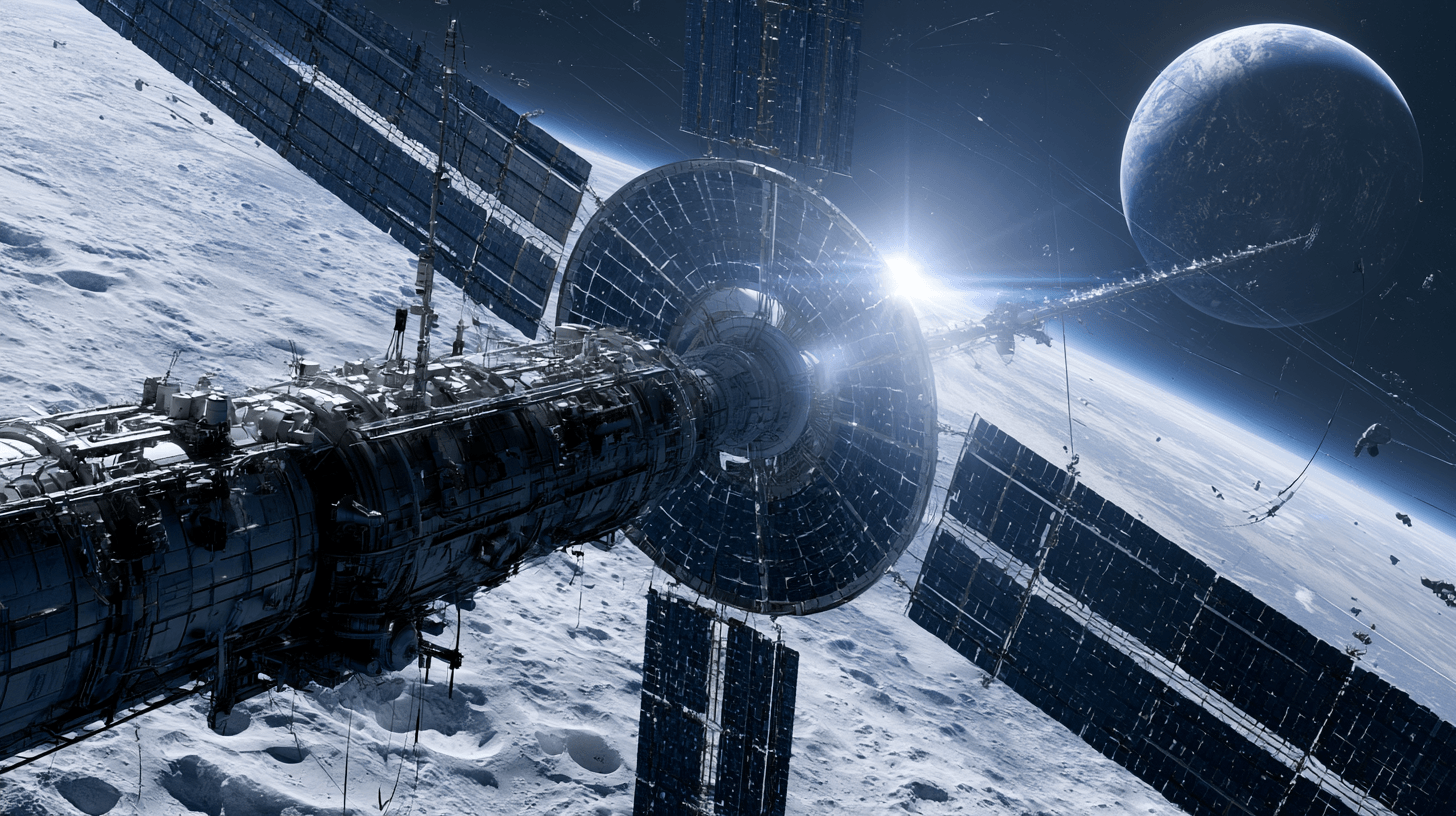
Space Based Solar Arrays
Slide subtitle text
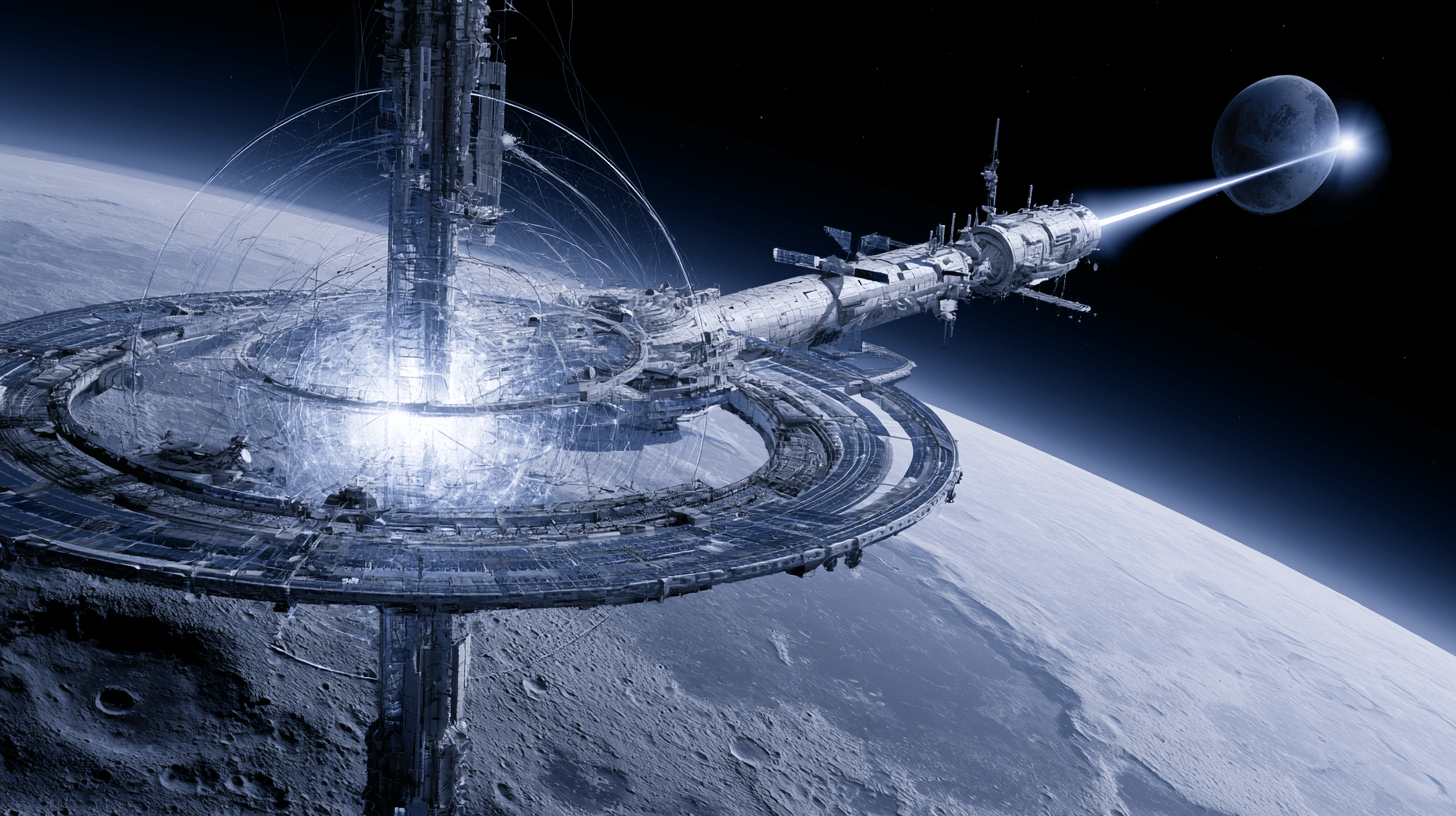
Solar Power Beamed to the Moon

Rectenna Space Based Solar Receiving Station
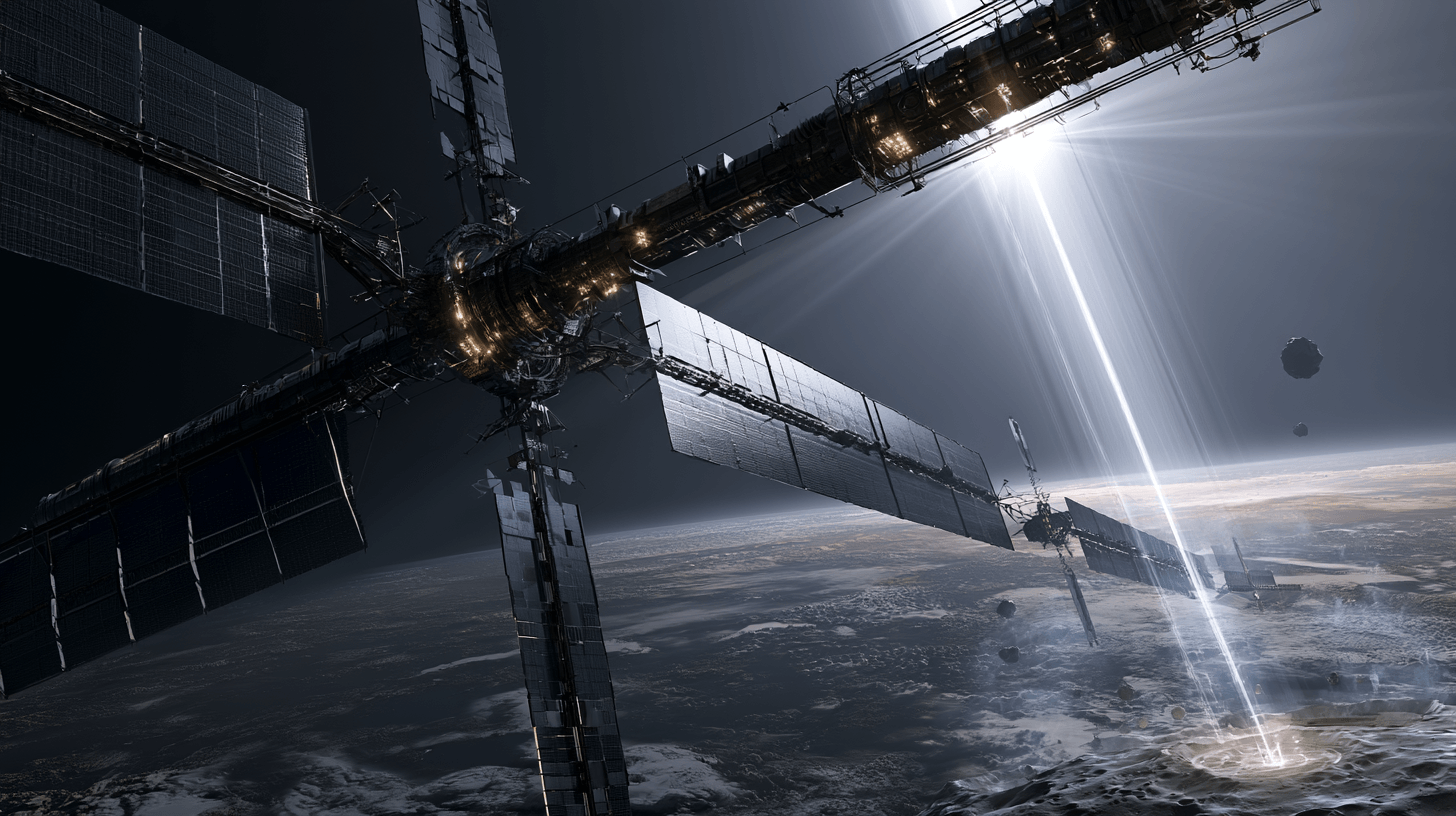
Space Based Solar Energy Array

Terrestrial Rectenna Farm
Sources
- Space-based Solar Power Market Market Size & Competitors
- Space Based Solar Power Market Size, Industry Share | Forecast, 2026-2034
- Space-Based Solar Power – NASA
- Space Based Solar Power Study – NASA Technical Reports Server (NTRS)
- Space-Based Solar Power Market Size, Share & Trends – 2034 – Global Market Insights
- Virtus Solis Space Based Solar and Power Beaming White Paper 2023
- Space for Sustainable, Connected and Liveable Cities – ESA Space Solutions
- Space-Based Solar Power Market | Global Market Analysis Report – 2035
- Space-Based Solar Power Market Size & Share Report, 2035 – SNS Insider
- Space-Based Solar Power Moves Closer to Commercial Reality, UK Report Suggests
- ARACHNE – Air Force Research Laboratory
- JAXA Activities for SSPS Research – Space Dream 2030
- Space Solar Power Project Ends First In-Space Mission with Successes and Lessons – Caltech
- Space-Based Solar Power Market Size & Share Analysis 2031 – Mordor Intelligence
- Survey of Space Based Solar Power (SBSP)
- (PDF) CASSIOPEIA SPS Space Based Solar Power for Net Zero – ResearchGate
- CASSIOPeiA Solar Power Satellite Antenna Array – Final Breadboard Results – ResearchGate
- Our Technology – Space Solar
- Space Solar Takes Major Step Forward with its CASSIOPeiA Concept
- Space Solar Study Advances Commercial Space-Based Solar Power
- CASSIOPeiA SPS – Advantages for Commercial Power
- Feasibility of Small-Scale Space Based Solar Power … – GOV.UK
- Space Solar Power Project
- ESA chooses Thales Alenia Space for SOLARIS feasibility study
- Space-Based Solar Power | Department of Energy
- Space-based solar power – Wikipedia
- Virtus Solis | Space Frontier Found
- Aetherflux – Wikipedia
- Space Solar Power
- This startup raised millions to beam solar power from space after dark – New Atlas
- Aetherflux – Factories in Space
- (PDF) Survey of Space Based Solar Power (SBSP) – ResearchGate
- In-orbit assembly of high-value modular infrastructures: Holistic analysis and mission concepts – University of Manchester
- ON-ORBIT ASSEMBLY OF SPACE ASSETS: A PATH TO AFFORDABLE AND ADAPTABLE SPACE INFRASTRUCTURE – The Aerospace Corporation
- Editorial: Robotic In-Situ Servicing, Assembly and Manufacturing – PMC
- Review of On-Orbit Assembly Technology with Space Robots – MDPI
- CASSIOPeiA Solar Power Satellite – Space Energy Initiative
- Making long-distance space travel efficient: Maximizing radiative cooling in a vacuum environment – ResearchGate
- (PDF) Review of advanced radiator technologies for spacecraft power systems and space thermal control – ResearchGate
- SPACE POWER BEAMING – Air Force Research Laboratory
- Frequency allocations of solar power satellite and international activities – IEEE Xplore
- FAQs – Space Solar
- Press release – ITU
- Frequency ranges for operation of non-beam wireless power transmission systems – ITU
- Recommendation ITU-R SM.2110-2 (09/2025) – Guidance on frequency ranges for operation of non-beam wireless power transmission
- Draft Proposal for a WRC-27 Agenda Item Spectrum allocations and associated regulatory provisions to support lunar and cislunar – FCC
- Agenda for WRC-27 – CEPT.org
- WRC 2027 Agenda Items for WP 3M – Introduction to Transfinite Systems
- The Time for International Space Traffic Management Is Now | RAND
- Space Policy Directive-3, National Space Traffic Management Policy – The White House
- Space Traffic Management (STM): Balancing Safety, Innovation, and Growth – AIAA
- SPACE TRAFFIC MANAGEMENT: THE CHALLENGE OF LARGE CONSTELLATIONS, ORBITAL DEBRIS, AND THE RAPID CHANGES IN SPACE OPERATIONS – The Aerospace Corporation
- China is Beaming into the Space-Based Solar Power – CEOInsightsAsia
- China’s solar space station: A game-changer in renewable energy
- Solaris (solar power) – Wikipedia
- Europe to absorb the Sun from space – First it will be covered and “darkened” – Ecoportal
- ARACHNE – Air Force Research Laboratory
- Deployable on-Orbit ultra-Light Composite Experiment (DOLCE) on the Caltech Space Solar Power Demonstration 1 (SSPD-1) Mission
- Space-Based Solar Project Completes its Mission
- Integration of space based solar power into a scaling lunar ISRU based infrastructure and economy – ResearchGate
- Published at Acta Astronautica – Feasibility study and prospects analysis of lunar regolith forming based on concentrated solar energy – SolarPACES
- Lifecycle greenhouse gas emissions from solar and wind energy: A critical meta-survey
- U.S.-China Militarization and the Risks to Global Strategic Stability – Project MUSE
- How Select Countries Approach Dual-Use Space Systems – RAND
- Targeting Dual-Use Satellites: Lessons Learned from Terrestrial Warfare – Air University
- New Space Economy | Feasibility, Economics, and Engineering in 2025
- Internet Pros | Space-Based Solar Power 2026
- POC.HK | SBSP 2026 Global Roadmap
- Caltech SSPP | Wireless Power Transfer
- China Daily | Zhuri Project Milestone
- CGTN | China Advances Space Solar Power
- Theia | Japan’s OHISAMA Project
- The Volt Post | OHISAMA Technical Details
- IEEE Spectrum | Japan WPT Demo
- CleanTechnica | Economic Reality of Space Solar
- Sustainable Atlas | SBSP Costs in 2026
- New Space Economy | SBSP Market Analysis 2026
- Space-Based Solar Power | Caltech SSPP Profile