

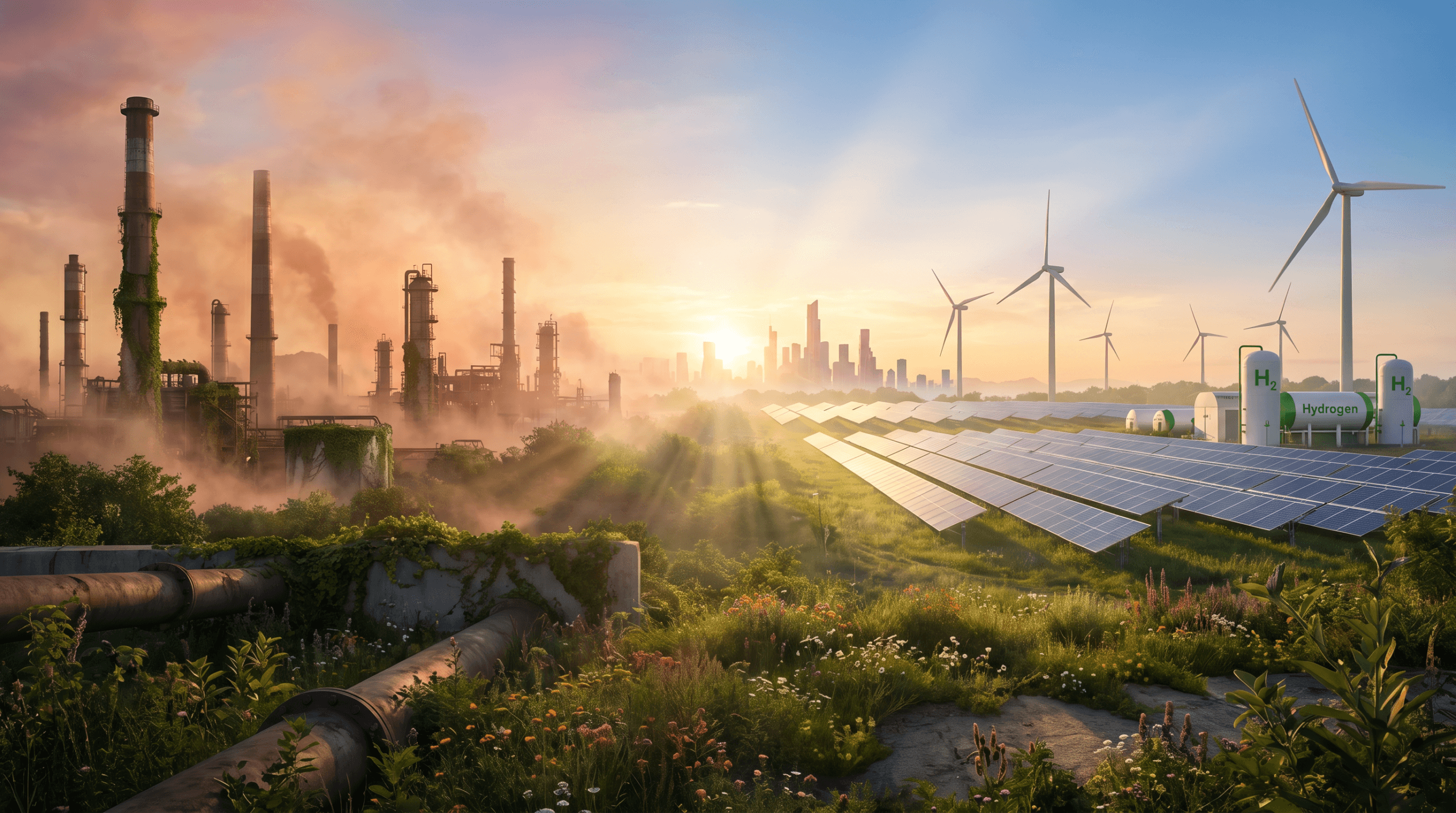
The Thermodynamic Reckoning of the Post-Darwinian Industrial Order
The industrial economy is the most consequential thermodynamic machine humanity has ever built – and it is running on the wrong fuel. Eight heavy sectors – steel, cement, primary chemicals, aluminum, shipping, aviation, trucking, and oil and gas – collectively account for nearly 40% of global greenhouse gas emissions.[1] Unlike the power sector, where renewables have achieved decisive cost parity, these sectors are defined by fundamental chemical and physical constraints that cannot be resolved by simply bolting a solar panel to the process. Reducing iron ore with coking coal is not an engineering preference; it is a 150-year-old metabolic pattern embedded in the supply chains that produce civilization’s physical substrate.
Within the Cognoscentae Ultrans (CU) framework, the global industrial system represents what might be called a “Legacy Darwinian Infrastructure Lock-In” – a vast network of capital-intensive, technically complex facilities whose emissions are not incidental byproducts but are intrinsic to the production chemistry itself. The Megatecture’s response is not mere incremental optimization, but a fundamental re-architecture of industrial metabolism: replacing fossil carbon as a chemical reactant, replacing fossil heat with electrified or hydrogen-derived thermal energy, and closing the material loops that currently transform concentrated resources into dilute waste. This page provides a rigorous, sector-by-sector analysis of how this transformation is unfolding, where the genuine breakthroughs are occurring, and – critically – where the overconfidence of transition narratives conceals unresolved systemic risk.
The Hard-to-Abate Taxonomy: Why Industry Is Different
The distinction between “easy-to-abate” and “hard-to-abate” sectors is not a political designation but a thermodynamic one. Power generation is relatively tractable because the final product – electrons – is fungible and the decarbonization of the production mechanism (swapping combustion for photovoltaics or wind turbines) does not change the output. Industrial sectors are fundamentally different for three compounding reasons.
Process Emissions: Approximately 40% of cement’s CO2 output comes not from burning fuel but from the chemical calcination of limestone itself – the reaction CaCO3 → CaO + CO2. No amount of fuel-switching eliminates this emission without carbon capture or a complete reformulation of the binding chemistry.[2] Steel’s blast furnace similarly uses carbon not only as fuel but as a chemical reductant to strip oxygen from iron ore. These are not combustion problems; they are chemistry problems.
Temperature Requirements: Many industrial processes require sustained temperatures between 900°C and 1,600°C. As of 2025, industrial heat pumps have been validated to approximately 550°C – unlocking decarbonization pathways for roughly 40% of industrial thermal demand – but the high-temperature range above this threshold requires either hydrogen combustion, direct electrification via induction or arc furnaces, or plasma technology, all of which carry major cost and scale penalties.[3]
Asset Lock-In and Capital Cycles: A modern integrated steel mill or cement kiln represents $1 – $5 billion in capital expenditure with an operational lifespan of 30 – 50 years. The average age of the global cement fleet is approaching 40 years, meaning many plants built before the 2015 Paris Agreement will still be operating in 2040. Transition is not a matter of choice alone but of capital depreciation cycles that create enormous structural inertia.
The Four Pillars of Industrial Decarbonization
The Megatecture identifies four non-negotiable pillars for transforming the industrial metabolism. These are not alternatives to one another – they are a stack. The absence of any single pillar creates bottlenecks that collapse the others.
1. Green Hydrogen as Industrial Feedstock and Fuel
Green hydrogen – produced via electrolysis powered by renewable electricity – is the linchpin of decarbonizing both the thermal and chemical functions of heavy industry. The logic is compelling: hydrogen combusts to produce water, not CO2, and as a reducing agent it can replace coking coal in steelmaking through the Hydrogen Direct Reduction (H2-DRI) process.
The economics, however, remain the defining challenge. As of mid-2026, the levelized cost of hydrogen (LCOH) from green electrolysis ranges from $2.00 – $2.50/kg in the best-in-class MENA and Australian projects (with access to sub-$0.03/kWh solar electricity) to $5.00 – $10.00/kg in most of the industrialized world.[4] This compares to natural gas-derived grey hydrogen at approximately $0.80 – $1.50/kg. The cost of electricity constitutes more than 60% of green hydrogen’s LCOH, making cheap, firm renewable electricity the primary strategic asset for any nation pursuing hydrogen-based industrialization.
The electrolyzer manufacturing landscape itself reveals a structural geopolitical tension. China controls approximately 60% of global electrolyzer manufacturing capacity, offering alkaline and PEM systems at $300 – $500/kW – roughly half the cost of Western alternatives at $750 – $1,300/kW.[5] This asymmetry creates a “decarbonization supply chain dependency” analogous to the solar panel manufacturing concentration that has defined the photovoltaic transition.
| Metric | 2025 Status | 2030 Target |
|---|---|---|
| Global green H2 LCOH (best case) | $2.00 – $2.50/kg [4] | <$1.00/kg [5] |
| Electrolyzer cost (Western) | $750 – $1,300/kW [5] | ~$250/kW |
| Electrolyzer cost (China) | $300 – $500/kW [5] | <$150/kW |
| Global electrolysis capacity | ~14 GW installed | 150 GW+ (IEA NZE) |
| H2-DRI green steel projects in Europe | 10+ approved [6] | First commercial ops 2026 – 2028 |
For steel, the H2-DRI pathway can reduce emissions by over 90% when powered by renewables, but early commercial plants using 100% hydrogen blends are estimated to cost 50 – 140% more than conventional blast furnace routes, depending on regional hydrogen and electricity prices.[6] The abatement cost via H2-DRI is estimated above $500/tonne CO2 in most current market conditions – a figure that requires either a very high carbon price or significant industrial policy support to be commercially viable.[6]
2. Electrification of Industrial Heat
Industrial heat represents approximately 20% of global final energy demand, with roughly two-thirds of that demand below 400°C – a temperature range now accessible to electrification.[3] The progression of heat pump technology to 550°C opens what the Megatecture designates as the “Low-Medium Thermal Band,” covering paper, food processing, chemicals, and portions of the automotive and pharmaceutical supply chains. For these sectors, replacing fossil fuel boilers with industrial heat pumps (IHPs) can achieve up to 80% CO2 reduction when powered by a clean grid, with IHPs delivering three to five times more usable heat per unit of electricity than conventional combustion systems.[3]
The “High Thermal Band” (above 550°C) represents the harder frontier, encompassing glass, ceramics, non-ferrous metals, and the cement kiln. Electric arc furnaces and plasma-enhanced kilns are proven in steelmaking but require substantial infrastructure reinvestment. Induction heating, microwave processing, and resistance furnaces are advancing for specific high-temperature applications, but no single “electric kiln” solution has yet achieved cost parity with natural gas combustion at above 1,000°C across multiple industries.
The systemic bottleneck is grid infrastructure. A comprehensive electrification of UK heavy industry alone is projected to require network reinforcement investments of up to £20 billion by 2035 – and this is a relatively small national industrial base.[7] Globally, the electricity network capacity requirements of full industrial decarbonization are poorly modeled and consistently underestimated in national transition plans.
3. Carbon Capture, Utilization, and Storage (CCUS)
CCUS is the most politically contested pillar of industrial decarbonization – simultaneously essential for some processes and consistently oversold as a universal solution. Its most accurate framing within the Megatecture is as a “residual chemistry remedy”: a technology that is indispensable precisely where process emissions make zero-carbon production impossible through any other means, but that should not be used to justify the perpetuation of fossil-dependent processes where clean alternatives exist.
The IEA’s World Energy Outlook 2025 Net Zero Emissions Scenario assigns CCUS a maximum contribution of 4.9% of total emissions reduction, with 3.7% from industrial applications – a markedly modest role that reflects both the technology’s genuine limits and the persistent gap between announced projects and operational reality.[8] No full-scale cement plant has yet integrated CCS into regular commercial operation as of 2025; the Heidelberg CCS project in Edmonton is scheduled to commission at approximately 1 Mt CO2/year capture capacity in late 2026, which would represent a landmark demonstration.[2]
For the cement sector specifically, the economic case for CCUS is stark: carbon capture costs range from $144/tonne CO2 for partial abatement (15% of the US cement sector) to $215/tonne for full abatement – levels that would increase cement prices by 20 – 40%.[2] This is not inherently prohibitive, but it demands a functioning CO2 transport and storage infrastructure that currently barely exists at industrial scale in most regions.
The most technically credible CCUS pathways for industry are post-combustion amine scrubbing (mature, high energy penalty), oxy-fuel combustion (retrofittable for cement and glass), and calcium looping (highly promising for cement due to process synergies with limestone calcination). Direct Air Capture (DAC) serves a complementary but distinct function – removing legacy atmospheric CO2 rather than capturing point-source emissions – and at current costs of $300 – $600/tonne, it cannot substitute for industrial source capture.
4. Material Efficiency and Industrial Symbiosis
The fourth pillar is the one most consistently underweighted in mainstream decarbonization analysis: simply using less material. A tonne of steel never produced generates zero emissions, and the circular economy represents the highest-leverage, lowest-capital decarbonization strategy available for materials-intensive sectors. Studies modeling circular economy interventions across multiple sectors find a GHG mitigation potential of 17% on average in isolation, rising to 50% when combined with energy efficiency and decarbonized energy supply.[8]
For steel, secondary production via electric arc furnaces (EAF) using scrap steel is already 70 – 80% less carbon-intensive than primary production and accounts for approximately 30% of global steel output – a share that could realistically reach 45 – 50% by 2040 as end-of-life steel accumulates in the built environment. For cement, clinker substitution using supplementary cementitious materials (SCMs) such as fly ash, ground granulated blast furnace slag (GGBS), and calcined clay can replace 30 – 50% of the most emissions-intensive component of the binder, cutting emissions by 30 – 40% at a cost of only $10 – $35/tonne – by far the cheapest decarbonization option available to the sector.[2]
Industrial symbiosis – the systematic exchange of waste streams between co-located industries – represents a deeper structural optimization. The waste heat from a steel mill becomes the input energy for a chemical plant; the CO2 captured from a cement kiln becomes the feedstock for methanol synthesis or algal protein production. This is not theoretical; industrial ecosystems at Kalundborg (Denmark), Ulsan (South Korea), and Tianjin (China) demonstrate that metabolic coupling between industrial processes can reduce net emissions and resource consumption by 30 – 50% compared to standalone operations.
Sector Deep Dives
Steel: The Hydrogen Transition vs. the Scrap Accumulation Race
Steel is responsible for approximately 7 – 9% of global CO2 emissions and presents the most mature decarbonization pathway of any hard-to-abate sector, due primarily to the proven H2-DRI + Electric Arc Furnace (EAF) route and the maturity of scrap-based secondary production. At least 10 H2-DRI projects have been approved across Europe, with first large-scale commercial plants expected between 2026 and 2028 in Sweden (H2 Green Steel, HYBRIT) and Germany (thyssenkrupp’s tkH2Steel).[6] Green steel production is projected to reach 46 million tonnes by 2035 – significant growth, but still less than 3% of current annual global production of ~1.9 billion tonnes.[6]
The critical structural tension in steel decarbonization is regional. Developing nations – India, Brazil, China, Southeast Asia – account for the vast majority of new blast furnace capacity additions, and these regions lack both the cheap green hydrogen and the scrap accumulation that would make near-term transition viable. China alone produces approximately 55% of global steel, predominantly via blast furnace routes, and its BF-BOF fleet is young and far from end-of-life. The global scrap accumulation curve – driven by the maturation of the 20th-century built environment in OECD nations – will become a major decarbonization lever over the coming decades, but its geographic distribution does not match the geography of current emissions.
Cement: The Chemistry of Civilization’s Foundation
Cement is structurally the most difficult material to decarbonize because its dominant emission source – the calcination of limestone – is intrinsic to the chemistry of Ordinary Portland Cement (OPC). No renewable energy input can eliminate this. The industry accounts for approximately 8% of global CO2 emissions, producing 4 billion tonnes annually.[2]
The decarbonization stack for cement operates at three levels of ambition. At the lowest cost and highest near-term accessibility, clinker substitution via SCMs can deploy immediately without new capital infrastructure and is already standard practice in the EU and parts of East Asia. At the intermediate level, alternative clinker chemistries – such as Limestone Calcined Clay Cement (LC3), reactive magnesia cements, and Belite-Calcium Sulfoaluminate (BCSA) cements – offer 30 – 50% emission reductions with performance profiles approaching OPC. At the highest ambition level, electrochemical cement production (as being commercialized by Sublime Systems) eliminates the calcination reaction entirely, replacing the kiln with an electrochemical cell powered by renewable electricity – a genuinely transformational pathway that remains at demonstration scale with a planned 30,000-tonne/year plant opening in 2026.[2]
The regulatory accelerant is now arriving. The EU’s Carbon Border Adjustment Mechanism (CBAM) entered full financial implementation in January 2026 for cement, steel, aluminum, fertilizers, electricity, and hydrogen.[9] For any exporter of these goods into the EU market without equivalent domestic carbon pricing, CBAM imposes a levy equivalent to the EU ETS carbon price. With EU ETS carbon allowances trading at approximately €50 – €70/tonne in 2025 – 2026, this creates a meaningful financial incentive for decarbonization at the supply chain level – though it does not reach the domestic construction markets of India, China, or Southeast Asia where the majority of cement demand growth is concentrated.
Chemicals: The Feedstock Fossil Dependency
The chemical sector’s decarbonization challenge is compounded by a unique duality: fossil fuels are consumed not only for energy but as molecular feedstocks – the carbon backbone of plastics, fertilizers, solvents, and pharmaceutical intermediates. Global ammonia production alone (primarily via the Haber-Bosch process using grey hydrogen from natural gas) accounts for approximately 1.8% of global CO2 emissions and is the primary input to nitrogen fertilizers that feed approximately 40% of the global population. Green ammonia – produced by combining green hydrogen with atmospheric nitrogen via a renewable-powered Haber-Bosch process – is technically mature but carries a cost premium of 1.5 – 2.5x over conventional ammonia at current green hydrogen prices.
China’s 15th Five-Year Plan (2026 – 2030) has identified industrial-scale green hydrogen breakthroughs as a strategic national priority, with specific targets for green ammonia and green methanol production.[10] This signals an intent to use policy-driven scale to achieve cost reductions analogous to those accomplished in solar and battery manufacturing – with the attendant geopolitical implications for global green chemical trade.
Shipping and Aviation: The Synthetic Fuel Imperative
Long-haul aviation and deep-sea shipping represent the two sectors where direct electrification is physically constrained by energy density requirements, and where synthetic fuels – Sustainable Aviation Fuel (SAF), green ammonia, green methanol, and green hydrogen – become the only viable zero-carbon energy carriers.
For aviation, EU SAF mandates require 2% of jet fuel to be SAF by 2025, scaling to 70% by 2050 with 35% required to be synthetic (e-fuels).[11] The UK has introduced a SAF mandate requiring 10% SAF content by 2030.[11] The critical constraint is feedstock: aviation competes for limited biomass and renewable electricity with shipping, trucking, and the chemicals sector. An analysis by the Clean Air Task Force (2025) concluded that aviation could consume almost all available sustainable biofuel, forcing shipping to prioritize green ammonia and green methanol – both of which offer competitive volumetric energy density for marine applications at the cost of requiring onboard fuel processing.
The International Maritime Organization’s (IMO) 2025 emissions agreement established binding fuel intensity reduction targets for international shipping, creating the first regulatory pull for e-fuels at scale. Companies including Hapag-Lloyd and the North Sea Container Line are planning commercial operations on e-methanol and e-ammonia-powered vessels beginning in 2027.[11]
The Economic and Policy Architecture
The transition from voluntary corporate decarbonization to mandatory systemic transformation is underway, though the global architecture remains fragmented. As of the close of 2025, 80 emissions trading systems and carbon taxes are estimated to cover 28% of global greenhouse gas emissions – a significant expansion but still leaving nearly three-quarters of global emissions outside any carbon pricing mechanism.[9] Record ETS revenues of approximately $80 billion in 2025 are now being directed to clean energy transition programs in the EU, UK, and several East Asian markets.[9]
The global industrial decarbonization market itself – encompassing all technologies, infrastructure, and services – was valued at approximately $23.85 billion in 2025 and is projected to reach $101.20 billion by 2035, growing at a CAGR of 15.55%.[12] Renewable energy integration dominates at approximately 30% of market share, followed by industrial energy efficiency, hydrogen production, and CCUS. The financing model is maturing: unlike early clean energy projects that were almost entirely equity-financed, industrial decarbonization is increasingly attracting project debt as performance data accumulates and regulatory certainty improves.
Critical Weak Points and Systemic Failure Modes
The Kylos Arc framework demands an unflinching assessment of where the transition narrative outpaces the physical and economic reality.
1. The Green Hydrogen Cost Valley of Death. The projected trajectory to sub-$2/kg green hydrogen by 2030 is achievable only in regions with exceptional renewable resources and minimal grid congestion. For the OECD industrial heartlands – the Rhine-Ruhr, the US Midwest, China’s coastal manufacturing belt – achieving cost-competitive green hydrogen in the transition decade requires either massive policy subsidy or accepting a structural cost penalty for decarbonized goods. Any analysis that assumes global green hydrogen at $1/kg by 2030 is extrapolating from the best 5% of project sites to the world.
2. The CCUS Execution Deficit. The repeated failure of CCUS projects to progress from announcement to commercial operation – a pattern documented across three decades – reflects genuine structural barriers beyond policy uncertainty: the absence of CO2 transport and storage infrastructure, the high energy penalty of current capture technologies (15 – 25% of plant output), and the lack of a liability framework for permanent geological CO2 storage. Treating CCUS as a confirmed pillar rather than an aspiration introduces fatal slack into decarbonization timelines for cement and chemicals.
3. The Infrastructure-Transition Mismatch. Electrifying industrial heat at scale requires grid infrastructure investments that are systematically absent from corporate and government transition plans. The grid reinforcement needed to deliver firm, high-capacity industrial electricity loads is a 15 – 20-year infrastructure program that must begin now to be operational when industrial facilities reach end-of-life and are ready for re-investment. The planning horizons for grid infrastructure and industrial capital cycles are misaligned in virtually every major economy.
4. The Developing World Divergence. Global decarbonization scenarios are routinely weighted by OECD assumptions. The actual emissions trajectory is dominated by the industrial expansion of South and Southeast Asia, where steel and cement demand growth is concentrated, where carbon pricing is nascent, and where the immediate development imperative often outweighs climate co-benefits in policy prioritization. A decarbonization architecture that cannot scale in India, Indonesia, and Sub-Saharan Africa is not a global solution – it is a Northern Hemisphere aesthetic.
5. Material Circularity Is Underfunded and Undervalued. Despite representing the highest-leverage, lowest-cost decarbonization option in materials sectors, circular economy measures consistently receive a fraction of the policy attention and investment directed at technological silver bullets. The failure to mandate extended producer responsibility for steel, cement, and plastics at a global level means that end-of-life material is systematically wasted – deferring the scrap accumulation that would make secondary production routes viable at scale.
Conclusion: Industrial Decarbonization as a Civilizational Design Problem
The decarbonization of heavy industry cannot be solved within the logic of the same market structure that created its emissions profile. It requires coordinated industrial policy at a scale not seen since postwar reconstruction, carbon pricing architectures that finally reach 100% of global emissions, and infrastructure investment programs that treat the hydrogen grid, the CO2 transport network, and the expanded electricity network as co-equal components of a 21st-century industrial system.
Within the Cognoscentae Ultrans framework, the industrial transition is not merely an environmental imperative but a prerequisite for the physical substrate of post-Darwinian civilization. Every tonne of green steel, every zero-carbon cement plant, every ship running on e-methanol is a node in a new metabolic architecture – one that decouples human productive capacity from the entropy cascade of fossil carbon combustion. The technology stack is ready. The economics are becoming viable. The missing variable is not innovation but will: the political and institutional courage to price carbon honestly, to build infrastructure at the speed the climate requires, and to recognize that the cost of inaction is compounding faster than the cost of transformation.

The Latest News and Talk about Global Industrial Decarbonization
BRIEF
Industrial decarbonization is gaining momentum as industries seek to address climate change and enhance competitiveness. The International Energy Agency (IEA) recently published its Energy Technology Perspectives 2026 report, highlighting critical supply chain challenges and competitiveness gaps in industrial decarbonization. This report underscores the urgency for industries to adopt new technologies and practices to reduce their carbon footprints, particularly in sectors like cement and steel, which are among the largest industrial emitters of CO₂ IEA.
Cement decarbonization initiatives are making significant strides, with innovative projects emerging globally. Fortera and MLC have signed a development agreement for the first full-scale commercial ReAct® cement plant, which aims to capture CO₂ from the atmosphere and convert it into cement. This project represents a pivotal step in reducing the carbon intensity of cement production, which is responsible for approximately 8% of global CO₂ emissions Business Wire. Additionally, companies like SCG in Thailand are transforming their operations to become sustainability benchmarks, implementing advanced technologies and workforce reforms to minimize emissions Nation Thailand.
The steel industry is also undergoing a significant transformation, driven by innovative technologies and practices. Hyundai Steel has successfully reduced its carbon emissions by 70% by switching from coal to natural gas in its production processes, demonstrating a viable pathway for other steel manufacturers to follow Seoul Economic Daily. Furthermore, Laureen Meroueh's new method for steel production not only cuts costs but also significantly lowers emissions, showcasing the potential for cleaner steel production MIT Technology Review.
Water circularity is becoming an integral part of industrial decarbonization strategies, particularly in cement and steel production. The implementation of water recycling and reuse systems is essential for reducing the overall environmental impact of these industries. Companies are increasingly recognizing that efficient water management can complement their decarbonization efforts, leading to reduced operational costs and improved sustainability profiles. For instance, Holcim UAE's partnership with 44.01 to launch a carbon capture and mineralization pilot also emphasizes the importance of integrating water management into carbon reduction strategies Carbon Herald.
The convergence of these trends indicates a transformative shift in industrial practices toward sustainability and resilience. As industries adopt innovative technologies and collaborative approaches, the potential for achieving significant emissions reductions becomes increasingly feasible. The ongoing developments in cement and steel decarbonization, coupled with advancements in water circularity, highlight a holistic approach to addressing climate challenges while maintaining economic viability.
KEY PATTERNS from the research
- The IEA's recent report emphasizes the need for urgent technological adoption in industrial decarbonization.
- Cement production is increasingly integrating CO₂ capture technologies to mitigate emissions.
- Steel manufacturers are shifting from coal to cleaner energy sources, significantly reducing carbon footprints.
- Water circularity is being recognized as a critical component of decarbonization strategies in heavy industries.
- Collaborative partnerships between companies and technology developers are essential for advancing decarbonization initiatives.
- Emerging startups are innovating in carbon management, creating marketable products from captured emissions.
- The focus on sustainability is reshaping competitive dynamics in traditional industrial sectors.
- Regulatory frameworks are likely to evolve, further incentivizing decarbonization efforts across industries.
Freshness
- 17 of 43 dated items are from the last 7 days.
Ranked Evidence Clusters
1. Add: IEA Energy Technology Perspectives 2026 Industrial Decarbonization Overview
Source: GitHub | Date: 2026-09-08
Score: 40
Stats
- Total evidence: 43 items across 4 sources
- Top voices: Hacker News, co3org/Industrial-Decarbonization, hydrogenjs/hydrogen, www.energy.gov, dycif/gren_ai-prompt_engg-test_set
- GitHub: 7 items | voices: co3org/Industrial-Decarbonization, hydrogenjs/hydrogen, dycif/gren_ai-prompt_engg-test_set
- Web: 10 items | domains: www.energy.gov, phenomenalworld.org, industrydecarbonization.com
- Hacker News: 14 items | 132 points, 148 comments | domains: Hacker News
- Reddit: 12 items | communities: r/Faxioms, r/hoi4, r/SFBayJobs
Web Research
Fortera and MLC Sign Development Agreement for First Full-Scale Commercial ReAct® Cement Plant
** ** Contact Us Contact Us ** ** Newsroom Services & Solutions Services & Solutions [ ...
Source: businesswire.com | Date: 2026-09-08
This founder is making cheaper, cleaner steel | MIT Technology Review
This founder is making cheaper, cleaner steel Laureen Meroueh developed a method that cuts the costs—and the emissions—of steelmaking. By - Bridget Reed Morawski archive page September 8, 2026 Age: 34 Affiliation: Hertha Metals MIRANDA BARNES The steel industry isn’t exactly ...
Source: technologyreview.com | Date: 2026-09-08
Hyundai Steel Cuts Carbon 70% Using Natural Gas Instead of Coal - Seoul Economic Daily
Daily Hyundai Steel Cuts Carbon 70% Using Natural Gas Instead of Coal [Inside Hyundai Motor Group's Louisiana Electric Arc Furnace Steel Mill] Carbon Capture and Storage Enables Preemptive Emissions Management Direct Reduction Plant Minimizes Impurities in Finished Products ...
Source: en.sedaily.com | Date: 2026-09-06
From Carbon Villain to Green Blueprint: Inside SCG's Playbook
From Carbon Villain to Green Blueprint: Inside SCG's Playbook WEDNESDAY, SEPTEMBER 09, 2026 | Nongluck Ajanapanya Inside the technology, alliances and workforce reforms that turned Thailand's biggest cement maker into a sustainability benchmark - SCG's green transition is framed ...
Source: nationthailand.com | Date: 2026-09-09
How cement plants can remove CO₂ from the atmosphere
August 12, 2026 How cement plants can remove CO₂ from the atmosphere by Samuel Schlaefli, ETH Zurich edited by Swati Mestri, reviewed by Alexander Pol A commercial plant operated by Heirloom Carbon Technologies, featuring air contactors where CO₂ is captured from the atmosphere. ...
Source: techxplore.com | Date: 2026-08-12
India's Jindal Steel Puts Captured CO2 to Use in 3D Printing - AM Insight Asia
Asia India’s Jindal Steel Puts Captured CO2 to Use in 3D Printing by Chikai Eto August 18, 2026 Steel Industry’s AM Use, Once Confined to Factory Parts, Expands Through Decarbonization Indian steelmaker Jindal Steel Limited (formerly Jindal Steel & Power Limited, listed on the ...
Source: aminsightasia.com | Date: 2026-08-18
Mantel Capture demonstrates its novel carbon capture technology at commercial scale | MIT Energy Initiative
Initiative Mantel Capture demonstrates its novel carbon capture technology at commercial scale The 2022 startup with roots in the MIT Energy Initiative sees affordable carbon capture as a necessity for industrial plants. Nancy W. Stauffer August 25, 2026 MITEI Mantel’s ...
Source: energy.mit.edu | Date: 2026-08-25
UrjanovaC Turns Industrial Carbon Emissions Into Marketable Products - TechVivaran
UrjanovaC Turns Industrial Carbon Emissions Into Marketable Products By Techvivaran August 16, 2026 Mumbai-based startup UrjanovaC is working to make carbon management commercially viable for heavy industries such as steel and cement. Founded in January 2023 by IIT Bombay ...
Source: techvivaran.in | Date: 2026-08-16
CN122582866A – High-efficiency catalytic conversion device and method for steel plant lime kiln tail gas co2 | Patsnap Eureka
gas co2 | Patsnap Eureka High-efficiency catalytic conversion device and method for steel plant lime kiln tail gas co2 CN122582866A Pending 📅 Publication Date: 2026-08-18浙江菲达环保科技股份有限公司 Patent Information Application Number CN202610842527.1 Authority / Receiving Office CN · China ...
Source: eureka.patsnap.com | Date: 2026-08-18
Holcim UAE And 44.01 Launch Cement Carbon Capture & Mineralization Pilot
Holcim UAE And 44.01 Launch Cement Carbon Capture & Mineralization Pilot by Violet George August 13, 2026 Image courtesy of Holcim UAE Holcim UAE and Oman, in partnership with carbon storage developer 44.01, have launched the UAE’s first continuous, live-condition carbon capture ...
Source: carbonherald.com | Date: 2026-08-13
✅ All agents reported back! ├─ 🟠 Reddit: 12 threads ├─ 🟡 HN: 14 stories │ 132 points │ 148 comments ├─ 🐙 GitHub: 7 items ├─ 🌐 Web: 10 pages - energy.gov, phenomenalworld.org, industrydecarbonization.com, finance.yahoo.com, globenewswire.com, sei.org, pubs.acs.org, snsinsider.com └─ 🗣️ Top voices: r/Faxioms, r/hoi4, r/SFBayJobs
Global Industrial Decarbonization
A systems-level assessment of hard-to-abate sector transitions, technology readiness, and the economics of civilizational re-architecture — 2025–2026
Green Hydrogen
Electrolytic H₂ as fuel and chemical reductant — replacing coking coal in DRI steelmaking and natural gas in Haber-Bosch ammonia synthesis.
Industrial Electrification
Heat pumps to 550°C unlock 40% of industrial thermal demand. Electric arc furnaces, induction kilns, and plasma systems target the high-temperature frontier.
CCUS
Indispensable residual chemistry remedy for process emissions in cement and chemicals — but constrained by absent CO₂ infrastructure and an execution deficit.
Circular Economy
Material efficiency, scrap-based secondary production, clinker substitution, and industrial symbiosis — the highest-leverage, lowest-cost pillar.
Green Hydrogen — LCOH by Region (2026)
Carbon Abatement Cost by Technology
- H₂-DRI + EAF: 90%+ emission reduction
- 10+ European H₂-DRI projects approved
- First commercial ops: 2026–2028 (SE/DE)
- Scrap-EAF: 30% of output, scaling to 45%+ by 2040
- SCM/clinker substitution: immediate, –30–40% CO₂
- LC3 (calcined clay): up to 50% clinker reduction
- Heidelberg Edmonton CCS: 1 Mt/yr, 2026 commissioning
- Electrochemical cement (Sublime): 30k t/yr demo, 2026
- Green ammonia: renewable H₂ + Haber-Bosch
- Cost premium: 1.5–2.5× over grey ammonia
- China 15th 5-Year Plan: strategic H₂ targets 2026–30
- Green methanol: shipping fuel + chemical feedstock
- IMO 2025 agreement: binding fuel intensity targets
- e-Methanol vessels: Hapag-Lloyd, NCL from 2027
- Green ammonia: IMO priority fuel, tech maturing
- Wind-assist propulsion: near-term efficiency measure
- EU SAF mandate: 2% 2025 → 70% by 2050
- UK SAF: 10% by 2030
- e-SAF (Power-to-Liquid): scalable but expensive
- Biomass feedstock competition with shipping is critical
- IHPs validated to 550°C: unlocks 40% of demand
- 3–5× efficiency vs. combustion boilers
- High-temp (>550°C): plasma, induction, H₂ combustion
- Grid reinforcement: critical bottleneck for electrification
Decarbonization Transitioning Value Chains

Sources
- World Economic Forum, “Scaling the Industrial Transition: Hard-to-Abate Sectors and Net-Zero Progress in 2025”
- UNIDO, “A Snapshot of Cement and Concrete Decarbonization Technologies” / Heidelberg CCS Edmonton Project; Sublime Systems demonstration plant 2026
- IEA World Energy Outlook 2025; McKinsey, “Tackling Heat Electrification to Decarbonize Industry”; High-Temperature Heat Pumps, ScienceDirect 2026
- IEA Levelised Cost of Hydrogen Maps 2025 – 2026
- ICCT, “The Price of Green Hydrogen: How and Why We Estimate Future Production Costs”; Enkiai, “Blue vs. Green Chinese Electrolyzer” 2026
- IEA, “Steel – Breakthrough Agenda Report 2025”; Environmental Science & Technology, “The Role of Hydrogen in Decarbonizing U.S. Iron and Steel Production”
- arXiv, “Assessing Electricity Network Capacity Requirements for Industrial Decarbonisation in Great Britain”
- IEEFA, “Minimal Role for CCUS in IEA’s World Energy Outlook 2025”; Environmental Science & Technology, “Material Efficiency and Circularity Goals to Achieve a Carbon-Neutral Society by 2050”
- ICAP, “Emissions Trading Worldwide: Status Report 2026”; EU CBAM full implementation January 2026
- Fuel Cells Works, “China Targets Industrial Green Hydrogen Growth in 15th Five-Year Plan,” November 2025
- Clean Air Task Force, “Aviation could consume almost all available biofuel,” April 2025; Advanced BioFuels USA, “Advancing Maritime Decarbonization: The 2025 IMO Agreement”
- Precedence Research, “Industrial Decarbonization Market Size to Hit USD 101.20 Billion by 2035”